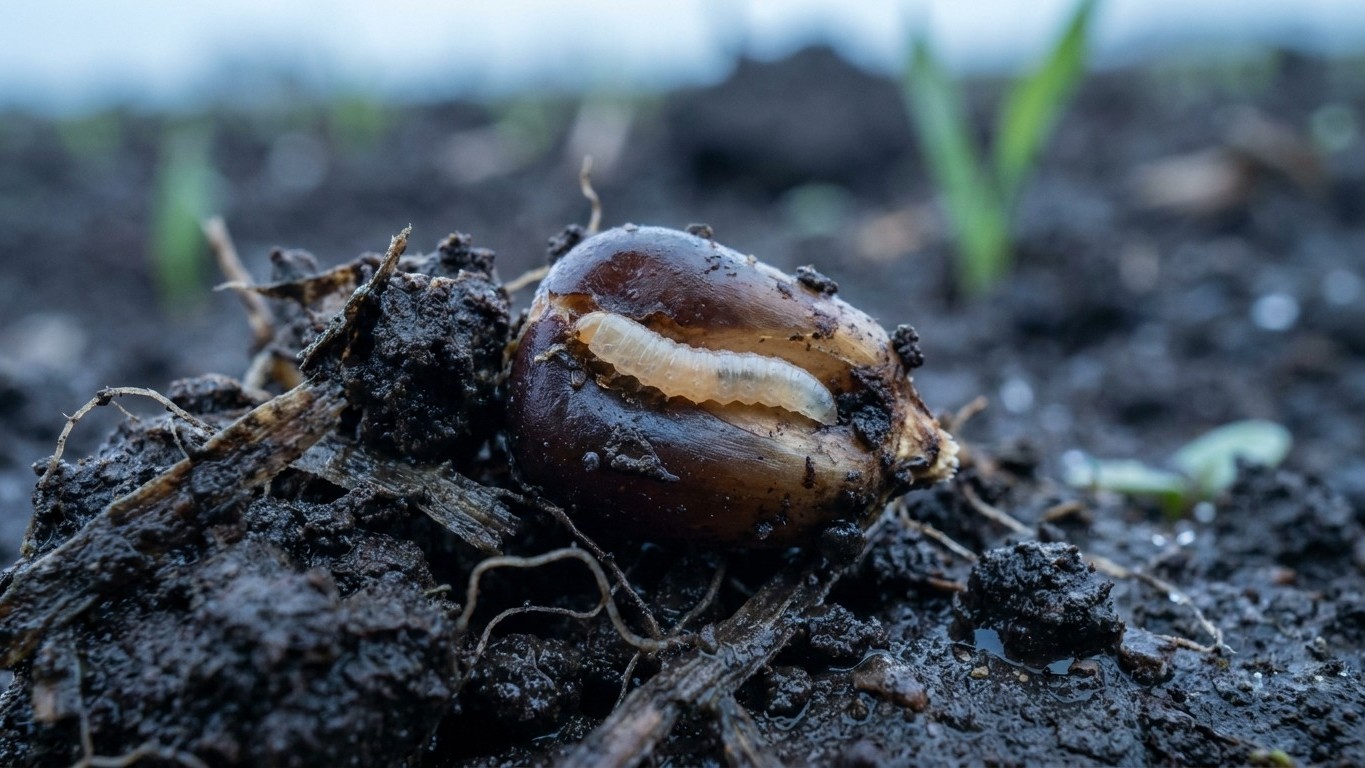

Seedcorn maggot damage in Quebec peaks during the first three to four weeks after snowmelt, when soil temperatures hover in the 45-55°F range and germinating seeds sit exposed underground far longer than they would in a warm spring. The fix isn’t one single product. It’s timing planting to outrun the pest’s window, keeping fresh organic matter out of the seed row, and choosing seed treatments or transplants when the ground stays cold longer than expected.
That combination works because the insect itself is entirely dependent on weather and soil conditions. Understand its biology and the calendar makes a lot more sense.
What the Seedcorn Maggot Actually Is

The seedcorn maggot (Delia platura) isn’t a worm at all. It’s the larval stage of a small, grayish-brown fly barely a fifth of an inch long, easy to mistake for an ordinary house fly if you’re not looking closely. The damage comes from its offspring: pale, blunt-tailed maggots up to a quarter inch long that tunnel directly into seeds before they’ve had a chance to sprout.
Adults overwinter as pupae buried in the soil and emerge once accumulated warmth hits a threshold, generally around 200 degree-days calculated on a 39°F base. In practical terms, that’s usually late April to early May across the St. Lawrence lowlands, though a late cold snap can push the first flight into mid-May. Females are drawn to freshly disturbed, moist, organic-rich soil, which is exactly the environment created every spring by manure spreading, cover crop incorporation, and early tillage.
Females lay eggs directly in that soil, often right next to or on top of planted seeds. The larvae hatch within days and go straight for the softest, most nutrient-dense target available: a germinating seed. Corn kernels get hollowed out. Bean and pea seeds turn to mush before they ever push a shoot above ground. Cucurbit and brassica seedlings that do emerge often show the telltale “snake head” symptom, a twisted, scarred stem where the maggot fed just below the surface.
Why Quebec’s Spring Is Prime Territory
Three things line up almost every year to make this insect a bigger problem here than in states with milder, faster-warming springs. Cold, clay-heavy soils in the lowlands warm slowly, which stretches out the vulnerable germination period for weeks longer than in sandier, quicker-draining ground. Manure application and cover crop turn-under are standard practice on most vegetable and field-crop operations, and both release exactly the decomposing organic matter that attracts egg-laying females. Add a wet spring, which slows drying and further delays germination, and you’ve got a near-perfect setup for stand loss.
The same pattern shows up across the border in northern New York, Vermont, Maine, and New Hampshire, plus the colder pockets of Minnesota and North Dakota. Anywhere spring soil takes its time warming past 50°F, seedcorn maggot risk climbs. Growers and gardeners in those regions face the identical calculation: plant too early into cold, rich soil and you’re rolling the dice on a fly that’s been waiting all winter for exactly that opportunity.
Which Crops and Fields Carry the Most Risk
Not every planting is equally exposed. Large-seeded, slow-germinating crops sit in the danger zone longest, which is why corn, snap beans, dry beans, peas, and soybeans top the damage reports every spring. Cucurbits, direct-seeded onions, and spinach follow close behind. Brassica transplants generally dodge the worst of it simply because they spend less time as a bare seed in open soil.
Field history matters just as much as crop choice. A field that received manure or had a cover crop worked in within the past two to three weeks before planting is at noticeably higher risk than one tilled a month earlier. Heavy, poorly drained soil that stays wet and cool longer after a rain event extends the germination window and, with it, the maggot’s opportunity. Low spots and headlands where equipment compacts soil tend to show the worst stand gaps first, which is often the earliest visible sign something’s wrong before anyone’s even scouted the field.
What Actually Stops the Damage
No single tactic fully eliminates seedcorn maggot risk, but stacking a few practical steps together closes most of the gap between a thin, patchy stand and a solid one.
Timing and Field Prep
Waiting to plant until soil temperature holds steady above 50°F, ideally closer to 55°F, cuts the germination window roughly in half compared to planting into 45°F ground. That single delay, often just five to ten days, removes a huge chunk of exposure. Pairing that with a gap of two to three weeks between manure or cover crop incorporation and seeding gives organic matter time to break down past the stage that attracts egg-laying flies. Improving drainage on chronically wet fields, through tile lines, raised beds, or simply avoiding the lowest-lying spots for early plantings, speeds up soil warming and reduces the standing moisture that draws adults in the first place.
Seed Choices and Treatments
Commercially treated seed, coated with an insecticide labeled for seedcorn maggot suppression, remains the most common line of defense on larger corn, bean, and soybean plantings. These coatings protect the seed during the exact window it’s most vulnerable, then lose effectiveness as the plant matures past the susceptible stage, which is the intended trade-off. For gardeners and smaller operations without access to treated seed, pelleted or primed seed that germinates faster shortens the exposure period on its own, even without any insecticide involved.
Switching from direct seeding to transplants is probably the single most reliable fix for high-value crops like cucumbers, squash, and melons. A transplant skips the seed stage entirely once it goes into the ground, so the maggot loses its preferred target. It costs more upfront in labor and tray space, but for a gardener who lost a cucumber bed to maggot damage the year before, it’s a straightforward trade worth making.
Monitoring Before You Plant
Yellow sticky traps placed at soil level a week or two before planting give a rough read on adult fly activity in a specific field or garden bed. A sudden jump in captures after a warm stretch is a reasonable signal to either delay planting a few more days or lean harder on seed treatment for that block. Digging a few test holes and checking soil temperature at the two-inch depth, where seed actually sits, is a five-minute habit that beats guessing based on air temperature alone, since soil consistently lags several degrees behind daytime highs this time of year.
When Damage Has Already Happened
Once maggots have hollowed out a seed or a stand comes up gappy and weak, there’s no rescue treatment that brings back what’s already been eaten. The only real option is replanting, ideally into slightly warmer soil than the first attempt and, if manure or fresh residue was the likely trigger the first time, into a different section of the field or bed where that factor doesn’t repeat. Growers who’ve been burned once tend to build a two-week buffer into their planting calendar the following spring, treating that gap as cheap insurance against a pest that shows up reliably every year the moment conditions tilt in its favor.
Degree-day tracking tools used by agricultural extension services base their first-flight predictions on a 39°F threshold accumulated from January 1, a model developed initially for onion maggot but widely applied to seedcorn maggot given the closely related biology of the two flies.
Related guides
- Seedcorn maggot in Ontario: When It Shows Up and What Stops It
- Seedcorn maggot in New Brunswick: When It Shows Up and What Stops It
- Seedcorn maggot in Indiana: When It Shows Up and What Stops It
- Seedcorn maggot in Maine: When It Shows Up and What Stops It
- Seedcorn maggot in Nova Scotia: When It Shows Up and What Stops It