
Seedcorn maggot larvae start attacking freshly planted seeds in Ontario as soon as soil temperatures climb into the low 40s Fahrenheit, usually in late April, with the heaviest damage window hitting during the first two to three weeks of May when spring stays cool and wet. Growers and gardeners stop it by delaying planting until soil warms past 50°F, avoiding fields with fresh manure or recently turned-under cover crops, and using treated seed where the risk is high. The insect doesn’t wait for warm weather to get moving, which is exactly why it catches so many people off guard.
What Seedcorn Maggot Actually Is

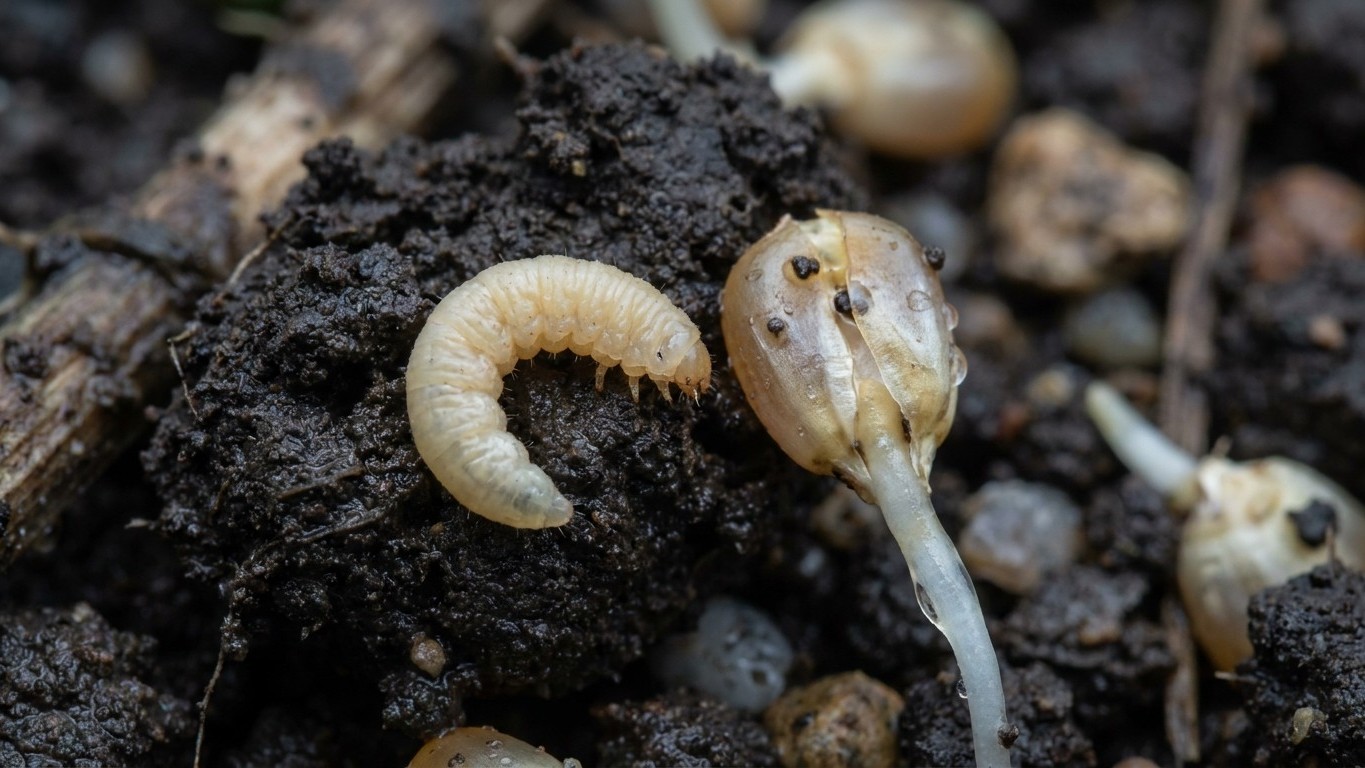
Seedcorn maggot isn’t a beetle or a worm in the traditional sense. It’s the larval stage of a small gray fly, Delia platura, that looks almost identical to a fruit fly if you catch one resting on a fence post. The adult fly itself does no damage. It’s the maggot, a legless, yellowish-white larva about a quarter-inch long, that tunnels into germinating seeds and young seedlings before they ever break the soil surface.
In Ontario, this pest overwinters as pupae buried a few inches down in the soil. Once temperatures rise in spring, adults emerge, mate, and the females go looking for one thing: decaying organic matter. That’s the detail that trips up a lot of gardeners and even experienced farmers. The fly isn’t drawn to your crop. It’s drawn to rot, and your newly planted seed just happens to be sitting in the middle of it.
When It Shows Up in Ontario
Southwestern Ontario, the corn and soybean belt running through counties like Chatham-Kent, Middlesex, and Elgin, sees the earliest and most consistent pressure because that’s where spring planting starts first and where manure applications and cover crop terminations are most common. First-generation flies typically emerge in late April, with egg-laying and larval feeding peaking through early-to-mid May.
Field crop specialists across the Midwest and Ontario track this pest using a degree-day model rather than a calendar date, because a warm April can shift everything up by a week or two. The model uses a base temperature of 39°F, with day-degree accumulation starting January 1. Peak fly activity for the damaging first generation tends to land around 200 to 300 accumulated degree-days. That sounds abstract until you realize it maps almost perfectly onto the exact stretch when Ontario farmers are pushing to get corn and soybeans in the ground.
There’s a second, smaller generation later in June, and sometimes a third in late summer, but neither causes anywhere near the economic damage of the spring flight. Cool soil slows seed germination, which means seeds sit vulnerable for longer. A seed that takes four days to sprout in warm soil might take twelve or fourteen days in cold, wet clay, and every one of those extra days is an invitation.
Crops at Risk
Soybeans and dry beans take the worst hits in Ontario field crop production, but the pest is far from picky. Home gardeners lose stands of peas, sweet corn, cucumbers, squash, and even onions to the same maggot. Anything planted as seed directly into cool spring soil, rather than transplanted as an established seedling, is fair game.
What Draws Seedcorn Maggot to a Field or Garden Bed
Three conditions show up again and again in damage reports, and they’re worth knowing before you ever pick up a seed bag.
Fresh organic matter is the biggest one. Manure applied within a few weeks of planting, a cover crop tilled under right before seeding, or even a heavy load of crop residue left on the surface all send out the same signal to egg-laying females. The rotting material draws them in, and they lay eggs in the surrounding soil, which puts your germinating seed directly in the blast radius.
Cool, wet weather compounds the problem because it slows germination while doing nothing to slow the maggot. A seed sprouting quickly outruns the threat. A seed sitting stalled in 45°F mud for two weeks is basically an open buffet.
Poorly drained or heavy clay soils, common across large stretches of southwestern Ontario, hold that cold and moisture longer than sandy loam, which is part of why the pest has such a strong regional reputation there. No-till fields with thick surface residue also trap moisture and organic debris right at seed depth, which is convenient for the crop’s water retention and just as convenient for the fly.
What Actually Stops It
Timing beats almost every other tactic. Pushing planting back until soil temperatures hold consistently above 50°F shortens the vulnerable window dramatically. It’s not a guarantee, since flies are still active at those temperatures, but faster germination means less exposure time, and exposure time is the whole game with this pest.
Seed treatments are the standard commercial response in Ontario row-crop production. Insecticide-treated seed, applied before planting, kills larvae attempting to feed on the seed coat before they can do real damage. This is why most commercial soybean and corn seed sold in Ontario already comes pre-treated, and why growers planting untreated or bin-run seed into high-risk fields face noticeably higher replant rates.
Managing organic matter timing matters just as much as the seed itself. Where manure needs to go down, applying it several weeks ahead of planting, rather than right before, gives the material time to break down and lose its attractiveness before seeds go in the ground. The same logic applies to cover crop termination: killing and incorporating a cover crop two to three weeks before planting, instead of the day before, reduces risk substantially.
Tillage choices play a role too. Fields with heavy surface residue and cooler, wetter soil profiles see more pressure, so incorporating residue earlier, or choosing planting windows on drier, warmer soils within a field, can shift outcomes. This is one of the few pests where a full-till system genuinely has an edge over no-till, at least in the years when spring stays cold.
For home gardeners, the fixes scale down but stay the same in principle. Skip fresh compost or manure right at planting time in beds going into peas, beans, or sweet corn. Wait for soil to warm before direct-seeding, and consider starting vulnerable crops like squash or cucumbers indoors as transplants instead of direct-seeding them into cold spring beds.
Scouting and the Replant Decision
Damage shows up as poor or spotty emergence, wilted or missing seedlings, and seeds that, when dug up, show small tunnels or are hollowed out entirely. Digging up a few feet of row where a gap appears is the fastest way to confirm the culprit versus other causes like poor seed-to-soil contact or seedling disease.
Stand counts drive the replant call in field crops. If a soybean stand drops below roughly 100,000 plants per acre with uneven gaps, most Ontario agronomists would flag it for replant evaluation, though the exact threshold shifts depending on row spacing and how evenly the surviving plants are distributed. Waiting a few extra days after suspected damage lets any remaining seedlings emerge before making a final call, since some delayed emergence is normal in cool soil regardless of pest pressure.
Replanting into the same field carries its own risk if the original conditions that attracted the fly, cold soil, recent organic matter, poor drainage, haven’t changed. Switching to treated seed for the replant, even if the original planting wasn’t treated, is a common and reasonable adjustment growers make after a first-round loss.
A Regional Quirk Worth Knowing
Ontario’s seedcorn maggot pressure tends to track closely with its dry bean and identity-preserved soybean acreage, both of which are concentrated in the southwestern part of the province and both of which get planted early relative to field corn. That overlap, early planting dates paired with cool Great Lakes-influenced spring weather, is a big part of why this particular pest gets so much attention from Ontario field crop specialists compared to, say, states farther south where soils warm up faster and the damaging window closes before planting even really gets underway.
Related guides
- Seedcorn maggot in Quebec: When It Shows Up and What Stops It
- Seedcorn maggot in Prince Edward Island: When It Shows Up and What Stops It
- Seedcorn maggot in Indiana: When It Shows Up and What Stops It