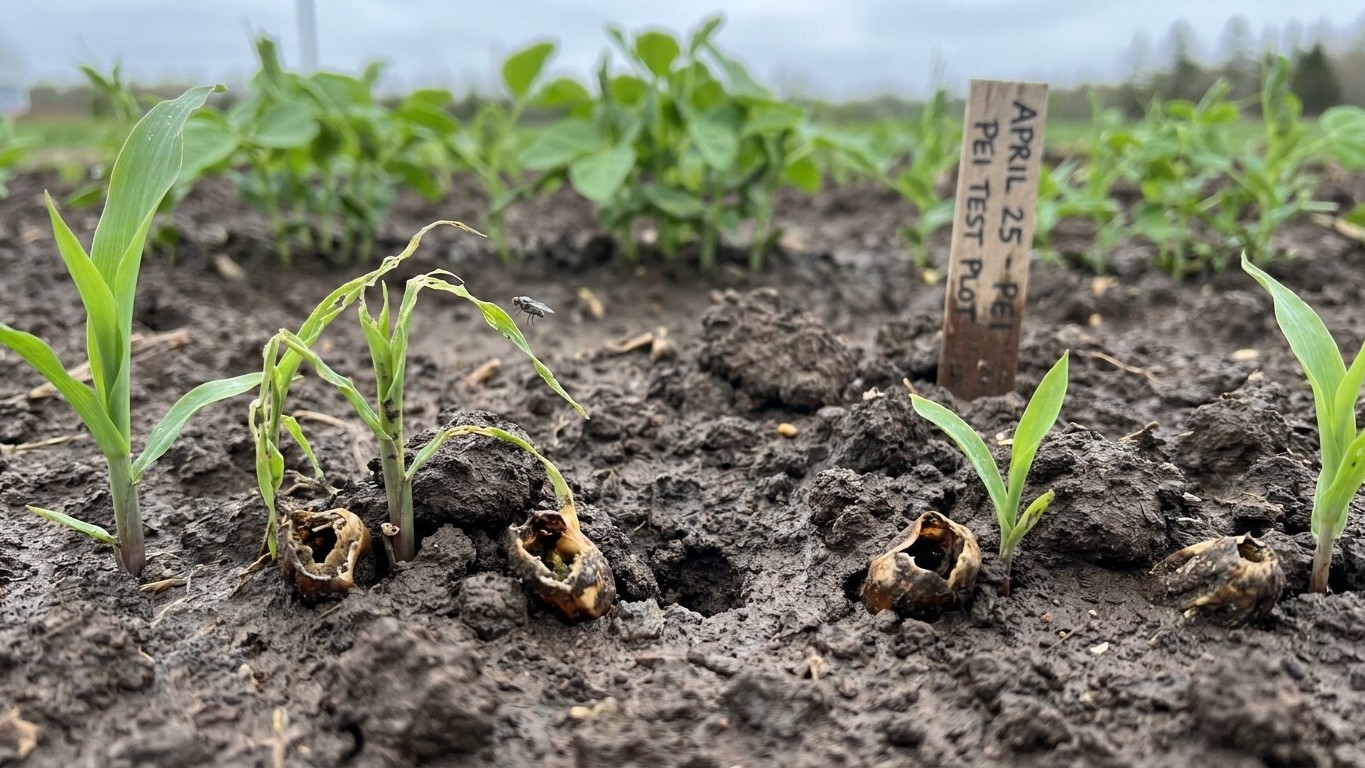

Seedcorn maggot shows up on Prince Edward Island in the first cool, wet weeks after planting, usually from late April through June, and again in a smaller second wave in late summer. The larvae tunnel into germinating corn, bean, and pea seeds before the plants ever break the surface, which means the first sign of trouble is often a bare patch where a full row should be. Cold soil, heavy organic matter, and slow germination are the three conditions that invite this pest onto Island farms and home gardens, and all three are common on PEI in early spring.
The insect itself is easy to overlook. Adults are small gray flies, roughly a fifth of an inch long, that resemble a shrunken housefly and rarely draw attention as they hover over freshly worked soil. The damage they cause is what gets noticed: hollowed-out seeds, stunted seedlings with ragged leaves, or gaps in a row that should have come up uniformly. By the time a gardener spots the problem, the larvae responsible have often already pupated and moved on.
What Seedcorn Maggot Damage Looks Like on PEI

Corn seedlings hit by seedcorn maggot often emerge with a shredded, whip-like first leaf, sometimes called “snakehead,” because the larvae fed on the growing point before the plant pushed through the soil. Bean and pea seeds are frequently destroyed outright before they sprout at all, leaving nothing visible above ground except an empty row. Cucumber, squash, and other cucurbit seedlings can show similar stunting, with cotyledons that never fully expand.
The larvae themselves are pale yellowish-white maggots, about a quarter inch long when full grown, tapered at the head and blunt at the rear. They’re rarely seen unless a gardener digs up a failed seed to check what happened to it. Splitting open a rotted seed or a stunted seedling’s root zone is usually the fastest way to confirm the culprit, since the damage pattern alone can be confused with damping-off disease or simple cold-soil stress.
What separates seedcorn maggot injury from a fungal problem is timing and texture. Damping-off tends to rot seedlings after they’ve emerged, with a soft, water-soaked stem at the soil line. Seedcorn maggot damage happens earlier, often before emergence, and leaves a hollowed or tunneled seed rather than a mushy stem. Both problems can occur in the same field in the same wet spring, which is part of why PEI growers sometimes assume a total loss is disease when insects are actually the bigger factor.
Why PEI’s Climate and Soil Favor This Pest
Prince Edward Island’s maritime climate keeps soil temperatures low well into late spring, and that slow warm-up is exactly what seedcorn maggot needs. The fly is drawn to fields and gardens where seeds sit in cold, damp ground for an extended stretch before sprouting, because a slow-germinating seed gives the larvae more time to find it and feed. A seed that pops up in five days in warm soil is a much smaller target than one sitting in 50-degree clay for two weeks.
The Island’s soil also plays a role. Much of PEI’s arable land runs through rotations that include potatoes, and cover crops or manure are commonly worked into the ground ahead of spring planting to build organic matter and manage the sandy-to-loam soils common across Queens, Prince, and Kings counties. That decomposing plant material and manure are exactly what attracts egg-laying adult flies. Freshly turned soil with a lot of undecomposed residue smells, to the fly, like a good place to lay eggs, whether that residue came from a cover crop, a manure application, or crop stubble that wasn’t fully broken down before planting.
Reduced tillage and no-till systems, increasingly used on the Island to cut soil erosion on its rolling terrain, add another layer of risk. Leaving more residue on the surface can mean more organic matter close to where seeds are placed, which extension entomologists across the Northeast and Atlantic Canada have long linked to higher seedcorn maggot pressure. That’s not an argument against reduced tillage, which brings real benefits for PEI’s erosion-prone red soils, but it does mean growers using those systems need to be more deliberate about seed treatment and planting timing.
Timing: When to Expect Activity on PEI
Seedcorn maggot overwinters as pupae in the soil and emerges as adult flies once the ground warms in spring. Entomologists across corn- and bean-growing regions track this emergence using a degree-day model based on a threshold near 39°F, accumulated from January 1. The first generation of adults typically appears once accumulated degree-days reach the low hundreds, which on PEI generally lines up with late April into May, right around the time many home gardeners and market growers are putting corn, beans, and peas into the ground.
This overlap is the core problem. The pest’s first flight coincides almost exactly with the Island’s traditional early planting window, so seeds sown in the first warm stretch of spring are often germinating at the same moment adult flies are searching for places to lay eggs. A second, usually smaller generation follows in mid- to late summer, but by then most spring-seeded crops have already grown past the vulnerable stage, so the summer generation causes far less damage on PEI than the spring one.
Cool, rainy stretches in May make the situation worse because they slow germination further. A bean seed that would normally sprout in six or seven days under decent conditions might take twelve or more in a cold, wet May on the Island, and every extra day below ground is another day of exposure. Growers who track soil temperature rather than the calendar date tend to have better luck, since a warm early May can shrink the risk window considerably compared to a cold, wet one.
Practical Control Steps That Work
Delaying planting until soil has warmed past the mid-50s Fahrenheit is one of the simplest and most effective steps available to PEI gardeners and small-scale growers. Faster germination means less time for larvae to find and damage the seed, and on the Island that can mean waiting until the third week of May rather than pushing corn or beans in during the first warm days of the month. It’s a tradeoff against a longer growing season, but for crops prone to seedcorn maggot losses, the wait usually pays off.
Seed treatments are the standard commercial defense. Insecticidal seed coatings, applied by seed suppliers before the seed ever reaches the field, protect the germinating seed during its most vulnerable window and are widely used in corn, bean, and pea production across Atlantic Canada. Home gardeners generally don’t have access to the same commercial treatments, which makes timing and soil management their main tools instead.
Managing organic matter incorporation matters just as much as timing. Fresh manure or a heavy cover crop worked into the soil right before planting is one of the strongest attractants for egg-laying flies, so allowing several weeks between incorporation and seeding gives the material time to break down and lose its appeal. Growers who till in a cover crop in early April and wait to plant until mid-May tend to see less pressure than those who till and seed in the same week.
Seedbed preparation also affects outcomes. A fine, well-drained seedbed that promotes quick, even germination reduces the number of days seeds sit exposed underground. Raised beds or improved drainage in a home garden can shave several days off germination time in a wet Island spring, which is often enough to reduce losses meaningfully. For larger plantings, a few practical habits help limit exposure:
- Wait for soil temperatures to reach the mid-50s before seeding corn, beans, or peas
- Leave at least two to three weeks between incorporating manure or cover crops and planting
- Choose well-drained ground or raised beds to speed germination
- Consider a slightly higher seeding rate for crops with a history of stand loss, to compensate for expected thinning
Crop rotation offers a smaller but real benefit. Because the pest is drawn to decomposing organic matter more than to any single crop species, rotating away from fields with heavy manure history or thick cover crop residue in a given spring can lower risk, though it won’t eliminate it the way it can with more host-specific pests.
Crops Most at Risk on the Island
Corn and dry beans carry the highest documented risk because their seeds are large, slow to sprout in cold soil, and attractive to egg-laying females. Peas fall into a similar category, particularly when planted early to take advantage of PEI’s cool-season growing preference for that crop. Cucurbits, including cucumbers and squash, are also vulnerable during their germination window, though home gardeners often plant these slightly later in the season when soil has already warmed, which naturally reduces exposure.
Root vegetables and leafy greens are rarely affected in the same way, since seedcorn maggot larvae target the seed and the emerging shoot rather than established root systems. That means a mixed home garden on PEI can often plant lettuce, carrots, or beets on the early side without much concern, while holding back corn, beans, and peas until the soil has genuinely warmed.
Second-generation flies in July and August occasionally attack late-season plantings of beans or a second corn sowing, though damage at that point is typically lighter because warmer soil speeds germination and shortens the vulnerable window. Growers who succession-plant beans through the summer for a fall harvest should still keep an eye on stand counts after each sowing, especially following a cool, wet stretch.
Related guides
- Seedcorn maggot in New Brunswick: When It Shows Up and What Stops It
- Seedcorn maggot in Nova Scotia: When It Shows Up and What Stops It
- Seedcorn maggot in Quebec: When It Shows Up and What Stops It
- Seedcorn maggot in Indiana: When It Shows Up and What Stops It
- Seedcorn maggot in Michigan: When It Shows Up and What Stops It