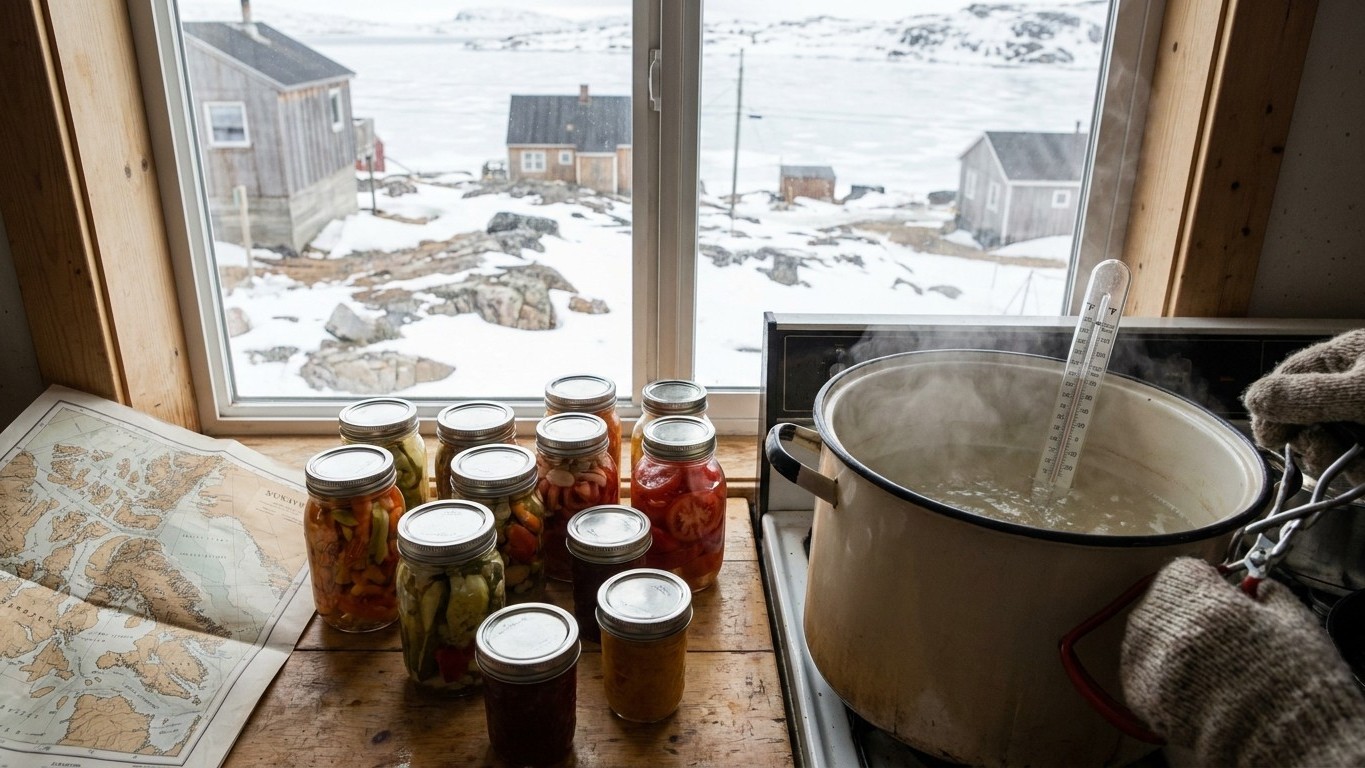

Rankin Inlet sits at 3 feet in elevation, and published boiling-point tables put water there between 208°F and 212°F. That range brackets sea level, and for a jar of pickles or tomatoes processed at 3 feet, nothing about the standard canning instructions needs to change. But Nunavut spans everything from tidal flats to inland ridges, and if your kitchen sits somewhere higher than Rankin Inlet, the math shifts under you.
The short answer

Nunavut does not have one elevation any more than it has one climate. Rankin Inlet, used here as the reference city, sits at 3 feet above sea level, and at that height water in an open pot boils somewhere between 208°F and 212°F, according to the USDA’s Complete Guide to Home Canning as published by the National Center for Home Food Preservation. That’s the full range home canning references use to bracket “sea level” behavior, and 3 feet falls comfortably inside it.
For a household in or near Rankin Inlet, this means the standard boiling-water canner times and the standard pressure canner settings printed on a tested recipe apply without modification. No added minutes, no added pounds of pressure. The recipe as written already assumes a boil close to 212°F, and that’s what a stove at 3 feet actually produces.
But that’s Rankin Inlet, not you
The figure above describes one town’s height above sea level, not the territory’s. Nunavut includes coastal hamlets barely above tide and inland terrain that climbs into the hundreds and thousands of feet. The National Center for Home Food Preservation organizes its altitude guidance in bands, commonly starting at sea level up to 1,000 feet, then continuing upward in steps, because each band calls for a different adjustment to processing time or canner pressure. Rankin Inlet’s 3 feet lands it in the lowest band, the one that needs no adjustment at all. A kitchen table sixty miles inland, at a few hundred feet higher, could sit in the very same band, or it could not. That’s the part worth checking rather than assuming, and the next section covers exactly how.
The point of naming Rankin Inlet at all isn’t to tell every Nunavut canner their elevation is 3 feet. It’s to show what “no adjustment needed” looks like in real numbers, so you can compare it against your own address once you find it.
Why a lower boil is a weaker process
Water’s boiling point drops as elevation climbs. At sea level it boils at 212°F. Climb to 10,000 feet and it boils at 194°F, a full 18 degrees cooler. That’s not a rounding error in canning terms. It’s the entire reason altitude adjustments exist in the first place.
Canning works by holding food at a temperature high enough, for long enough, to destroy the microorganisms that would otherwise spoil it or make it dangerous. A boiling-water bath relies on that 212°F ceiling to do the work. When the ceiling drops to 194°F because you’re higher up, every minute of processing at that lower temperature accomplishes less than the same minute would at sea level. The jar isn’t getting the treatment the tested recipe assumed it would get. It looks identical to a properly processed jar. It is not the same jar.
Here’s the part that trips people up: boiling water cannot get hotter by boiling harder. A rolling, violent boil and a gentle, barely-there boil sit at the exact same temperature, because boiling is a phase change locked to a fixed point at a given elevation and pressure. Cranking up the burner speeds up how fast liquid turns to steam. It does not raise the ceiling. Someone at 6,000 feet who boils their water bath as hard as their stove allows is still processing at roughly 201°F, not 212°F, no matter how aggressive the bubbles look.
What actually compensates for a lower boiling point is time and pressure, not intensity. In a boiling-water canner, the fix is a longer processing period, calculated for the specific elevation band, so the food spends more total minutes at the reduced temperature to make up for the lost heat. In a pressure canner, the fix runs the other direction: the canner raises the pressure inside the vessel, which pushes the internal temperature back up past what an open pot could ever reach at any elevation, sea level or otherwise. Either method solves the same problem from a different angle. Neither one is optional once you’re high enough that the standard numbers no longer apply.
Finding your own elevation
Rankin Inlet’s 3 feet tells you nothing about the property where you’re actually filling jars. Nunavut’s elevation varies enough across its hamlets and inland areas that guessing is a bad habit. Here’s the order to work through it.
- Locate your specific address or the nearest named settlement, not just “Nunavut” as a whole, since the territory covers a wide spread of heights.
- Visit the National Center for Home Food Preservation’s “Find Your Elevation” page, built specifically to let home canners look up elevation by location.
- Enter your location and record the elevation in feet exactly as returned, rather than rounding it in your head.
- Match that number to the elevation band in the NCHFP’s altitude adjustment tables for your specific food and canning method.
- Note whether your band requires a boiling-water time increase, a pressure increase, or, as with Rankin Inlet at 3 feet, no change at all.
- Recheck this if you can or process at a different property, a cabin, a relative’s kitchen at different elevation, since the adjustment travels with the location, not with you.
That last step matters more than it sounds. A processing time correct at your home kitchen isn’t automatically correct at a hunting camp or a family member’s place forty minutes inland. Altitude adjustments are tied to where the canner is actually sitting on the day you process, not to a general sense of “up north” or “coastal.”
What goes wrong
- An under-processed jar that looks perfectly normal. A jar sealed and processed at a boiling point too cool for its elevation can seal, cool, and sit on a shelf looking exactly like a safe one. The seal forming tells you the lid pulled down; it tells you nothing about whether the contents reached a safe temperature for long enough. The remedy is checking your elevation band before you start, not after the jars are already cooling on the counter.
- A recipe pulled from a sea-level source. Plenty of recipes online, in older family notebooks, or from regions near sea level list processing times with no altitude note at all, because the writer never needed one. Using those times unmodified at any elevation above roughly 1,000 feet builds the same gap discussed above straight into the batch. The remedy is running that same recipe’s time or pressure through the NCHFP’s altitude tables before touching a single jar.
- A pressure gauge read as though elevation doesn’t exist. Weighted-gauge and dial-gauge pressure canners both need their target pressure adjusted upward as elevation rises, because the whole point of pressure canning is reaching a temperature above what boiling water can hit on its own, and that target keeps moving as the baseline boiling point drops. Setting the canner to a sea-level pressure at a higher elevation quietly weakens the process the same way a cool boiling-water bath does. The remedy is confirming the pressure listed for your food matches your actual elevation band, not the number printed for sea level.
Where the exact adjustment comes from
This page hasn’t given you a processing time or a canner pressure, and it isn’t going to. Those numbers depend on the specific food, the jar size, and your elevation band together, and they belong to tested recipes published for that combination, not to a general article about altitude. The National Center for Home Food Preservation publishes those adjustments food by food, and that’s the resource to check once you know your elevation and your recipe.
The reason for this caution isn’t bureaucratic. Botulinum toxin, the danger an under-processed low-acid jar can harbor, has no taste and no smell. A jar can look right, smell right, and taste right, and still not be safe. That’s exactly why the adjustment has to come from a tested source matched to your food and your elevation, rather than from a rounded-off guess.
Common questions
Does Nunavut count as high altitude for canning purposes?
Not as a whole. Rankin Inlet, used here as a reference point, sits at only 3 feet, well within the lowest elevation band, where no adjustment applies. Other parts of the territory sit higher, so the answer depends on your specific location, not on the territory’s name.
If I boil my water bath harder, can I skip the altitude adjustment?
No. Boiling water stays at the same temperature regardless of how vigorously it boils; a harder boil turns liquid to steam faster but doesn’t raise the ceiling. The only way to compensate for a lower boiling point is more time or more pressure, not more heat.
Where do I find the elevation for my exact address, not just the nearest town?
The National Center for Home Food Preservation hosts a “Find Your Elevation” lookup tool built for this purpose, letting you enter a specific location rather than relying on a town-wide figure.
What happens if I use a sea-level processing time at a higher elevation?
The jar can seal and look completely normal while still being under-processed for its actual boiling point, which can leave harmful organisms alive without any visible, tasted, or smelled sign of it.