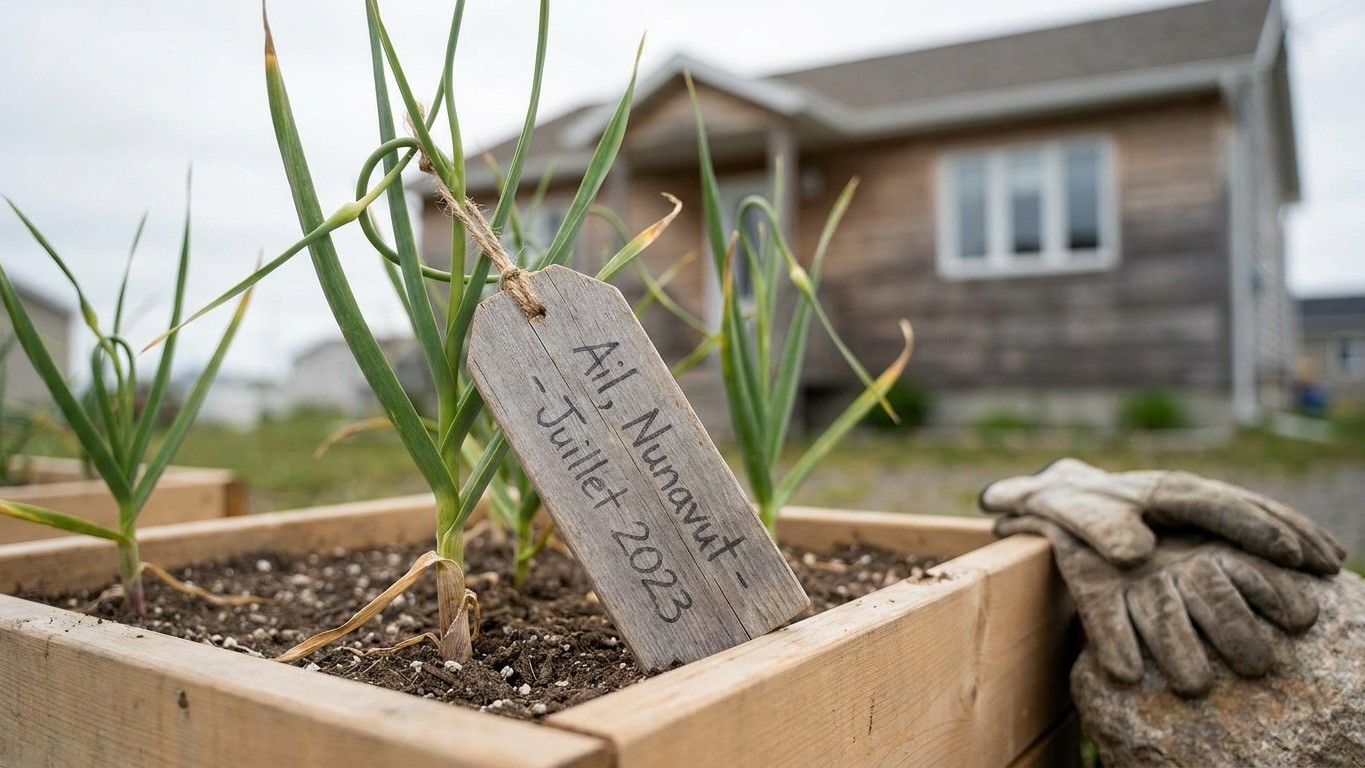

Garlic grows in Nunavut, and the territory’s cold is an asset rather than an obstacle. Environment and Climate Change Canada’s 1981-2010 climate normals put the average first fall frost at Rankin Inlet on September 13, and the deep, sustained cold that follows it does more than satisfy garlic’s chilling requirement, it exceeds it several times over. The action that follows: plant a hardneck variety from the Garlic Varieties That Suit Nunavut Winters guide in late August, following the schedule laid out in When to Plant Garlic in Nunavut that growers rely on, mulch it heavy before the ground locks up, and stop worrying about whether the clove will get enough cold. It will.
Will garlic get the cold it needs in Nunavut

Garlic only forms a proper head of cloves if the planted clove goes through a real cold spell first. Skip that step and you lift a single round, undivided bulb instead of a cluster of cloves, the same disappointment you get from garlic planted too late in spring farther south. University of Georgia Extension publication C854 sets the benchmark most growers work from: six to eight weeks with soil temperatures below 40°F after planting, before the ground freezes hard enough to stop root activity.
Rankin Inlet’s climate leaves that threshold far behind. Using Environment and Climate Change Canada’s 1981-2010 normals for that station, the mean first fall frost lands September 13, and from there the territory’s air temperature keeps dropping for months, not weeks. Soil lags behind air temperature but follows the same direction, and by the time deep winter sets in, cloves planted in late August have already spent well past two months below 40°F. Nunavut clears the University of Georgia’s six-to-eight-week minimum with room to spare, in most years by a wide margin.
That surplus changes what actually threatens the crop here. In a state where winters run mild, like Delaware, the whole planting calculation revolves around scraping together enough cold for the clove to divide at all, and growers there refrigerate seed cloves for several weeks before planting or lean on softneck types bred to need less chilling. Nunavut growers never face that shortage. The risk runs the other way: a clove that goes into unprotected ground here can be killed outright by the cold before it has rooted, which is a different failure than under-vernalization and calls for a different fix, covered under winter protection below.
So the honest answer to whether garlic gets the cold it needs in this territory is yes, decisively, and the real planning question shifts from “will it divide” to “will it survive the winter intact.” That’s a solvable problem with the right depth, timing, and mulch, not a reason to skip the crop. A grower comparing notes with someone in Ohio, where the chilling math and the mulch math both look different again, will find the two problems don’t overlap much: see Growing Garlic in Ohio: Planting Dates, Varieties and Winter Cold for how a milder frost window changes the calculus there.
When to put the cloves in
Garlic wants to go into the ground with enough time to grow roots before the soil freezes solid, but not so early that it pushes green top growth that then gets cut down by the first hard freeze. That balance is set against the fall frost, not against a fixed calendar date, because the frost is what actually locks the soil.
Reading the arithmetic
Environment and Climate Change Canada’s 1981-2010 normals put Rankin Inlet’s mean first fall frost at September 13. Treat that as a midpoint, not a guarantee: in roughly one year out of two, the actual first frost falls later than that date, and in the other half it falls earlier. Every variety in this territory’s catalog data is set out in late August, which works out to roughly two to three weeks ahead of that mean September 13 frost. That gap is enough for a clove to send down roots into cooling soil without enough time left to send up much leaf before the ground starts to shut down for the season.
What moves that window from one part of Nunavut to another isn’t written into the Rankin Inlet data, but the direction is predictable. A community sitting close to open water on Hudson Bay tends to hold moderate fall temperatures a little longer than an inland site at the same latitude, because a large body of water releases stored summer heat slowly. Elevation and exposure to wind push the other way, cooling the soil faster than the coastal average would suggest. A grower on a colder inland site is better off planting toward the earlier end of the late-August window and watching soil temperature directly, rather than assuming Rankin Inlet’s normal applies unchanged.
Which types suit Nunavut
Garlic splits into two broad camps, and here the split isn’t a matter of preference, it’s a matter of which one the winter actually rewards. Hardneck garlic (the ophioscorodon varieties) needs a genuine cold season to form a scape and divide properly, and Nunavut’s winter supplies that without any help. Softneck garlic evolved for regions with mild winters and rewards the grower with much longer storage life, but it doesn’t ask for anywhere near the cold this territory delivers.
Hardneck varieties carried in the catalog and set out in late August here include Bavarian Purple, Blue Music, Chesnok Red, Duganski, Fall Festival, Georgian Crystal, Georgian Fire, German Red, German White, and Ivan. These are the varieties whose catalog days-to-maturity and bulbing habit line up with a territory that hands out cold in surplus rather than short supply.
Softneck varieties are also on the same late-August planting schedule here: Early Red Italian, Inchelium Red, Italian Late, and Lorz Italian. They’ll still divide and store, and their longer shelf life after curing is a real advantage if storage space is tight. What they don’t get here is an easier winter: Nunavut’s cold runs well past what a softneck was bred to shrug off, so any softneck planted in this territory still needs the same deep mulch a hardneck does, unlike a milder state where a softneck can often skip that step. A grower in a place like Delaware, where softneck garlic is the default choice precisely because the winters are gentle, is working from a different set of constraints; see Growing Garlic in Delaware: Planting Dates, Varieties and Winter Cold for that comparison.
| Trait | Hardneck | Softneck |
|---|---|---|
| Cold requirement | High, matches Nunavut’s winter | Lower, bred for mild winters |
| Scape | Produces a scape, cut for eating | No true scape |
| Storage length | Shorter, several months | Longer, often into the following spring |
| Catalog examples here | Duganski, Chesnok Red, German White | Inchelium Red, Lorz Italian |
Soil and bed preparation
Drainage comes before everything else. A garlic clove sits in that bed through the entire winter, and standing water that freezes and thaws around it will rot the clove long before any disease organism gets the chance. A bed that puddles after rain is not ready for garlic, whatever else is done to it.
Raised beds and the active layer
Nunavut sits on permafrost, and the seasonally thawed layer of soil above it, the active layer, is often shallow and slow to drain because meltwater has nowhere to go once it hits the frozen ground beneath. A raised bed or a mounded row lifts the clove above that saturated zone and gives it a warmer, better-drained root run than flat ground can offer. Work compost into the top few inches to lighten heavy soil and hold that improved structure in place.
- Check the bed after a heavy rain: water sitting for more than a few hours signals a drainage problem to fix before planting.
- Build up a raised or mounded bed rather than planting into flat, low ground.
- Work compost into the top layer to improve structure and add nutrients ahead of a long dormant season.
- Clear rocks and old root debris so cloves sit against loose soil, not an air pocket that invites rot.
- Level and firm the bed a couple of weeks ahead of the late-August planting window so it isn’t freshly disturbed when the cloves go in.
What the climate here favours, and what it does not
UC IPM’s Pest Management Guidelines for onion and garlic, UC ANR Publication 3453, publish the temperature ranges that let each major garlic pathogen thrive. Matching those published ranges against the mean air temperature for each month of Nunavut’s growing season, from September through July, shows which diseases find a window here and which do not.
| Disease | Published range (UC IPM) | Months in range here | Reading |
|---|---|---|---|
| White rot (Sclerotium cepivorum) | 50-75°F | 1 (July) | Critical pathogen, brief window |
| Fusarium basal rot (Fusarium oxysporum f. sp. cepae) | 59-90°F | 0 | No month falls inside the range |
| Southern blight (Sclerotium rolfsii) | 86-95°F optimum | 0 | Well outside its optimum, less active |
| Pink root (Setophoma terrestris) | 75-85°F optimum | 0 | Well outside its optimum, less active |
Only white rot finds a month of the growing season, July, where Rankin Inlet’s mean air temperature falls inside its published range, and even that single month is worth taking seriously since white rot’s sclerotia can persist in soil for decades once introduced. Fusarium basal rot never finds a matching month here at all, and southern blight and pink root sit well below the warm optimum each needs to run hard, meaning they’re less active in this climate, not eliminated by it.
Three cautions matter more than the count itself. UC IPM’s published thresholds are soil temperatures, while the figures used here are air temperatures, and soil lags behind air and swings less through the day. A monthly mean also hides real variation: a month averaging inside a pathogen’s range can still include plenty of days outside it, and vice versa. And Rankin Inlet is one weather station covering a small slice of a very large territory. None of this means a Nunavut grower can plant infected seed stock and expect the cold to sort it out. Climate sets a tendency toward or away from disease, and infected planting material carries these pathogens wherever it goes.
Getting it through the winter
This is where growing garlic in a territory this cold diverges hardest from growing it almost anywhere farther south. The clove has plenty of cold to satisfy its chilling requirement long before winter’s worst arrives, so the job of winter mulch is protection, not encouragement.
Lay mulch once the ground has begun to cool and firm but before a hard, sustained freeze sets in, so the layer traps the moderate soil temperature that’s already there rather than trying to warm up ground that’s already frozen solid. A thick blanket of clean straw or similar loose organic material insulates against the sharpest temperature swings and, just as importantly, against the freeze-thaw cycles that heave a shallow-planted clove partway out of the ground. A heaved clove sits exposed to direct cold and wind with no soil buffer left around it, and that exposure kills far more garlic in northern gardens than any pathogen does.
Planting depth works together with mulch here: a clove set shallow in this climate is a clove more likely to heave, no matter how much mulch sits on top. In spring, once the thaw is clearly underway and the risk of a hard refreeze has passed, pull the mulch back gradually rather than stripping it all at once, so the emerging shoot isn’t shocked by a sudden swing in soil temperature.
Harvest and curing here
Garlic tells you when it’s ready by how it looks, not by a date on a calendar. Watch the leaves: when the lower several leaves have browned and dried back while a handful of upper leaves are still green, the bulb has finished sizing and it’s time to lift it. Pulling too early leaves cloves undersized and the wrappers loose; waiting too long past that point lets the bulb split its wrapper and lose the storage quality that made the wait worthwhile.
Curing in a short, cool season
Curing is where a lot of an otherwise successful crop goes wrong, and Nunavut’s short, cool growing season changes how it needs to be done compared with a warm, humid state where garlic simply hangs in an open shed. Cool air holds moisture differently than warm air does, and a cure that would finish in a couple of weeks outdoors in a warmer climate can drag on and invite mold here if the bulbs are left in damp, poorly circulating air. Move the harvested bulbs, tops still attached, to a dry, shaded, well-ventilated indoor space rather than counting on open-air curing to finish the job on its own, and keep air moving across them with a small fan if the space is at all humid or still. Check a few bulbs by feel after a couple of weeks: the outer wrappers should be dry and papery with no give in the neck before you trim tops and roots and move the crop to storage.
Local help
County-level frost timing, soil testing, and any locally observed pest or disease pressure are best confirmed with an extension service before finalizing a planting plan, since Rankin Inlet’s data is one station standing in for a very large and varied territory. Agriculture and Agri-Food Canada, at agriculture.canada.ca, is the federal starting point for that kind of local guidance and can direct a grower to territorial resources for Nunavut specifically.
Common questions
Can I Plant Garlic in spring instead of fall in Nunavut?
Spring planting skips the cold period the clove needs to divide into a proper head, so a spring-planted clove typically grows into a single round bulb rather than a cluster of cloves. Fall planting, timed against the season’s cooling soil, is how garlic is grown here and everywhere else it’s grown outdoors.
Do I need to refrigerate my seed garlic before planting here?
No. Refrigerating cloves before planting is a workaround for regions that don’t get enough natural cold, and Rankin Inlet’s climate normals show this territory clears that chilling requirement on its own, several times over in most years.
Will my garlic survive if I forget to mulch it?
It might, but the odds drop sharply. Unmulched cloves are far more exposed to the freeze-thaw cycles that heave them out of the soil, and a heaved clove with no insulating soil around it is much more likely to be killed outright by the cold than one that’s protected.
Why did I only get one big clove instead of a bulb with several cloves?
That’s the classic sign of insufficient vernalization, though it’s an unlikely outcome in this territory given how much cold the winter here provides. It’s more often caused by planting too late for roots to establish, or by using seed stock that was already compromised before it went in the ground.
Can I grow softneck garlic even though it’s known for mild winters?
Yes, softneck varieties like Inchelium Red and Lorz Italian will grow and divide here just as well as anywhere, and they’ll reward you with longer storage life than a hardneck. They still need the same deep winter mulch a hardneck gets in this climate, since Nunavut’s cold goes well beyond what a softneck was bred to tolerate unprotected.