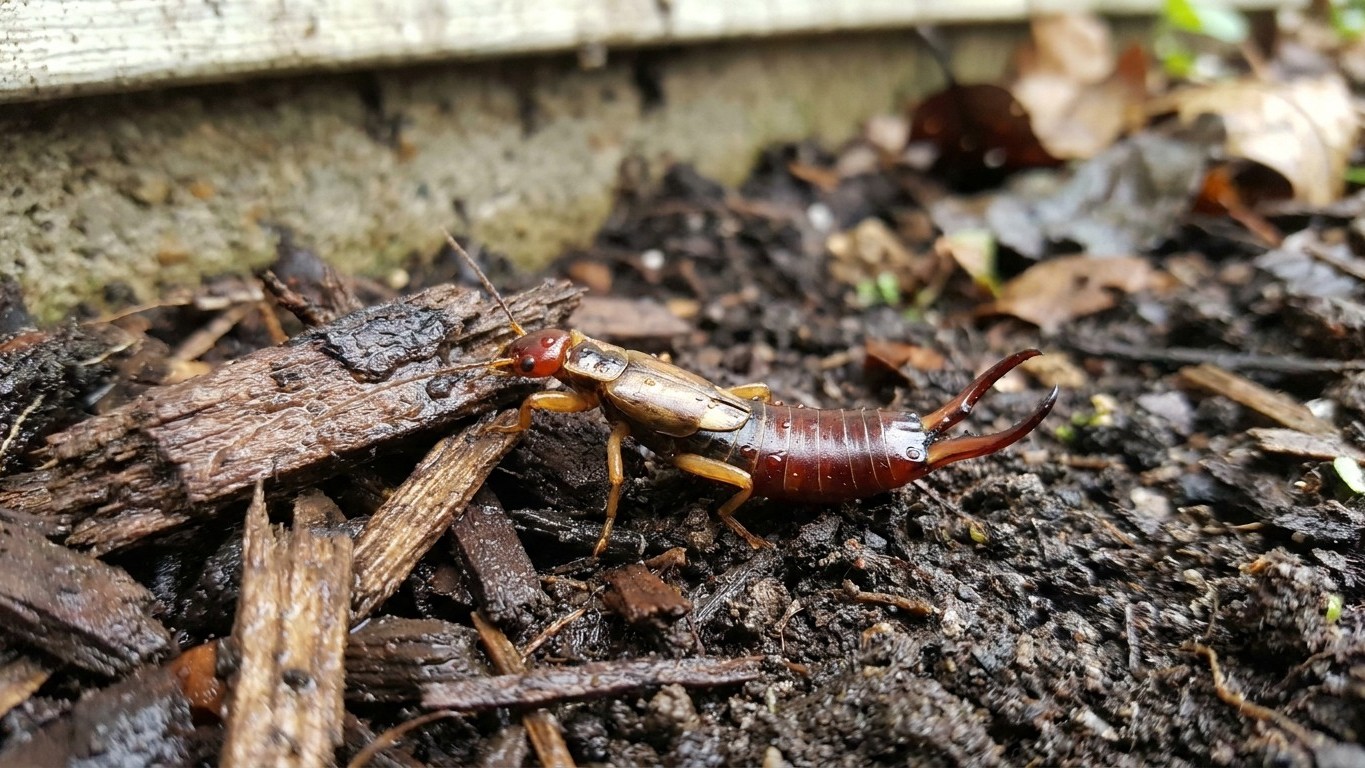

European earwigs (Forficula auricularia) turn up across Ohio from late spring through fall, with the heaviest activity hitting in July and August when nymphs mature and start foraging in large numbers. They gather in damp, dark spots near foundations, mulch beds, and porch furniture, and the fastest way to stop them is cutting off moisture and hiding spots while sealing the cracks they use to slip indoors.
Ohio’s humid summers and heavy clay soils create exactly the kind of damp micro-habitats earwigs favor. That’s not a coincidence. The insect was introduced to North America from Europe more than a century ago and has since adapted well to the Midwest’s mix of wet springs, mulched landscaping, and older housing stock with plenty of foundation gaps.
What a European Earwig Actually Looks Like

Adults run about five-eighths of an inch long, reddish-brown, with short wings and a pair of curved pincers (called cerci) at the tail end. Males have thicker, more curved pincers than females, whose cerci stay straighter and closer together. Despite the intimidating look, they rarely pinch hard enough to break skin, and they don’t carry disease or damage wood framing the way termites or carpenter ants do.
Homeowners often confuse them with cockroaches at first glance because of the shiny brown body, but the pincers give it away immediately. No cockroach species common in Ohio has that tail-end forceps.
When Earwigs Show Up in Ohio
Adult earwigs overwinter in soil, usually two to four inches down, near foundations, in garden beds, or under leaf litter. They emerge as temperatures climb into the 50s Fahrenheit, typically in April across southern Ohio and closer to early May in the northern part of the state near Lake Erie.
Females lay 20 to 50 eggs in underground burrows during late winter, and again sometimes in early summer for a second batch. Nymphs hatch in roughly three weeks and go through four to five molts before reaching adulthood, a process that takes about two months. That timeline puts peak nymph activity squarely in July, which lines up with the surge of earwig complaints Ohio State University Extension offices field every summer.
By late August and September, populations are at their highest density and searching aggressively for shelter as nights start cooling. This is when they show up on porches, in window sills, and occasionally inside homes, not because the season is ending for them but because they’re hunting for humid crevices to ride out cooler temperatures. Activity drops off sharply once nighttime lows consistently dip below 50°F, usually in October.
A Two-Generation Pattern in Warm Years
In unusually warm, wet years, some populations in Ohio produce a partial second generation, which extends the nuisance window into early fall instead of tapering off in late summer. This isn’t universal across the state, but it explains why some years feel like earwigs never really “leave.”
Why They Head Toward Ohio Homes
Earwigs are drawn to moisture more than almost anything else. Mulch beds pressed directly against siding, gutters that dump water at the foundation, and dense ground cover like ivy or pachysandra all create the humid microclimate they need to survive daytime heat. Firewood stacks and stone retaining walls do the same thing, offering both moisture and hundreds of tiny gaps to hide in.
Outdoor lighting adds another layer to the problem. Earwigs aren’t strongly attracted to light themselves, but the insects that are, moths, gnats, small beetles, draw earwigs in as a food source since earwigs are omnivorous scavengers that eat other insects, decaying plant matter, and occasionally seedlings and soft fruit.
Once they’re staged near the foundation in large numbers, it takes surprisingly little to get them indoors. Gaps around basement window wells, unsealed utility penetrations, and worn door sweeps are the usual entry points. A quarter-inch gap under a garage door is plenty of clearance for an adult earwig.
What Actually Stops European Earwigs in Ohio
Control comes down to removing moisture and hiding places outdoors, then sealing entry points, with pesticide treatments as a supplement rather than the primary fix. Extension entomologists across the Midwest consistently point to habitat modification as the step that produces the biggest, most lasting drop in earwig numbers.
Outdoor Moisture and Debris Management
Pull mulch back at least six inches from the foundation and keep the layer no deeper than two to three inches, since thick, damp mulch against siding is one of the most reliable earwig magnets in any Ohio yard. Redirect downspouts so water lands well away from the house, and fix any grading that lets water pool near the foundation after rain.
Stack firewood off the ground and away from exterior walls. Clear dead leaves, grass clippings, and other plant debris from flower beds close to the house, particularly in the fall when earwigs are actively hunting for winter shelter.
Sealing the Building Envelope
Caulk gaps around window frames, foundation cracks, and utility line penetrations. Install or replace door sweeps on exterior doors, including garage service doors, and check that basement window wells have tight-fitting covers. These fixes address earwigs, but they also cut down on entry points for other Ohio nuisance pests like boxelder bugs and cluster flies, so the labor pays off more than once a season.
Traps and Targeted Treatments
Rolled-up damp newspaper, corrugated cardboard, or shallow containers with an inch of vegetable oil placed near known hiding spots will draw earwigs overnight; shaking them out into a bucket of soapy water each morning is a low-cost way to knock down a concentrated population without chemicals. This works especially well near porches, decks, and mulch beds where numbers are highest.
For persistent infestations, a perimeter treatment with a residual insecticide labeled for earwigs, applied in a band along the foundation and around known entry points, can help during peak population weeks in July and August. Products containing bifenthrin, cyfluthrin, or permethrin are common active ingredients used for this purpose, but always follow the label directions and note any restrictions near vegetable gardens or water features. Indoor treatments are rarely necessary if outdoor sealing is done well; earwigs that get inside usually die within a few days since Ohio homes don’t offer the humidity they need to survive long term.
Are Ohio Earwigs Actually Harmful?
Mostly, no. They’re a nuisance pest, not a structural or health threat. The pincers can deliver a mild pinch if handled roughly, but they don’t inject venom and don’t transmit disease to humans or pets. The real damage, when it happens, shows up in gardens rather than houses: earwigs will feed on soft seedlings, strawberries, and the petals of dahlias and zinnias, which is where Ohio gardeners tend to notice them first, often before homeowners spot them near the foundation.
That garden feeding habit is worth weighing against the good they do. Earwigs also eat aphids, mites, and other small garden pests, so a moderate population in a flower bed isn’t automatically a problem worth treating. It’s the large concentrations near the house, the ones tied to excess moisture and clutter, that actually warrant action.
The population swings year to year with rainfall more than with any single control method. A wet spring followed by a humid July almost guarantees a heavier earwig season across central and southern Ohio, while a dry stretch in June can knock numbers down before they ever peak. Watching the weather pattern each spring gives a rough preview of how aggressive the fall push toward the house is likely to be.