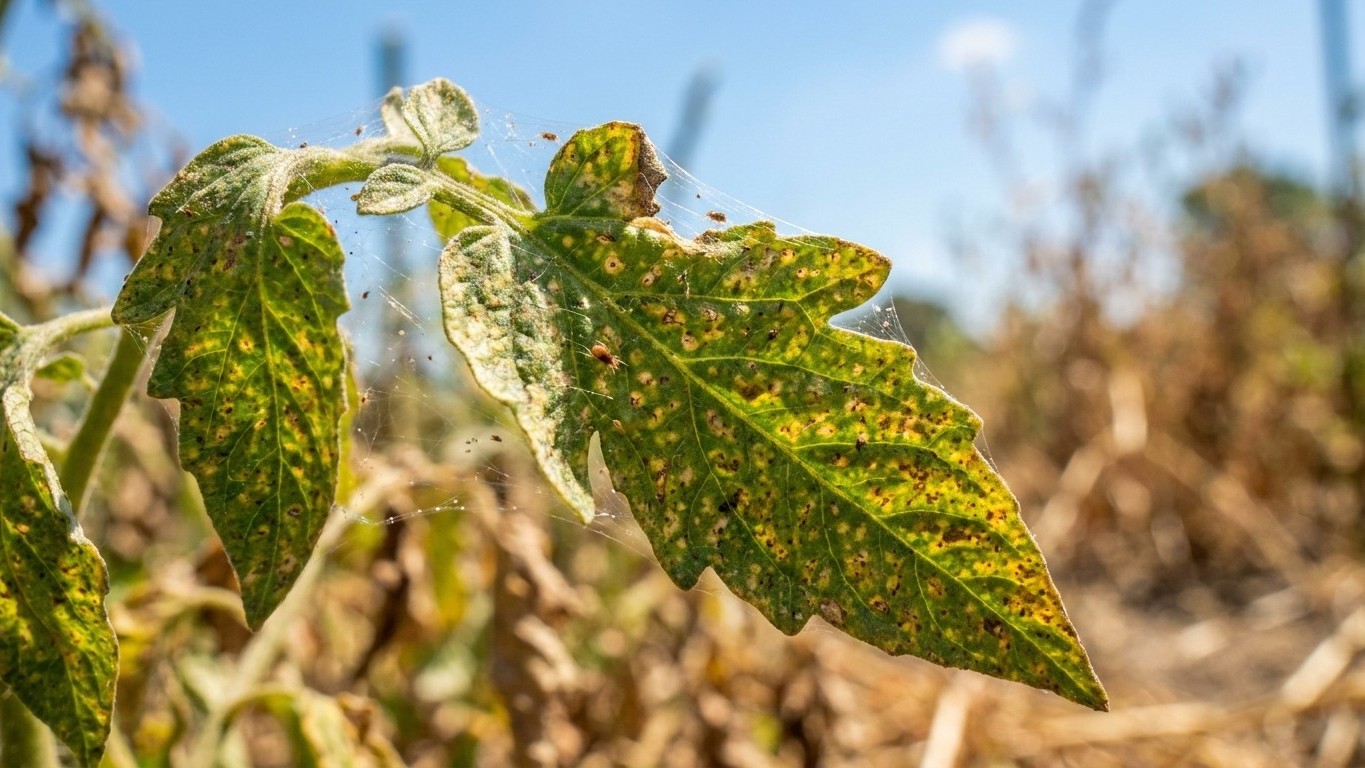

Twospotted spider mites become a problem in Ohio gardens during the hottest, driest stretches of summer, not in spring. Ohio State University Extension (Ohioline) places this pest’s peak activity squarely in summer heat, which sets it apart from the early-season insects gardeners usually worry about first.
When Twospotted spider mite turns up in Ohio

Ohio State University Extension (Ohioline) is direct about this one: Twospotted spider mite is worst in summer heat. That’s the whole seasonal note the fact sheet gives for this species, and it’s worth taking at face value rather than trying to pin it to a specific week. Heat, not a date on the calendar, is what drives this pest.
Compare that to the other pests Ohioline tracks on the same page. Slugs show up in wet springs and falls. Plant bugs cause damage in late spring and early summer. Japanese beetles emerge in late June and stick around until early fall. Squash vine borer adults appear in early-to-mid summer, timed to roughly 1,000 degree days above a 50-degree base. Spider mites don’t fit any of those windows. They build steadily as July and August heat sets in, feeding faster in dry conditions than in a normal, rainy Ohio summer.
This matters for how you watch your garden. A gardener checking tomato leaves in May for spider mite damage is looking too early. The population explosion tends to happen once daytime temperatures sit in the 85-to-95-degree range for stretches at a time, conditions that speed up the mite’s reproductive cycle dramatically. A single female can produce a new generation in under two weeks when it’s hot enough, which is why a plant that looked fine on a Friday can look dusty and bronzed by the following weekend.
None of this means spring inspection is pointless. It means the priority window shifts. Early season, you’re watching for other pests. By midsummer, spider mites move to the top of the list, especially on any plant already stressed by heat or short on water.
Reading the calendar from your last frost
Ohio State University Extension puts the last spring frost for zone 6a between May 5 and May 15. That’s the date most Ohio gardeners actually plan transplanting around, and it’s useful here even though spider mites aren’t a frost-driven pest. Their arrival tracks heat accumulation after that frost window closes, not the frost date itself.
An early, warm spring speeds up the mite’s summer buildup because heat units accumulate sooner. A cool, wet spring pushes the whole timeline back, sometimes by weeks. This is why two Ohio gardens thirty miles apart, planted on the same day, can see spider mite pressure at noticeably different points in the summer. Soil temperature and air heat call the shots, and the last frost date is only the starting line for counting toward that heat.
Ohioline’s fact sheet doesn’t give a fixed number of weeks after transplanting when spider mite damage typically first appears, so don’t force a precise count where the source doesn’t provide one. What you can say with confidence: damage tends to lag well behind the frost date, showing up only once sustained summer heat has had time to build. That’s a range tied to weather, not a single day you can circle on a calendar.
For row covers or other physical barriers meant to delay pest pressure, this points to a practical rule. Covers matter far more for spring pests tied to the frost date than for spider mites, which arrive on their own schedule regardless of when you removed a cover in April or May. Treat the frost date as a planting guide, not a spider mite forecast.
What it attacks, and what the damage looks like
Twospotted spider mite feeds on a wide range of garden plants, including tomatoes, beans, cucumbers, melons, eggplant, and many ornamentals. It’s one of the least picky pests in the Ohio garden, which is part of why it turns up almost everywhere once summer heat sets in.
What you’ll notice first
The symptom usually shows up before the insect does. Leaves develop a fine, pale stippling, almost like the surface has been dusted or sandpapered, and in heavy infestations that stippling turns into an overall bronze or yellowed cast across the whole leaf. Fine webbing on the undersides of leaves, or between a stem and a leaf petiole, is the giveaway that separates spider mites from other stippling causes like heat stress or nutrient deficiency. Left unchecked, affected leaves curl, dry out, and drop, and the plant’s growth slows noticeably.
The actual mites are tiny, close to the size of a period on a printed page, and you’ll typically need a hand lens or a sheet of white paper (tap a leaf over it and watch for tiny specks crawling) to confirm what you’re looking at.
Both the nymph and adult stages do the feeding damage, piercing individual plant cells and drawing out the contents. Unlike a pest such as squash vine borer, where the larva burrows inside the stem and becomes untouchable from the outside, spider mites feed openly on the leaf surface through every damaging life stage. That’s actually useful information: it means the pest stays exposed and reachable for as long as it’s causing damage, rather than disappearing into plant tissue where nothing you do from the outside will matter.
How Ohio sits in this pest’s range

This site documents Twospotted spider mite in 2 territories. That’s a narrow footprint compared to a pest logged across a dozen or more states, and it puts Ohio near an edge of the documented range rather than in the middle of it.
A narrow count like this doesn’t mean the pest is rare or minor. Twospotted spider mite is, in reality, one of the most widely distributed plant pests in North America. What a count of 2 territories reflects here is which territories have published, extension-backed guidance on this site, not the biological limits of where the mite can survive. The guidance here comes directly from Ohio State University Extension’s own reporting on Ohio conditions.
What this means practically: don’t read Ohio’s position in this dataset as a statement about severity or risk level relative to other states. The fact sheet gives a seasonal pattern (worst in summer heat) and a wide host list, but it doesn’t rank Ohio’s infestation pressure against any other territory, and neither should this article. Treat the count as a map of documentation, not a map of danger.
What actually works against it
Start with the cheapest, simplest measures first, since they work directly against the conditions spider mites love, and move down the list only as needed.
- Spray plants with water. Twospotted spider mites thrive in hot, dry, dusty conditions, and a firm spray of water aimed at the undersides of leaves physically knocks mites and their eggs off the plant, disrupting the colony before it builds; this works best done regularly through the hottest weeks, and it stops working once a plant is so heavily infested that webbing has matted leaves together, shielding mites from direct spray.
- Water consistently at the soil level and avoid letting plants sit stressed and dusty. Drought-stressed plants are consistently more attractive to spider mites, so keeping foliage from drying out under heat removes one of the conditions that lets a mild population turn into an outbreak.
- Go easy on nitrogen fertilizer. Excess nitrogen pushes soft, lush new growth, and that tender tissue is easier for mites to pierce and feed on than tougher, well-hardened leaves, so cutting back on heavy feeding, especially mid-summer, removes an incentive rather than treating a symptom.
- Clear weedy borders and garden debris near vegetable beds. Spider mites overwinter and build up on weeds and plant debris at the garden’s edge before moving onto crops, so removing that habitat reduces the source population before it ever reaches your tomatoes or beans.
Hand-picking, effective against larger pests like Japanese beetles, isn’t realistic here given the mite’s tiny size. Crop rotation offers limited benefit too, since spider mites disperse readily on wind and don’t rely heavily on overwintering in one specific bed. All of these measures work only while the mites are exposed on leaf surfaces, which, given their feeding habits, is essentially their entire life cycle in your garden.
Common questions
Do Twospotted spider mites spread from plant to plant on their own?
Yes. They move on wind currents and by crawling between touching plants, which is part of why they can jump from a stressed weed patch to a whole row of vegetables within days once summer heat sets in.
Can I tell spider mite damage apart from a nutrient deficiency?
The stippling pattern looks similar at first glance, but fine webbing on leaf undersides or between stems and leaves is specific to spider mites. A nutrient deficiency won’t produce webbing, so checking closely there settles the question.
Does row cover fabric help against spider mites the way it helps against other pests?
Not much. Row covers are most useful for pests tied to the spring frost timeline. Spider mite buildup depends on summer heat and dry conditions, which a cover placed in spring won’t affect once it’s removed for the season.