
Emerald ash borer first turned up in North America in 2002, discovered almost simultaneously in Detroit, Michigan and just across the river in Windsor, Ontario. More than two decades later, the beetle has spread through nearly every populated corridor of southern and eastern Ontario, and it keeps pushing north and east each year. Nothing eliminates it outright once it’s established in a region, but a mix of provincial firewood rules, biological control agents, and targeted insecticide treatment can slow the damage and save individual trees that matter to a property owner.
How Emerald Ash Borer Got Into Ontario and Where It Stands Now

The beetle almost certainly arrived in solid wood packing material shipped from Asia sometime in the 1990s, though nobody caught it until adult beetles and dying ash trees showed up around the Windsor-Detroit border region in 2002. From that single entry point, Ontario’s ash borer population didn’t creep outward slowly. It jumped, mostly because people moved infested firewood to cottages, campgrounds, and construction sites without knowing what they were carrying.
By the early 2010s, the beetle had established itself across most of southwestern Ontario, then Toronto’s urban forest, then Ottawa’s. Today it’s present through the majority of the settled parts of the province, from Windsor to the Quebec border, and it continues to expand into cottage country and parts of northern Ontario where ash stands are common along lakeshores. The Canadian Food Inspection Agency stopped drawing local quarantine boundaries around 2014 because the insect had simply outrun them, and the federal government moved instead to a nationwide restriction on moving ash material and firewood, treating the whole country as at-risk rather than trying to fence off individual counties.
Ontario has lost an estimated hundreds of millions of ash trees since the outbreak began, a number roughly on par with what Michigan and Ohio experienced in the years before Ontario got hit hard. White ash and green ash, the two species most common in Ontario’s urban and rural woodlots, are both highly susceptible. Black ash, more common in wetter northern sites, dies just as reliably once beetles arrive, which matters for Indigenous communities that rely on black ash for traditional basket weaving.
When the Beetle Actually Shows Up Each Year
Emerald ash borer has one generation per year in most of Ontario, though cooler northern regions sometimes stretch that to two years per generation. Adults emerge from beneath the bark starting in late May, with activity building through June and peaking around late June into early July. By early August, most adult flight has tapered off, though warm years push the window later.
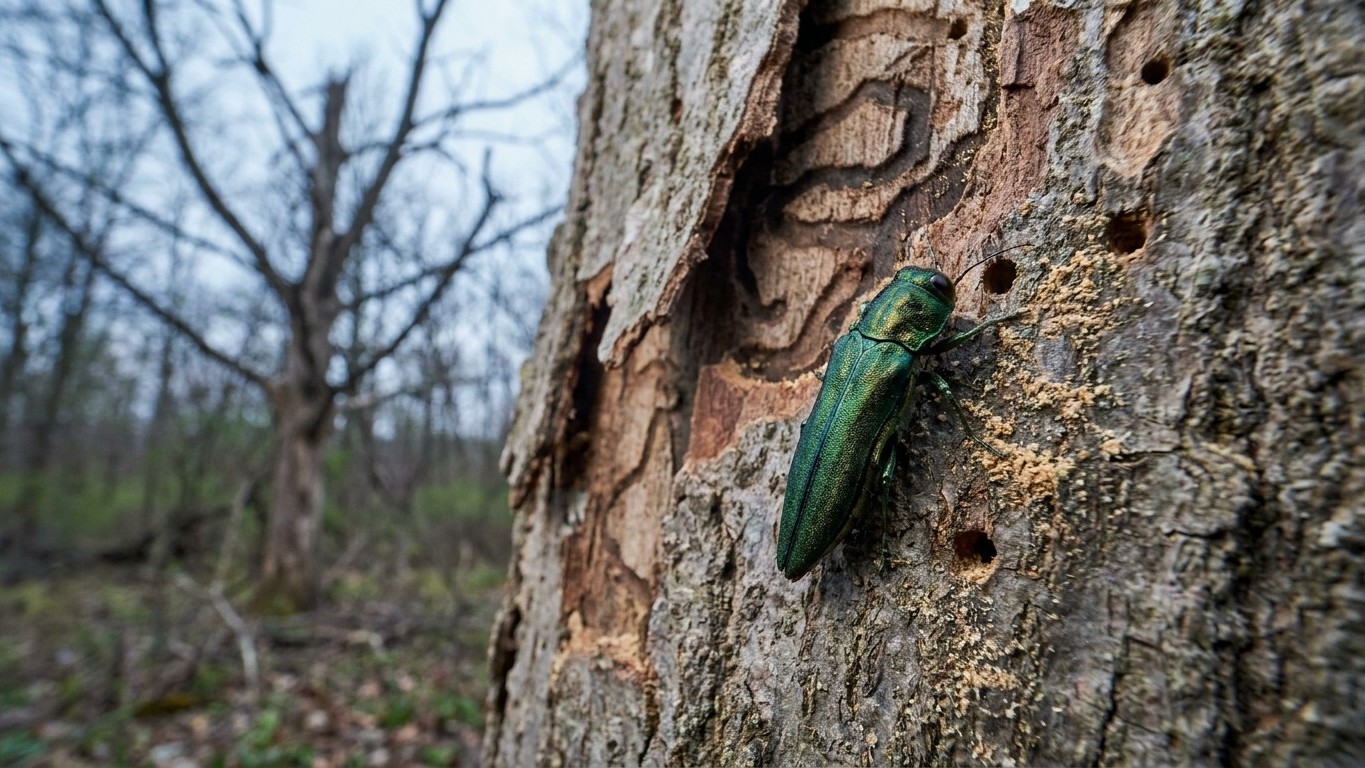
The adults themselves are metallic green, about half an inch long, roughly the size of a grain of cooked rice standing on end. They’re easy to miss because they spend most of their short adult lives (three to six weeks) up in the canopy, feeding lightly on leaves and mating. The real damage happens below the bark, where the larvae tunnel through the tree’s living tissue for most of the year, cutting off the water and nutrient flow between roots and crown.
This timing matters practically. Insecticide soil drenches and trunk injections work best when applied in spring, before adult emergence, so the chemical is already circulating through the tree’s vascular system when larvae start feeding. Homeowners who wait until they spot D-shaped exit holes in July have usually missed the best treatment window for that season.
Signs to Look For, Season by Season
Canopy thinning at the very top of the tree is usually the first visible sign, showing up in late summer or the following spring as the upper third of the crown fails to leaf out fully. Woodpecker activity follows close behind. Birds strip bark away hunting for larvae underneath, leaving patches of lighter, exposed wood that arborists call “blonding,” visible from the ground even in winter when there’s no foliage to hide it.
D-shaped exit holes, about one-eighth of an inch across, appear on the trunk and larger branches where adult beetles chewed their way out. Vertical bark splits sometimes reveal S-shaped larval galleries packed with what looks like sawdust underneath. Epicormic shoots, small clusters of new growth sprouting directly from the trunk or root collar, often appear on stressed trees as a last-ditch survival response. Any ash tree showing two or more of these signs is generally past the point where treatment makes financial sense.
What Actually Slows the Beetle Down
No single tool stops emerald ash borer cold. Control in Ontario relies on layering several approaches, each aimed at a different part of the problem.
Firewood Rules and Movement Restrictions
Moving firewood is still the single fastest way the beetle jumps to a new area, faster than its own natural flight range, which tops out around a few miles per year without human help. Ontario, along with the rest of Canada, restricts moving ash wood, ash nursery stock, and in many cases all hardwood firewood across regulated boundaries. Campers heading to provincial parks are consistently told to buy firewood locally and burn it on site rather than hauling it from home. This single behavior change, buying wood where you burn it, has done more to slow the beetle’s long-distance spread than any spray program.
Biological Control
Since the mid-2000s, Canadian and American researchers have released several species of tiny parasitoid wasps that attack emerald ash borer eggs and larvae without harming other insects. Species like Tetrastichus planipennisi and Oobius agrili lay their own eggs inside beetle eggs or larvae, and over time these wasps have established self-sustaining populations in parts of Ontario and the northern United States. Biocontrol doesn’t save individual trees on a homeowner’s timeline. It’s a slower, landscape-level strategy meant to reduce beetle populations enough that surviving ash trees, and the next generation growing from seed, have a fighting chance over the coming decades.
Insecticide Treatment for Individual Trees
For a specific tree worth protecting, whether it’s shading a driveway or anchoring a backyard, chemical treatment remains the most reliable option. In Canada, TreeAzin, a systemic insecticide derived from neem tree extract, is the product most commonly used by certified arborists, injected directly into the trunk on a two-year cycle. In the United States, products containing imidacloprid or emamectin benzoate serve a similar role, applied as trunk injections, soil drenches, or bark sprays depending on tree size and site conditions.
Treatment only pays off on trees caught early. Arborists generally consider a tree treatable if canopy loss is under 30 percent; past that threshold, the tree has usually lost too much vascular tissue for the insecticide to reach effectively, and removal becomes the safer and cheaper option. According to CFIA (the Canadian Food Inspection Agency), once a regional infestation is well established, individual tree protection through insecticide is realistically about slowing decline and buying years, not achieving permanent immunity, since surrounding beetle pressure never fully disappears.
Deciding Between Treatment and Removal
The math on this decision usually comes down to three questions: how much canopy is already gone, how much the tree is worth to the property (shade, aesthetics, property value), and how close it stands to a house, driveway, or power line. A healthy, structurally sound ash with less than a quarter of its crown showing dieback is usually a good treatment candidate, especially if it’s a specimen tree in a front yard that would be expensive and slow to replace.
Dead or severely declining ash trees turn brittle fast, often within one to two years of death, and they drop large limbs with little warning. That combination makes removal, rather than treatment, the responsible choice once a tree has crossed into serious decline, particularly for anything standing within falling distance of a structure, driveway, or spot where people regularly park or walk. Many Ontario municipalities now factor dead ash removal into their annual urban forestry budgets specifically because of how quickly hazard trees accumulate once an infestation takes hold in a neighborhood.
Homeowners weighing the decision on their own property typically get the most useful answer from a certified arborist who can assess canopy percentage and structural integrity in person, since photos and general guidelines only go so far when a tree’s remaining strength is on the line.
Related guides
- Emerald ash borer in Manitoba: When It Shows Up and What Stops It
- Emerald ash borer in Quebec: When It Shows Up and What Stops It
- Emerald ash borer in Prince Edward Island: When It Shows Up and What Stops It
- Emerald ash borer in Saskatchewan: When It Shows Up and What Stops It
- Emerald ash borer in Maine: When It Shows Up and What Stops It