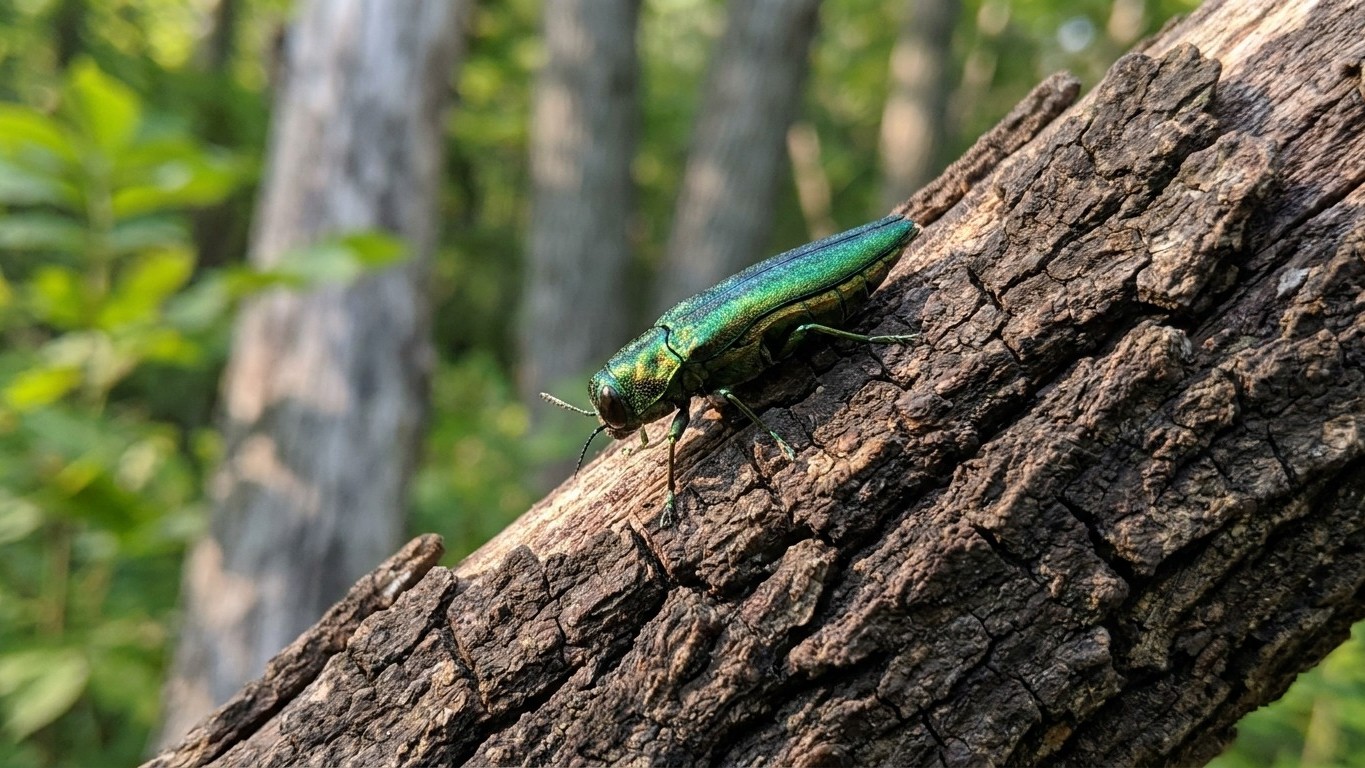

Emerald ash borer has been confirmed in Quebec since 2008, and today it’s established across most of the southern part of the province, from the Ontario border to the Quebec City region. There’s no product that eliminates the beetle once it’s in your area. What actually works is a combination of provincial quarantine rules, targeted insecticide injections for trees worth saving, and prompt removal of dead ash before it becomes a safety hazard.
Where and when EAB showed up in Quebec

The first Canadian detection happened in Windsor, Ontario, back in 2002, likely arriving in wood packing material from Asia. Quebec’s first confirmed case came six years later, in 2008, in Carignan, a small municipality in the Montérégie region southeast of Montreal. That location matters: Montérégie sits close to the Ontario border and along major trade corridors, which is exactly how the beetle tends to move, hitching a ride in firewood, pallets, and nursery stock rather than flying long distances on its own.
From that Montérégie foothold, the insect spread steadily north and east. Montreal, Laval, and Longueuil all reported infestations within a few years. By the early 2020s, the Canadian Food Inspection Agency (CFIA) had extended regulated zones to cover Estrie, the Outaouais, Centre-du-Québec, and parts of Mauricie. Quebec City’s urban forest saw its first confirmed cases around 2022, a jump of roughly 150 miles from the original Montérégie site in under fifteen years.
An adult emerald ash borer only flies about a half-mile in its lifetime under normal conditions. The rapid provincial spread has almost nothing to do with the bug’s own wings and everything to do with people moving firewood and unprocessed ash lumber across regions. That’s the single biggest reason quarantine rules exist and why they focus on wood movement rather than the insect itself.
How to tell if an ash tree in your yard is infested
Ash trees (genus Fraxinus) have compound leaves with five to nine leaflets, branches and buds arranged directly opposite each other, and diamond-patterned bark on mature trunks. If you’re not sure what you’re looking at, that opposite-branching pattern is the fastest tell, since most other common shade trees in Quebec have alternating branches.
Once a tree is infested, the clock is already running. Adult beetles emerge from late May through July and are metallic green, about the size of a grain of rice. They chew D-shaped exit holes in the bark, roughly 1/8 inch across, though these are easy to miss unless you’re looking closely at the trunk or larger branches. More visible signs tend to show up later:
- Thinning or dying canopy starting at the top of the tree, often noticeable by the second or third year of infestation
- Vertical bark splits exposing S-shaped tunnels (larval galleries) underneath
- Clusters of new shoots sprouting from the trunk or roots (epicormic growth), the tree’s stress response
- Increased woodpecker activity, since birds strip bark to reach larvae, leaving patches of lighter, exposed wood known as “blonding”
Once more than half the canopy is gone, an ash tree typically dies within one to two more growing seasons. Municipal foresters in Montreal and Quebec City generally agree that trees with over 30 percent canopy loss are poor candidates for treatment, mostly because the beetle population inside has already grown too large to control with insecticide alone.
What actually stops the spread in Quebec
Three tools work together here, and none of them works alone: movement restrictions, chemical or biological treatment for individual trees, and coordinated removal of dead wood before it becomes fuel for the next generation of beetles.
Quarantine and firewood rules
The CFIA maintains a Ministerial Order that regulates the movement of ash material, including logs, branches, wood chips, and firewood of any species, out of infested zones. Because most of southern Quebec now falls inside a regulated area, the practical rule for homeowners is simple: don’t transport firewood across regions, even short distances, and definitely not to cottages, campgrounds, or rural properties outside the current quarantine boundary. Details on current regulated areas and the order itself are available through the CFIA’s official page on the pest, inspection.canada.ca.
This rule exists because larvae can survive inside cut firewood for months, and a single infested log hauled to an uninfested municipality can start a brand-new outbreak. Campground bonfires are a classic transmission point, which is why several Quebec regions now post signage reminding visitors to buy firewood locally rather than bring their own.
Insecticide injection for high-value trees
For ash trees homeowners or municipalities want to keep, usually because of size, shade value, or heritage status, licensed arborists inject a biological insecticide called TreeAzin directly into the trunk. It’s derived from neem tree extract and disrupts larval feeding and development. Treatment needs to be repeated roughly every two years and has to start before the tree has lost significant canopy, ideally before any visible dieback at all. Cost runs into the hundreds of dollars per tree depending on trunk diameter, which is why this option tends to make sense for prominent yard trees rather than for ash growing in dense woodlots.
Soil-applied systemic insecticides common in the United States, such as imidacloprid drenches, aren’t the standard approach in Quebec’s urban forestry programs, which lean on the trunk-injected biological product instead. If a contractor offers something different, it’s worth asking whether the product is approved for use in Quebec and whether the arborist holds the required pesticide applicator certification.
Biological control
The CFIA and provincial partners have released three species of tiny parasitoid wasps at select sites in Ontario and Quebec: Tetrastichus planipennisi, Oobius agrili, and Spathius galinae. These wasps attack emerald ash borer eggs and larvae and don’t sting or bother people. They’re not a fast fix, results take years to show up at a population level, and they’re deployed at research and monitoring sites rather than distributed for private property use. Their long-term role is slowing the beetle’s population growth across a landscape, not saving any individual tree.
Should you treat or remove an infested ash tree
The decision usually comes down to three questions: how much canopy is already gone, how much the tree is worth to you (shade, property value, sentimental reasons), and how close it stands to a house, driveway, or power line.
A tree with light canopy thinning and no bark splitting is a reasonable treatment candidate. A tree that’s already lost a third or more of its crown, has visible S-shaped galleries, or shows heavy woodpecker damage is better off scheduled for removal, since dead ash wood becomes brittle fast and drops large limbs without much warning. Several municipalities in the Montreal area report that dead ash near sidewalks or streets have caused property damage within a year or two of losing their leaves, which is faster than most homeowners expect from a standing dead tree.
If removal is the call, get quotes from arborists who specifically mention EAB experience, since safely dropping a structurally weakened ash requires different rigging than a healthy tree removal. And check with your municipality first: many Quebec cities, including Montreal and Quebec City, run subsidized removal or replanting programs for ash lost to the beetle, sometimes covering part of the cost if you plant a replacement species from an approved list.
What to do next if you suspect EAB on your property
Report suspected sightings to your municipal urban forestry department or through the CFIA’s reporting channels rather than guessing on your own. Early confirmation matters because treatment windows close fast, and a tree that’s still a good injection candidate in April might not be by September. If you’re planning any outdoor wood-related project this fall, whether that’s stacking firewood for a camp trip or clearing a dead tree, checking the current regulated zone boundaries first will save you a fine and, more importantly, keep you from being the reason a new pocket of infestation shows up somewhere it hasn’t reached yet.
Related guides
- Emerald ash borer in Ontario: When It Shows Up and What Stops It
- Emerald ash borer in New Brunswick: When It Shows Up and What Stops It
- Emerald ash borer in Saskatchewan: When It Shows Up and What Stops It
- Emerald ash borer in Maine: When It Shows Up and What Stops It
- Lily leaf beetle in Quebec
- Leek moth in Quebec
- Striped cucumber beetle in Quebec
- Emerald ash borer in Nova Scotia: When It Shows Up and What Stops It