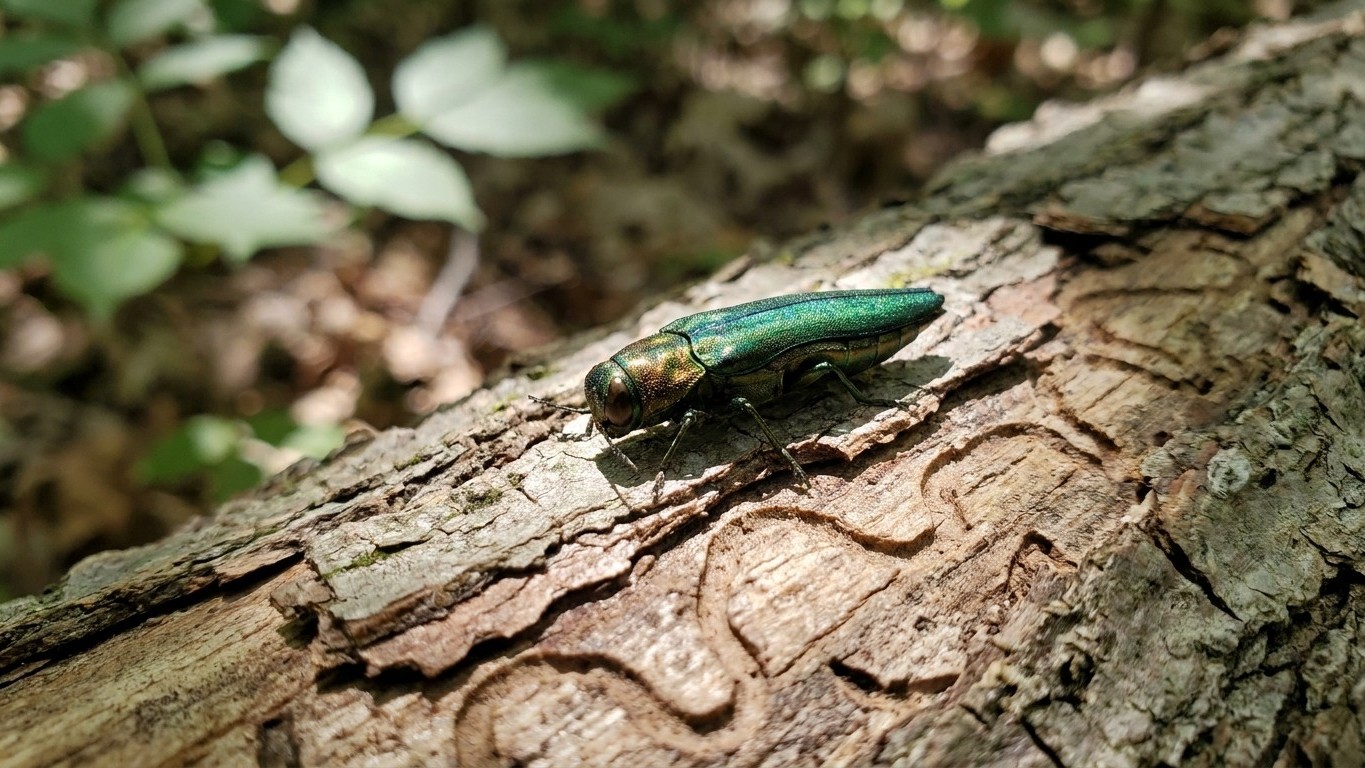

Emerald ash borer showed up in Maine in 2018, and it hasn’t left. The invasive beetle is now confirmed in scattered pockets from Aroostook County down to York County, and state officials track its spread every summer through a mix of purple sticky traps, girdled “trap trees,” and reports from loggers and homeowners. Nothing stops the beetle outright once it’s established in a stand of ash, but a combination of quarantine rules, biological control agents, and targeted insecticide treatment can slow it down enough to save individual trees and buy time for forests to adapt.
Where and When Emerald Ash Borer Arrived in Maine

The first confirmed detections in Maine came in the spring of 2018, and they popped up in two places at once, on opposite ends of the state. One infestation was found near Madawaska, in Aroostook County, close to the New Brunswick border. The other turned up roughly 300 miles south, in York County near the town of Acton, close to the New Hampshire line. That dual arrival matters because it points to two separate introductions rather than a single wave creeping in from a neighboring state.
Firewood is the usual suspect. Adult beetles don’t fly far on their own, typically a half-mile or so a year under natural conditions, but larvae hiding under the bark of cut logs can ride hundreds of miles in a truck bed before anyone notices. Maine’s northern detection likely tracked with EAB’s known spread through New Brunswick and Quebec, while the southern one lines up with infestations already established in New Hampshire and Massachusetts.
Since 2018, additional infestations have been confirmed in other counties as state surveyors expand their trapping network. The Maine Forest Service, part of the Department of Agriculture, Conservation and Forestry, updates its infestation map each year, and that map is the most reliable source for anyone trying to figure out whether their own town falls inside a known-affected zone. New detections tend to cluster near infested areas but also occasionally jump ahead of the visible front, usually tied to firewood or nursery stock movement.
How to Recognize an Infestation
Emerald ash borer larvae do the actual killing, not the adults. The larvae tunnel just beneath the bark, carving S-shaped galleries as they feed on the layer of tissue that moves water and nutrients through the tree. Cut off enough of that layer and the canopy starts dying from the top down, usually within two to four years of the first infestation, sometimes faster on stressed trees.
A few visible clues tend to show up in this order:
- Thinning or dying branches at the very top of the tree, while lower limbs still look healthy
- Small D-shaped exit holes in the bark, about the width of a pencil eraser, left when adult beetles emerge
- Vertical bark splits that expose the winding larval galleries underneath
- Clusters of new shoots sprouting from the trunk or roots (called epicormic growth), a stress response as the tree tries to compensate
- Patches of bark stripped away by woodpeckers hunting for larvae, sometimes called “blonding” because it exposes lighter wood underneath
The adult beetle itself is easy to overlook. It’s metallic green, about half an inch long, roughly the size of a grain of rice, and it’s only active from late May through August in Maine’s climate. Most people never spot the insect itself and instead notice the damage months or years after the infestation started, which is part of why early detection through official trapping programs matters more than backyard vigilance alone.
Trees at Risk
Emerald ash borer attacks every native ash species, but it doesn’t touch mountain ash, which despite the name isn’t a true ash at all (it belongs to the rose family). In Maine, the species on the line include white ash, green ash, and brown ash, also called black ash. White ash is the one most familiar to homeowners, planted as a shade tree and used in furniture and tool handles. Brown ash grows in wetter, low-lying sites, often along stream banks and in swampy hardwood stands.
Why Maine’s Ash Trees Carry Extra Weight
Ash makes up a small slice of Maine’s overall forest, generally estimated at under 5 percent of trees statewide. That sounds like it should limit the damage. But raw percentages miss the cultural stakes tied to one particular species.
Brown ash holds a role in Wabanaki basket-making that goes back generations among the Passamaquoddy, Penobscot, Maliseet, and Mi’kmaq communities. Basket makers pound freshly cut brown ash logs to separate the wood into thin, flexible splints along its natural growth rings, a technique that doesn’t work with substitute woods. Losing brown ash stands to the beetle would mean losing access to a material with no practical replacement, not just an economic hit to loggers and sawmills.
That’s one reason tribal natural resource departments in Maine have been active partners in EAB monitoring and seed-banking efforts, collecting brown ash seed for long-term storage in case wild populations collapse the way American elm and American chestnut did after their own invasive pests and pathogens arrived decades earlier. The comparison isn’t exaggerated. In parts of the Midwest where EAB has been established the longest, ash mortality in unprotected stands has approached total loss.
What’s Stopping the Spread, and What Actually Works
Nothing available today eliminates emerald ash borer from a landscape once it’s dug in. The tools in play are about containment and buying time, not eradication, and they work at three different scales: state regulation, biological control, and individual tree treatment.
Quarantine and Movement Restrictions
Maine maintains a quarantine restricting the movement of ash wood, ash nursery stock, and hardwood firewood out of infested counties. The boundaries shift as new infestations are confirmed, so the current map (available through the Maine Forest Service) is the only reliable reference, not last year’s version. The rule of thumb campgrounds and state parks push hardest, “buy it where you burn it,” exists specifically because firewood transport is the number one way this beetle jumps to new regions faster than it could ever fly on its own.
Biological Control
USDA APHIS has released several species of tiny parasitoid wasps in EAB-infested regions across the country, including Tetrastichus planipennisi, Oobius agrili, and Spathius galinae. These wasps don’t sting people or bother anything else in the yard; they specifically hunt EAB eggs and larvae, laying their own eggs inside the pest to kill it before it matures. In longer-established infestations in the Midwest, these wasps have measurably reduced EAB larval survival over time, though they work slowly and won’t save trees already in steep decline. Maine’s release sites, where used, tend to be concentrated in and around the earliest confirmed infestation zones.
Chemical Treatment for Individual Trees
For high-value trees, like a mature ash shading a house or anchoring a yard, licensed arborists can apply systemic insecticides, most commonly emamectin benzoate, through trunk injection. Treated correctly and repeated roughly every two to three years, this method has a strong track record of protecting individual trees even in heavily infested areas. It’s not something homeowners do themselves with a store-bought soil drench and expect the same results; trunk injection by a certified applicator is the version with real research behind it. It’s also not practical or affordable at forest scale, which is why it’s reserved for landscape trees rather than woodlots.
What Homeowners Can Do
If there’s ash on the property, the most useful first step is figuring out whether it’s actually ash. Ash has compound leaves with 5 to 9 leaflets arranged opposite each other on the twig, and diamond-patterned bark on mature trees. Once that’s confirmed, checking the current Maine Forest Service infestation map tells you whether you’re inside, near, or well outside a known-affected zone, which shapes whether preventive treatment makes sense or whether monitoring is enough for now.
Reporting suspected signs matters more than most people assume. Maine’s early detection network depends heavily on tips from landowners and loggers who notice something odd about a dying ash tree before state surveyors get to that particular patch of woods. And skipping the firewood shortcut, resisting the urge to bring logs from home to a camping trip two counties over, remains the single easiest thing anyone can do to keep the beetle’s spread on foot rather than on wheels.
Related guides
- Emerald ash borer in Manitoba: When It Shows Up and What Stops It
- Emerald ash borer in Michigan: When It Shows Up and What Stops It
- Squash vine borer in Maine
- Cabbage maggot in Maine
- Spotted wing drosophila in Maine
- Emerald ash borer in Ontario: When It Shows Up and What Stops It
- Emerald ash borer in North Dakota: When It Shows Up and What Stops It