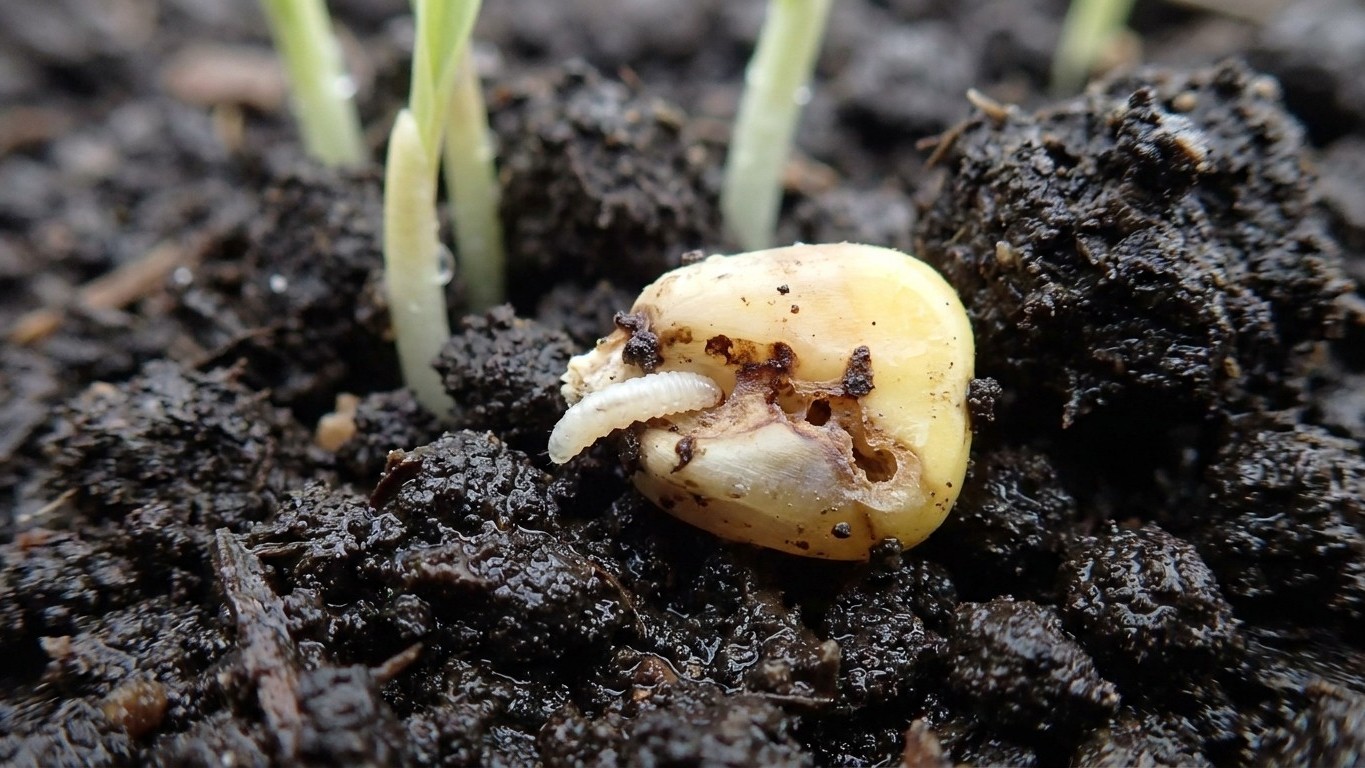

Seedcorn maggot shows up in Michigan fields during cold, wet spring stretches, usually from late April through mid-May, and again in a smaller second wave in June. The larvae tunnel into germinating corn and soybean seeds before they emerge, and once the damage is done, no spray fixes it. The real defense happens before planting: seed treatments, tillage timing, and avoiding fresh manure or cover crop residue right before the seed goes in the ground.
When Seedcorn Maggot Activity Peaks in Michigan

Michigan State University Extension tracks this pest with a degree-day model rather than a calendar date, because a warm March can push activity two weeks earlier than a cold one. The model starts accumulating heat units on January 1 using a base temperature of 39°F. Adult fly emergence and egg-laying typically ramp up between 200 and 400 degree days, then peak again near 1,000 degree days for a second generation later in the season.
In practical terms, that first window lands during Michigan’s classic wet April, right when growers in the Thumb and southwest counties are itching to get corn and soybeans in the ground. The insect isn’t picky about weather the way some pests are. It actually thrives in it. Cool soil slows seed germination, which stretches out the window when a seed sits vulnerable underground, sometimes for two or three weeks instead of five or six days.
The second generation in June causes less economic damage in field corn and soybeans because plants are usually past the seedling stage by then, but it still matters for late-planted fields, replants, and vegetable growers running successive plantings of beans or sweet corn.
What Draws Seedcorn Maggot Into a Field
Adult flies, which look like small, dull gray houseflies, are drawn to decaying organic matter to lay their eggs. That’s the piece a lot of growers underestimate. Fields with recent manure applications, terminated cover crops, or plowed-down green vegetation send out a chemical signal that reads like a dinner bell to these flies.
A field disked two weeks before planting carries far more risk than one worked a month or more earlier, simply because the decomposition process is still active and attractive when the seed goes in. Manure spread and incorporated right before planting is one of the highest-risk combinations Michigan agronomists flag every spring, especially on the heavier clay soils common in the Saginaw Bay region where drainage is already slow.
Soil type plays its own role too. Heavy, poorly drained soils that stay cold and wet longer into spring extend the germination window and give larvae more time to find a seed before it sprouts past the vulnerable stage. Sandy fields that warm and drain faster generally see less pressure, all else being equal.
Which Crops Take the Hit
Corn and soybeans get the most attention because of acreage, but seedcorn maggot isn’t picky about species. Snap beans, peas, and various cole crops like cabbage and broccoli transplants are also on the menu, which matters for the diversified vegetable operations scattered across western Michigan’s fruit belt and the Detroit-area market garden fields. Direct-seeded crops with slow germination, like beans planted into cool soil, carry more risk than fast-germinating ones.
Prevention: The Only Real Control That Works
There’s no rescue treatment for seedcorn maggot once maggots are already inside a seed or seedling. Insecticide sprays don’t reach larvae feeding underground, and by the time stand loss shows up as gaps in the row, the window to act has already closed. Every effective strategy happens before or at planting.
Insecticidal seed treatments remain the standard tool for field corn and soybeans across Michigan. Most commercial seed already arrives treated, but growers buying untreated seed or saving their own for replant situations need to specifically request protection against seedcorn maggot, since not every base treatment package includes it at a rate strong enough for high-pressure fields.
Timing tillage and manure applications matters just as much as any seed treatment. Michigan State University Extension recommends incorporating manure or terminating a cover crop at least three to four weeks before planting whenever possible, giving organic matter time to break down before it becomes an egg-laying magnet. Waiting for that window is inconvenient when spring weather compresses the planting calendar, but rushing the sequence is exactly what invites higher larval counts.
Delaying planting until soil temperatures climb past roughly 50°F at the two-inch depth also cuts risk, since seeds germinate faster and spend less time exposed underground. That’s a tough call for growers watching a shrinking planting window, but a few days’ wait for warmer soil often costs less than a spotty stand and a replant bill.
For vegetable growers, transplanting instead of direct seeding sidesteps a lot of the exposure window entirely, since transplants arrive past the most vulnerable stage. When direct seeding is the only option, shallow planting into warm, well-drained soil speeds emergence and shortens the larvae’s opportunity.
Spotting Damage and Confirming the Cause
Damage shows up as poor or uneven stand establishment: skips in the row, seedlings that emerge and then collapse, or seeds that never come up at all when dug and inspected. Digging up a few unsown areas next to healthy plants is the fastest diagnostic step. A hollowed-out kernel or a wilted, discolored seedling with a small yellowish-white maggot (typically a quarter-inch or less) tunneling through the stem or seed points squarely to this pest rather than a disease or cold-injury issue.
Cutting open a soybean seed that failed to emerge and finding it hollowed rather than rotted is a reliable tell. Rot from cold, wet soil alone usually leaves a soft, discolored seed without the clean tunneling pattern larvae leave behind. Growers unsure of the cause can send samples to their county MSU Extension office, which routinely fields these calls every spring during cool, wet stretches.
Michigan’s Department of Agriculture and Rural Development, along with MSU Extension field crop entomologists, publish seasonal pest alerts that flag elevated seedcorn maggot risk when degree-day accumulation and rainfall data point toward a high-pressure spring. Checking those updates before finalizing planting dates on marginal fields, especially those with recent manure history, gives growers a data point beyond just watching the calendar.
Weighing Replant Decisions
When stand loss from seedcorn maggot is severe enough to consider replanting, the same risk factors apply the second time around. A field that got hit once because of cool soil and recent organic matter incorporation doesn’t automatically clear itself of larvae in two weeks. Growers replanting into the same conditions without a stronger seed treatment or without waiting for warmer soil often see a repeat, smaller-scale problem rather than a clean second attempt.
Stand counts matter more than gut feel here. Michigan agronomists generally advise assessing whether remaining plant population can still reach economic yield targets before tearing up a stand, since replanting always carries its own yield-drag cost from a shortened season, particularly for corn planted after late May in Michigan’s shorter-season northern counties.
Seedcorn maggot pressure tends to run in cycles tied to spring weather rather than building steadily field to field over years, which means a bad year doesn’t necessarily predict a bad year in the same field going forward. Fields with a history of manure application or reduced tillage stay on the higher-risk list regardless, and that’s the pattern worth tracking on a farm-by-farm basis over multiple seasons rather than any single spring’s degree-day count alone.
Related guides
- Seedcorn maggot in Indiana: When It Shows Up and What Stops It
- Seedcorn maggot in New Brunswick: When It Shows Up and What Stops It
- Seedcorn maggot in Newfoundland and Labrador: When It Shows Up and What Stops It
- Seedcorn maggot in Maine: When It Shows Up and What Stops It
- Seedcorn maggot in Ontario: When It Shows Up and What Stops It