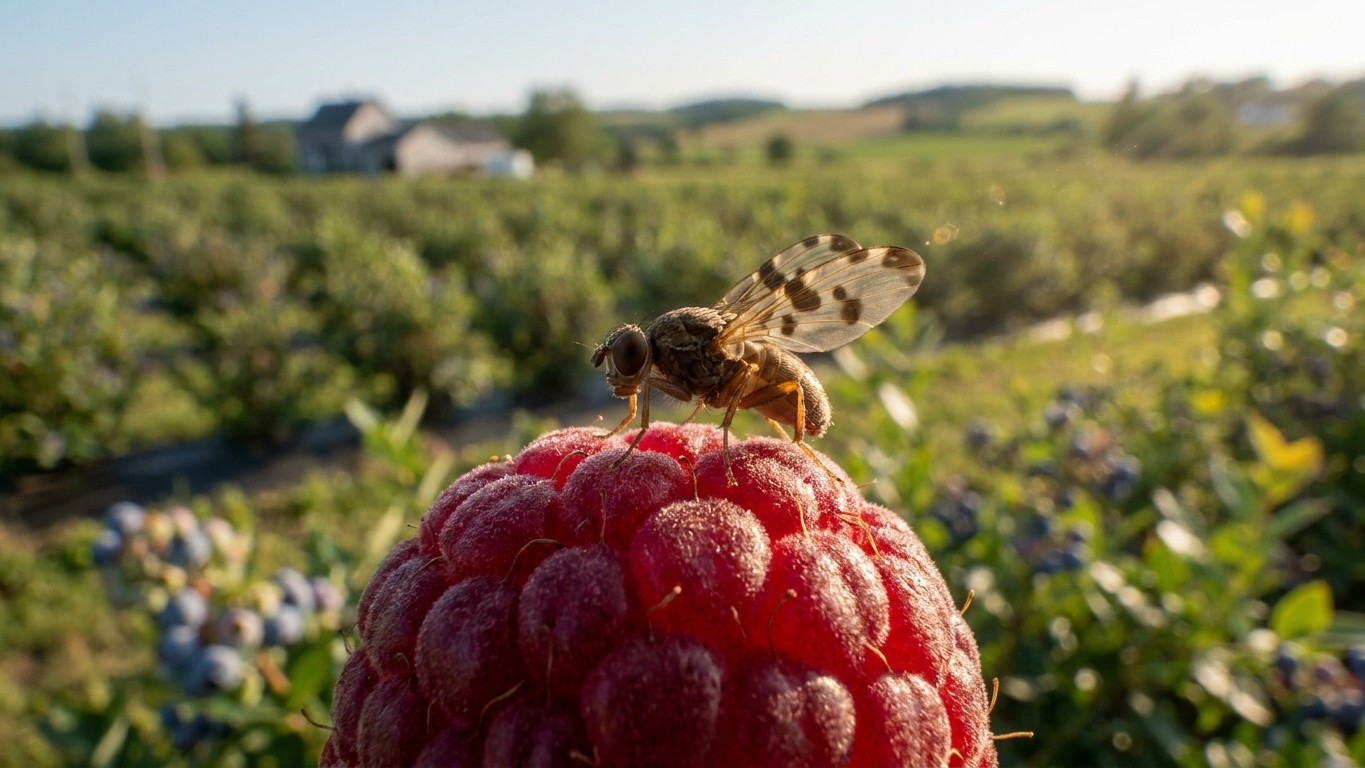

Spotted wing drosophila becomes active on Prince Edward Island as soon as daytime temperatures hold above roughly 50°F for several days running, typically in late May or early June, and it stays a threat straight through the fall raspberry and late blueberry harvests until the first hard frost. What stops it isn’t one product or one trap. It’s a combination of fast, frequent harvest, ruthless sanitation, targeted insecticide timing, and in some orchards, exclusion netting that physically keeps the flies off the fruit.
When Spotted Wing Drosophila Arrives Each Season on PEI

Unlike a lot of insect pests that die off completely and reinvade from warmer regions each spring, spotted wing drosophila (Drosophila suzukii) survives the Island’s winter right where it is. Adults tuck into leaf litter, brush piles, and wooded field margins, then emerge once conditions warm up. That means growers aren’t waiting on a migration front from the south. They’re watching a local population wake up.
Monitoring traps, usually a cup baited with apple cider vinegar and a drop of dish soap to break the surface tension, go up in fields and hedgerows starting in early June. The first male catch, identifiable by the small dark spot near the tip of each wing, is the signal that adults are moving and mating. From there, egg-laying risk climbs fast once fruit starts to change color, well before it’s fully ripe.
Populations build steadily through the summer and hit their peak in late July through September, right when strawberries wind down and raspberries, blueberries, and haskap are at their most vulnerable. In a cool, humid climate like PEI’s, growers typically see three to five generations per season. That’s fewer than the ten-plus generations reported in warmer growing regions, but still enough for numbers to snowball if nobody’s watching the traps.
Why This Fly Is Different From the One in Your Fruit Bowl
Most people know common fruit flies as the tiny insects that show up around overripe bananas on the counter. Spotted wing drosophila plays by different rules. Females carry a large, saw-toothed ovipositor that lets them cut into fruit skin while it’s still firm and coloring on the plant, not after it’s soft and rotting. That single anatomical difference is what turns a nuisance insect into a crop-threatening pest.
A single female can lay several hundred eggs over her lifetime, and under favorable conditions the whole life cycle from egg to adult can wrap up in about a week and a half. Larvae feed inside the fruit, invisible from the outside until the berry starts to collapse or weep juice. For a commercial grower, that means fruit can look market-ready one day and be infested and unsellable within days.
How to Spot an Adult
Males are the easier catch to identify: a single dark spot near the tip of each wing, visible with a hand lens or even good eyesight in bright light. Females lack the spot, which is why traps and field scouting lean on catching males as the early warning signal, then confirming egg-laying pressure by sampling fruit directly.
The Crops Most at Risk on the Island
PEI’s berry sector isn’t small. Wild, lowbush blueberries cover thousands of acres across the province and represent one of the Island’s signature crops, alongside a growing mix of strawberries, raspberries, haskap, and some grape and elderberry plantings. Spotted wing drosophila doesn’t rank these crops equally.
- Raspberries and blackberries, with their soft skin and clustered drupelets, are highly attractive and easy for females to penetrate.
- Day-neutral strawberries grown in high tunnels extend the fruiting window, which also extends the exposure window for egg-laying.
- Lowbush blueberries, especially later-ripening fields, coincide with peak fly populations in August and September.
- Haskap, harvested earlier in the season, generally faces lower pressure but isn’t immune once populations establish.
Home gardeners growing raspberries or blueberries in backyard plots deal with the same pest, just on a smaller scale, and the same warning signs apply: soft spots, premature juice leakage, and tiny white larvae visible when a berry is cut open or crushed.
What Actually Stops It
No single tactic handles spotted wing drosophila on its own in a Maritime climate. Growers and extension specialists in the region, including staff at Perennia and Agriculture and Agri-Food Canada research stations, generally recommend layering several approaches at once.
Harvest Frequency and Sanitation
Picking fields every two to three days instead of once a week cuts down the window fruit spends at its most attractive stage. Overripe, damaged, or dropped fruit left on the ground or on the plant acts as a breeding reservoir, so removing and destroying it, rather than composting it in place, matters more than most growers expect. A field that looks clean from the road can still be hosting hundreds of larvae in the fruit nobody bothered to pick up.
Trapping and Threshold-Based Spraying
Rather than spraying on a calendar, most current guidance ties insecticide applications to trap catches and fruit sampling. Once male catches climb and larvae show up in a fruit sample, growers rotate insecticide classes to slow resistance and respect pre-harvest intervals so treated fruit is safe to sell on schedule. Spraying blind, without monitoring data, tends to waste product and speed up resistance without actually protecting the crop.
Physical Exclusion and Cold Handling
Fine-mesh exclusion netting, tight enough to block adult flies from reaching ripening fruit, has shown promise in high-value plantings like raspberries and some tunnel-grown strawberries, though the labor and material cost limit it mostly to smaller, intensively managed blocks. After harvest, cooling fruit quickly, ideally down near freezing within a few hours of picking, slows larval development inside any fruit that got infested before it was caught, buying time before spoilage becomes obvious.
Biological Control on the Horizon
Researchers in North America have been studying and releasing parasitoid wasps, including species in the genus Ganaspis, that attack spotted wing drosophila larvae in its native range. This classical biological control approach is still in early field evaluation and hasn’t become a standard tool for PEI growers yet, but it represents the kind of longer-term option that could reduce reliance on repeated insecticide rotations down the road.
For Home Gardeners: A Simple Check Before You Eat the Berries
Anyone growing raspberries or blueberries in a backyard bed can run a quick check without any special equipment. Drop a handful of ripe berries into a cup of salt water, about a tablespoon of salt per cup, and let them sit for fifteen minutes. Small white larvae, if present, will float out of the fruit and become visible against the water. It’s not a pleasant discovery, but it’s a fast way to confirm whether a patch has been hit before deciding whether the crop is worth harvesting fresh or better suited to jam, where cooking neutralizes the issue entirely.
Fallen or overripe fruit under home plantings should go in the trash or get buried deep, not tossed on a compost pile a few feet from the same bushes, since that pile can function as a breeding site right through the rest of the season.
One detail that surprises a lot of first-time berry growers on the Island: spotted wing drosophila can still find fruit inside a greenhouse or high tunnel, since the mesh vents and door gaps used for ventilation are usually far too large to block a fly roughly the size of a grain of rice. Tunnel growers who assume the structure offers automatic protection often get caught off guard the first season they deal with an infestation.
Related guides
- Spotted wing drosophila in New Brunswick: When It Shows Up and What Stops It
- Spotted wing drosophila in Nova Scotia: When It Shows Up and What Stops It
- Spotted wing drosophila in Quebec: When It Shows Up and What Stops It
- Spotted wing drosophila in Vermont: When It Shows Up and What Stops It