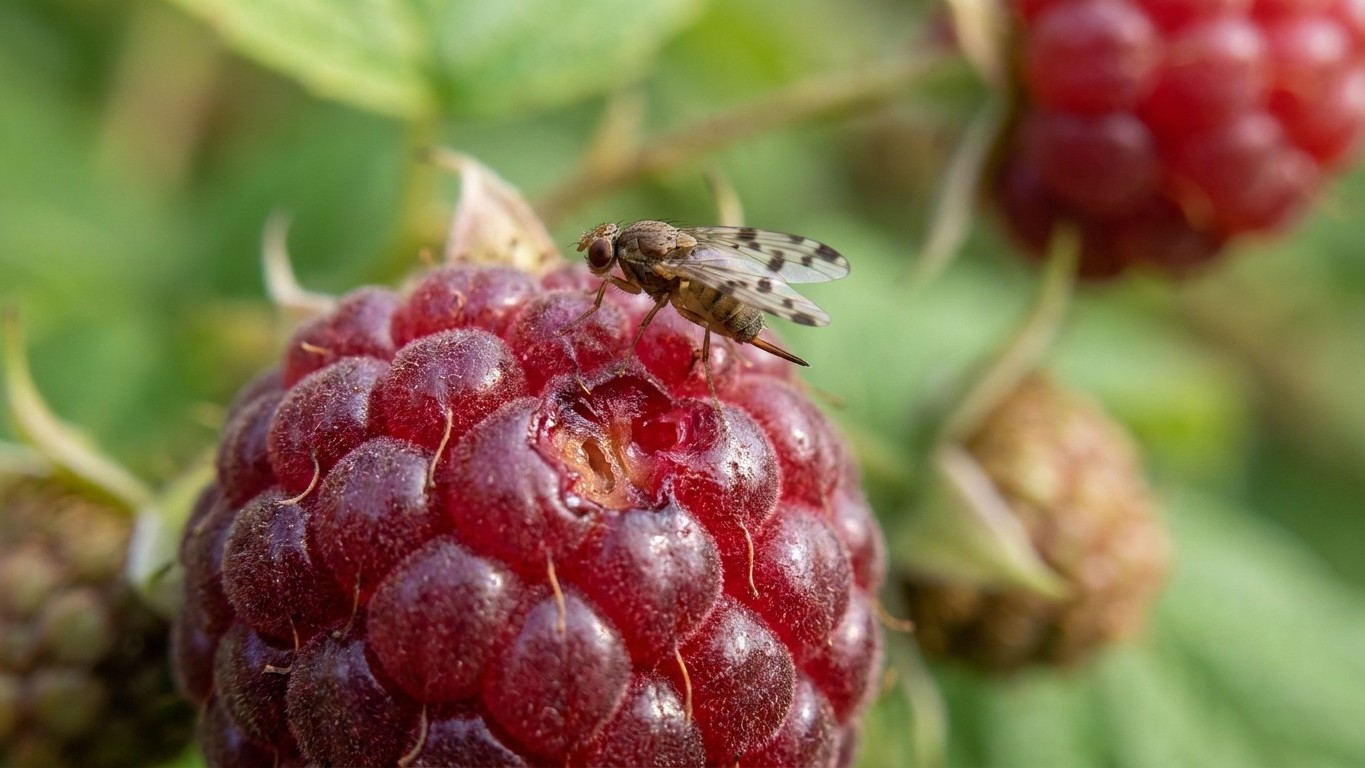

Spotted wing drosophila starts cutting into ripening fruit in Quebec as early as mid-June, with populations exploding through July and August. The fly (Drosophila suzukii) doesn’t wait for fruit to rot like the common fruit fly does. It attacks berries and cherries while they’re still firm and marketable, which is why growers and backyard gardeners across the province, and in the northern U.S. states that share its climate, treat this insect as a season-long threat rather than a late-summer nuisance.
Stopping it comes down to four things working together: early detection through traps, strict sanitation to remove breeding sites, well-timed protective measures (netting or targeted insecticide), and fast post-harvest cooling. Skip any one of those and the fly finds a way back in.
What Makes This Fly Different

Most fruit flies show up after fruit has already split or fallen, feeding on decay. Spotted wing drosophila skips that step entirely. Females carry a serrated, saw-like ovipositor that slices into intact, ripening skin, laying eggs inside fruit that looks perfectly fine on the outside. Within days, larvae hatch and start feeding from the inside out. By the time a homeowner notices soft spots or a slight collapse in a raspberry, the damage is already done.
Adult males are the easier of the two sexes to identify, thanks to a single dark spot near the tip of each wing, the trait that gives the species its common name. Females lack the spots but are recognizable by that serrated egg-laying organ under magnification. Both sexes measure around 1/8 inch, roughly the size of a standard fruit fly, which means visual ID in the garden is unreliable without a hand lens.
Which Fruits Are at Risk
The fly favors thin-skinned, soft fruit. In Quebec gardens and commercial plots, the highest-risk crops include:
- Raspberries and blackberries (the most vulnerable of all)
- Blueberries, both highbush and lowbush
- Sweet and tart cherries
- Strawberries, especially day-neutral varieties fruiting into fall
- Grapes, particularly thin-skinned table varieties
Wild hosts matter too. Untended chokecherry, wild grape, and pin cherry growing along fence lines or forest edges act as reservoirs, letting populations build up before cultivated fruit even starts ripening.
When It Shows Up: Quebec’s Seasonal Timeline
Overwintering adults survive Quebec’s cold in sheltered spots such as leaf litter, hedgerows, and wood piles, tolerating conditions that kill off many other insect pests. Provincial monitoring networks typically catch the first spring adults in traps around late May to mid-June, once daytime temperatures hold reliably above 59°F.
Population growth then tracks temperature closely. Each generation can complete its life cycle in roughly one to two weeks under warm, humid conditions, meaning a single mating pair in June can produce many overlapping generations by September. That compounding growth is why trap counts that look manageable in early July often spike dramatically by mid-August, right when raspberries, blueberries, and early apples are at their most vulnerable.
Peak pressure in most of southern Quebec runs from late July through September, tapering off only after several nights near or below freezing. In milder microclimates, such as sheltered valleys or urban gardens with more heat retention, activity can stretch into early October.
Why Monitoring Networks Matter
Quebec’s agricultural monitoring system tracks spotted wing drosophila activity across regions and publishes weekly trap counts during the growing season, giving growers a heads-up before damage becomes visible. Home gardeners without access to that network can still replicate the same idea on a small scale: a simple trap made from a container with small entry holes, baited with a mix of apple cider vinegar and a drop of dish soap, catches adults and gives an early warning sign when checked twice a week.
What Actually Stops Spotted Wing Drosophila
No single method eliminates this pest. Effective control relies on stacking several tactics, starting well before fruit ripens rather than reacting once damage appears.
Sanitation First
Removing overripe, damaged, or fallen fruit is the single most effective non-chemical step available to home growers. Every piece of fruit left on the ground or hanging past its prime is a potential breeding site capable of producing dozens of new adults within two weeks. Fruit should be picked clean at each harvest, not left “for later,” and drops should be collected and either sealed in a bag left in direct sun for several days (which kills larvae through heat) or buried at least a foot deep. Composting infested fruit in an open pile does nothing to stop the cycle, since larvae often survive and adults simply fly back out.
Physical Exclusion
Fine mesh netting with openings smaller than 0.98 millimeters, sometimes labeled “insect exclusion netting,” placed over susceptible plants before fruit starts to color, blocks adult flies from reaching the crop entirely. This works particularly well for raspberry canes, blueberry bushes, and dwarf cherry trees where full coverage is practical. The tradeoff is labor: netting has to go up early and stay secured, since a single gap large enough for a fly to slip through defeats the purpose.
Harvest Frequency and Cold Handling
Picking every one to two days during peak season, rather than every four or five, dramatically cuts the window fruit spends exposed and ripe on the plant. Once picked, cooling fruit to below 39°F within a few hours slows larval development and, held long enough, kills eggs and young larvae outright. This is one reason commercial operations move fruit into refrigeration almost immediately after picking, and it’s a habit worth copying at home: don’t let a bowl of freshly picked raspberries sit on the counter overnight during high-pressure weeks in August.
Targeted Insecticide Use
When infestation pressure is high and other methods aren’t enough, insecticides labeled for spotted wing drosophila on food crops can reduce populations, but timing is everything. Because the fly targets fruit right as it ripens, sprays applied too early miss the window, while applications too close to harvest raise residue concerns. Anyone using a product on edible crops should follow the label’s pre-harvest interval exactly and rotate active ingredients to slow resistance buildup, a problem already documented in some commercial berry operations. Home gardeners are generally better served leaning on netting and sanitation first, reserving chemical options for years when trap counts spike early and fruit set is heavy.
Why This Matters Beyond Quebec’s Borders
Spotted wing drosophila isn’t confined by the U.S.-Canada border, and its behavior in Quebec’s climate zone mirrors what growers see across Maine, Vermont, New Hampshire, and upstate New York, all of which share similar winter lows, summer humidity, and berry-growing seasons. A backyard grower in the Northeast Kingdom of Vermont faces essentially the same emergence timeline and pressure curve as one outside Sherbrooke or the Eastern Townships. The Canadian Food Inspection Agency and provincial agriculture ministries track the species as part of broader invasive pest surveillance, since it arrived in North America from Asia only around 2008 and has since spread across nearly every fruit-growing region on the continent, according to federal pest monitoring data available through the Canadian Food Inspection Agency.
That shared climate reality means U.S. gardeners near the border shouldn’t wait for local extension warnings before acting. If trap counts are climbing in southern Quebec, similar pressure is very likely building 50 or 100 miles south, often within the same week.
Signs of Infestation to Check Before Harvest
A quick visual and physical check on suspect fruit can confirm whether spotted wing drosophila is already active in a garden. Soft, slightly sunken spots on otherwise firm raspberries or blueberries are an early tell. Cutting open a handful of suspect fruit and leaving the pieces in a sealed plastic bag at room temperature for a day or two will often reveal small white larvae, visible without magnification, if eggs were present. Growers who find larvae in even a small sample should assume the whole planting is at risk and move immediately to daily harvest and fruit removal rather than waiting for wider confirmation.
One detail that surprises a lot of home gardeners: this pest can complete multiple generations in the same season on the same plant, meaning early-season vigilance in June and July does more to limit total damage than any single treatment applied later in August, once populations have already multiplied several times over.
Related guides
- Spotted wing drosophila in Ontario: When It Shows Up and What Stops It
- Spotted wing drosophila in New Brunswick: When It Shows Up and What Stops It
- Spotted wing drosophila in Vermont: When It Shows Up and What Stops It
- Spotted wing drosophila in Maine: When It Shows Up and What Stops It
- Spotted wing drosophila in Minnesota: When It Shows Up and What Stops It