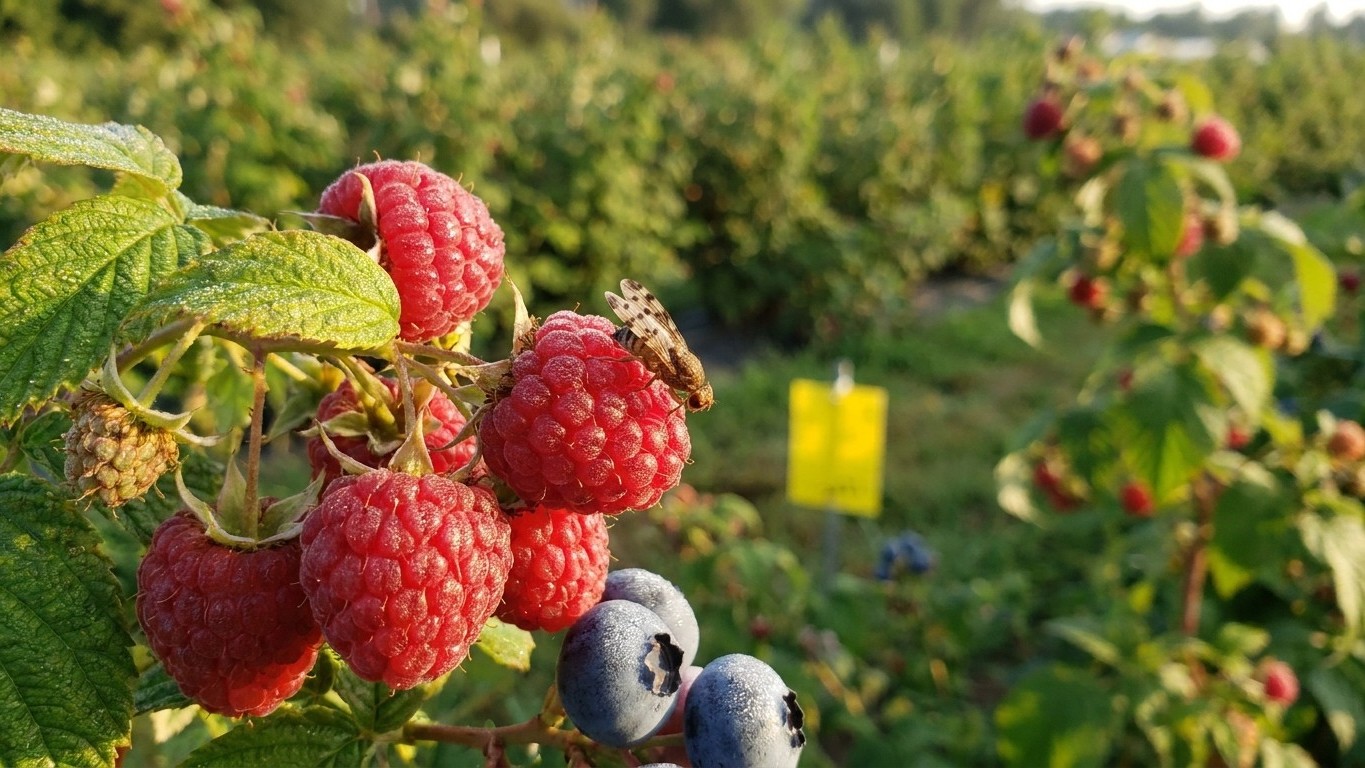

Spotted wing drosophila (SWD) has been active in Nova Scotia since the early 2010s, and growers now treat it as a standing seasonal risk rather than an occasional scare. The fly typically builds to damaging numbers from late July through September, right when raspberries, highbush blueberries, and haskap ripen. Stopping it comes down to three moves done consistently: trap-based monitoring starting in early summer, fast and frequent harvest with strict fruit sanitation, and a rotation of approved insecticides timed to trap counts rather than the calendar.
A West Coast pest that found its way into the Annapolis Valley

Spotted wing drosophila is native to East Asia. It turned up in California fruit crops in 2008 and moved east faster than most entomologists expected, showing up in the Maritimes within a few growing seasons. By the early 2010s it was established in Nova Scotia’s soft fruit regions, particularly the Annapolis Valley and parts of Kings County where berry and tree fruit production is concentrated.
What makes this species different from the fruit flies already living in Nova Scotia kitchens and compost bins is a small anatomical detail with big consequences. Female SWD carry a serrated, saw-like ovipositor strong enough to cut into intact, ripening fruit skin. Native fruit flies can only lay eggs in fruit that’s already damaged, bruised, or overripe. SWD doesn’t wait for that opening. It creates one, which is why a raspberry patch can look perfect on Monday and be riddled with larvae by Thursday.
When SWD actually becomes a threat in Nova Scotia
Nova Scotia’s cooler spring temperatures work in growers’ favor early in the season. Adult flies overwinter in leaf litter and wooded field margins, and they don’t become consistently active until daytime temperatures hold above roughly 50°F. That usually pushes meaningful activity into June, with populations staying low through most of that month.
The real pressure builds from mid-July onward. Under warm, humid conditions, SWD can complete a generation in as little as one to two weeks, and each female can lay well over a hundred eggs in her lifetime. That compounding math is why populations that seem minor in early July can explode by late August, right as fall-bearing raspberries, late blueberries, and haskap hit peak ripeness. Growers who wait until they see obvious damage are almost always managing an infestation that’s already several generations deep.
The monitoring window growers rely on
Provincial extension programs recommend setting traps by early June, well before fruit starts coloring. Simple traps baited with apple cider vinegar or a yeast-sugar-water mixture, checked weekly, give growers an early read on when adults arrive in a given field. Commercial lures designed specifically for SWD are also widely used because they attract the species more selectively than vinegar alone.
The threshold that matters isn’t a big number. Because females can start laying eggs almost immediately after mating, catching even a single SWD adult in a trap near fruit that’s close to ripe is treated as a signal to begin management, not a reason to wait for confirmation of damage.
Which Nova Scotia crops carry the highest risk
Not every fruit crop in the province faces equal exposure. Thin-skinned, soft fruit ripening in mid-to-late summer sits squarely in the danger zone:
- Raspberries, especially fall-bearing varieties that ripen when SWD populations peak
- Highbush blueberries, more vulnerable than the wild lowbush type due to thinner skin
- Haskap, a relatively new crop in Nova Scotia with fruit skin soft enough to be a favorite SWD target
- Wild lowbush blueberries, lower risk overall but still susceptible late in the harvest window
- Grapes and cherries, grown on a smaller scale in the province but still capable of hosting infestations
Home gardeners with even a handful of raspberry canes or a few haskap bushes face essentially the same exposure as commercial operations. SWD doesn’t distinguish between a backyard planting and a five-acre field once fruit starts ripening nearby.
What actually stops spotted wing drosophila
No single tactic controls SWD on its own. Effective management in Nova Scotia stacks several practices together, and dropping any one of them tends to let populations rebound.
Harvest frequency and sanitation do more heavy lifting than most growers expect. Picking ripe fruit every one to two days during peak SWD pressure removes egg-laying targets before larvae can develop. Overripe, damaged, or dropped fruit left on the ground or on the plant acts as a breeding reservoir, so removing and destroying it (not just tossing it nearby) cuts population growth significantly.
Canopy management matters more than gardeners often realize. SWD prefers shaded, humid microclimates. Pruning to open up airflow and sunlight exposure, and mowing ground cover between rows, makes the growing environment less hospitable without any chemical input at all.
Exclusion netting has become a practical option for high-value, small-footprint crops like haskap, where fine mesh installed before fruit ripens physically blocks adult flies from reaching the fruit. It’s labor-intensive to install and remove, which is why it’s used mostly where crop value justifies the effort.
Insecticide rotation remains the backbone of commercial control once trap counts confirm adult activity near ripening fruit. Products containing spinosad and various pyrethroids are commonly used under short pre-harvest intervals, and growers rotate between different modes of action specifically to slow the development of resistance, a real concern given how many generations SWD can produce in a single season.
Post-harvest cold treatment is the tool that direct-market and pick-your-own operations lean on heavily. Refrigerating picked fruit quickly, ideally close to freezing, slows or halts larval development inside fruit that may already carry eggs. This won’t remove existing damage, but it stops the problem from getting worse in a box sitting at room temperature.
Biological control is still more promise than practice in this region. Parasitoid wasps such as Ganaspis brasiliensis, which attack SWD larvae in their native range, are the subject of ongoing research trials in North America, but they aren’t yet a reliable, widely available control option for Nova Scotia growers.
One detail that surprises a lot of backyard fruit pickers: freezing harvested berries for at least 48 hours kills any SWD larvae present before the fruit is eaten fresh or used in preserves. It’s a simple, low-effort safeguard for anyone picking raspberries or haskap from a home planting without a spray program in place.
Related guides
- Spotted wing drosophila in New Brunswick: When It Shows Up and What Stops It
- Spotted wing drosophila in Ontario: When It Shows Up and What Stops It
- Spotted wing drosophila in Prince Edward Island: When It Shows Up and What Stops It
- Spotted wing drosophila in Minnesota: When It Shows Up and What Stops It
- Spotted wing drosophila in Maine: When It Shows Up and What Stops It