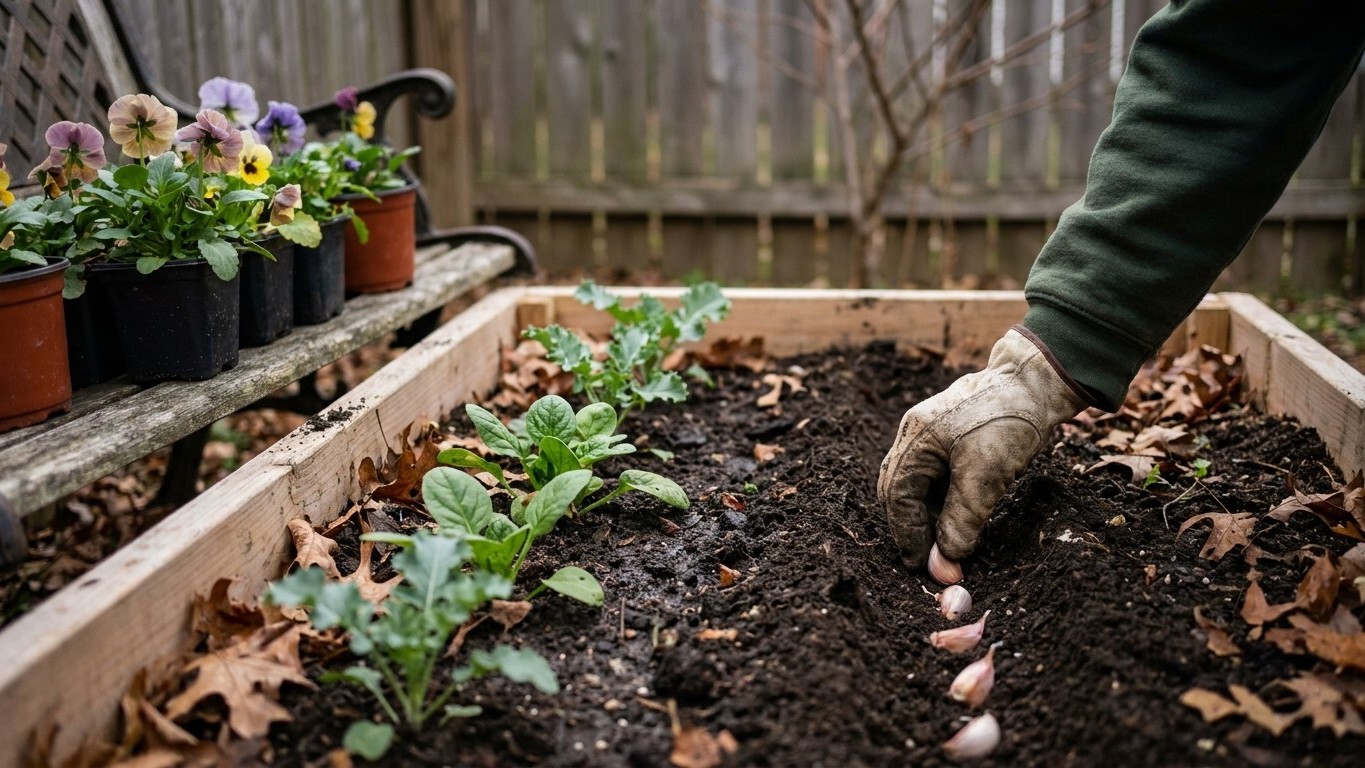

October in Rhode Island sits right at the edge of the first fall frost window, so the answer depends on which week you’re standing in. Garlic and shallots go in the ground now. Spring bulbs go in now. Hardy greens can still be direct-sown early in the month, and cold frames extend the harvest well past that. Tender crops, though, are done. The soil, not the calendar, decides what survives.
What goes in the ground in October

The reference point that matters most this month is the first fall frost window: October 24 to November 3, based on NOAA NCEI Climate Normals for 1991-2020. That’s a range, not a date, and it comes from one airport weather station, so a garden a few miles inland or at higher ground can see frost a week or two earlier. Everything you plant outdoors this month gets measured against that window, not against “it’s still October.”
Garlic and shallots are the safest bet in the ground right now. Both need four to six weeks of root growth before the soil locks up, and planting them ahead of that first frost window gives them exactly that. Push cloves and bulbs 2 inches deep, mulch after planting, and let them sit dormant through winter.
Spring-flowering bulbs (tulips, daffodils, crocus) also go in through October. They need a cold period to bloom properly, and the ground is still workable enough to dig.
Early in the month, hardy greens like spinach, mache, arugula, and claytonia can still be direct-sown outdoors for a fall harvest, especially with a floating row cover to buy a few extra degrees on cold nights. Once you’re past the middle of the month, that window closes fast for anything not already established.
What doesn’t belong in the ground now: tomatoes, peppers, beans, squash, anything that dies at 32°F. If the plant can’t shrug off a light frost, October soil is a gamble it will lose. Save that soil space for garlic, bulbs, or a cover crop instead.
What to start under cover
Starting seeds under cover in October isn’t about getting a jump on spring. It’s about squeezing a last harvest of greens out of a cold frame or low tunnel before day length drops too far to support real growth. Count backward from the first fall frost window (October 24 to November 3): a crop like spinach or mache needs roughly 6 to 8 weeks to reach a pickable size, so sowing in a protected structure through the first half of October still gives it a shot at maturing before light becomes the limiting factor rather than cold.
That’s the arithmetic to redo for your own spot: take your local frost window, subtract the days-to-maturity on the seed packet, and see where that lands you on the calendar. If the math puts your sowing date past mid-month, you’re better off waiting for a spring planting instead.
Two ways this goes wrong. Sow too early under cover and the structure traps heat on a warm afternoon, plants bolt or get leggy reaching for light before the days shorten. Sow too late and the seedlings never build enough leaf mass before daylight drops below the threshold most greens need to keep growing, meaning they sit stalled all winter instead of producing. Cold frames and low tunnels don’t add growing days once light is the constraint, only frost protection.
Onions and leeks for next season are started indoors, but that’s a late-winter job, not an October one. Don’t sow those now expecting a head start; they’ll just get rootbound waiting for a planting date months away.
What is ready to pick
October is one of the fullest harvest months Rhode Island gardens see. Winter squash and pumpkins come off the vine once the stem has dried and turned brown and the skin resists a thumbnail scratch. Apples are ready when a gentle upward twist separates the fruit from the branch without tearing. Both should be handled carefully if you plan to store them; bruised fruit rots fast in the root cellar.
Fall brassicas, broccoli, cabbage, and Brussels sprouts, actually improve with a light frost. The cold converts starches to sugars, so a touch of frost on Brussels sprouts is a flavor upgrade, not a loss. Pick sprouts from the bottom of the stalk up, once they’re firm and about an inch across.
Root crops keep going too. Carrots, beets, and parsnips can stay in the ground through several frosts, and parsnips in particular are better left in the soil until after a hard cold snap, which sweetens them the same way it does the sprouts.
Potatoes and onions harvested earlier in the season should be curing by now. Check stored crops weekly: a soft spot on a potato or a squash that’s gone spongy near the stem means it’s on its way out, and it should be used or composted before it spreads mold to the crops sitting next to it.
The jobs that matter this month

Garlic planting has a real deadline, tied directly to that first fall frost window (October 24 to November 3). Miss it by too much and the cloves don’t get the root development they need before the ground freezes solid, which shows up as smaller, weaker bulbs next summer.
Fall sanitation matters more this month than almost any other job on the list. Pull and discard, don’t compost, any plant showing blight, powdery mildew, or other disease symptoms. Those spores overwinter in plant debris and reinfect the same bed next season if left in place.
Cutting back perennials after the first hard frost, then mulching with 2 to 3 inches of straw or shredded leaves, protects roots through the cold months and cuts down on spring weeding. Do this after frost has killed back the top growth, not before; the dying foliage still feeds the roots for a few extra weeks.
Test and amend soil now if you haven’t already. Lime takes months to adjust pH, and compost worked in before the ground freezes has all winter to integrate rather than sitting inert come spring.
Round out the month by draining and storing hoses and irrigation lines before a hard freeze cracks them, raking leaves into the compost pile rather than bagging them for the curb, and bringing in any tender potted plants before nighttime temperatures start dipping into frost range.
What not to do in October
The most common mistake is planting garlic on the wrong end of the calendar, either too early, which encourages excess top growth that gets damaged by winter cold, or too late, which leaves the cloves without enough root development before the soil freezes. Aim for the weeks leading into the first fall frost window, not right up against it.
Nitrogen fertilizer is the wrong input this month. Nitrogen pushes soft new growth, and soft new growth is exactly what a frost damages first. If anything, favor compost or a phosphorus-and-potassium amendment that supports root development instead of top growth.
Don’t uncover row covers or cold frames on a mild afternoon and forget to close them back up. A warm spell in mid-October is often followed by a sharp drop overnight, and tender greens that were fine at 2pm can be blackened by 6am if the cover stays off.
Skip fall pruning of trees and shrubs beyond removing dead or damaged wood. Cutting live wood now can stimulate new growth right before the cold sets in, and that new growth is the part most likely to suffer winter dieback. Save the real pruning work for true dormancy, later in the season.
Checking this against your own county
Everything above is built around one reference station’s frost data, and Rhode Island is small but not uniform. Coastal gardens along Narragansett Bay tend to run a week or two milder than inland spots, and low-lying areas that collect cold air can see frost arrive earlier than the stated window suggests. Elevation and local drainage move these dates more than most gardeners expect.
Treat the October guidance here as a starting point, then check it against the University of Rhode Island Cooperative Extension, which tracks local conditions and planting timing specific to Rhode Island counties.
Common questions
Can I still plant tomatoes or peppers in October in Rhode Island?
No. Both crops die at freezing temperatures, and the first fall frost window (October 24 to November 3) means the growing season for tender crops is effectively over by this point. Use the soil for garlic, bulbs, or a hardy green instead.
Is it too late to plant garlic in October?
Not for most of the month. Garlic needs four to six weeks of root growth before the ground freezes solid, and planting through October, ahead of the first fall frost window, usually leaves enough time for that. Planting much later reduces bulb size next summer.
Why do my Brussels sprouts and parsnips taste better after frost?
Cold triggers these plants to convert stored starches into sugars, which is a natural response to freezing temperatures. A light frost genuinely sweetens the flavor rather than damaging the crop, so there’s no rush to harvest before the first cold night.
What USDA hardiness zone is Rhode Island in?
Rhode Island spans USDA Plant Hardiness Zones 6a to 7b, based on the 2023 USDA map using 1991-2020 averages. This is a statewide range built on one variable, average annual extreme minimum temperature, so a specific town’s zone can sit anywhere within that range depending on its location.
Gardeners who plant by the Moon can check the October 2026 moon planting calendar, a tradition rather than a proven method.
Related guides
- When to Plant Potatoes in Rhode Island
- When to Plant Melons in Rhode Island
- What to Plant in Rhode Island in April
- the Rhode Island planting calendar
- What to Plant in Rhode Island in November
Elsewhere? See what to plant in October in every state and province.