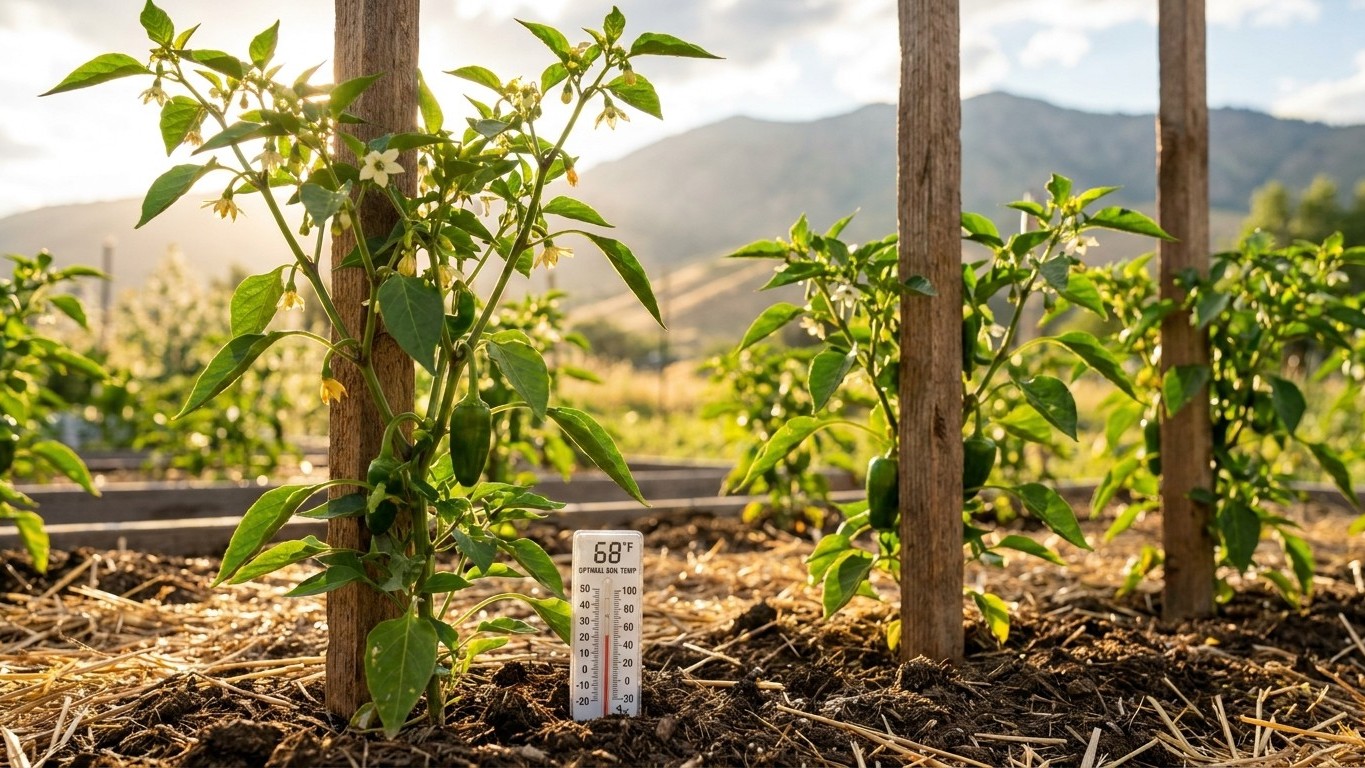

South Dakota gardeners get roughly two weeks a year when daytime highs push past 90 F, and that heat can shut down pepper fruit set just as fast as a cold snap can. The reliable ripening window sits between the last spring frost and whatever heat the mid-to-late summer throws at the plants, so picking varieties that flower and size fruit before the worst of both extremes is what actually decides the harvest.
The short answer

Sioux Falls averages 13.8 days a year at or above 90 F, based on NOAA NCEI Climate Normals for 1991-2020. That’s not a heat wave here and there. It’s close to two full weeks scattered across July and August, often stacked in short runs of three or four days at a time. For peppers, that matters because fruit set doesn’t just slow down in heat, it stops. Blossoms open, get pollinated, and then abort instead of swelling into fruit once daytime highs climb into the 90s, especially when the heat holds overnight too.
That’s the hot end. The cool end is just as unforgiving, and it’s the one gardeners tend to forget about because they’re watching the thermometer for frost, not for marginal warmth. According to Utah State University Extension, pepper fruit set also fails when nights drop below 55 F. A plant can sail through a 95 F afternoon and still drop its blooms that same night if the temperature slides into the low 50s before dawn. South Dakota’s summer nights can do exactly that, particularly in the western part of the state and in low-lying spots anywhere in the state where cold air pools.
Here’s the catch: this site tracks days at or above 90 F for South Dakota, but it does not carry summer overnight low data. There’s no reliable way to state, county by county, how many nights in a typical July or August dip under 55 F, and guessing based on latitude or on how cold the winters get would be misleading. A place with brutal winters can still have warm, humid summer nights, and a place with mild winters can still cool off hard after sunset if it sits at elevation or in a valley. The only sound approach is to watch your own thermometer through the growing season, ideally with a min-max reader left outside overnight, and treat any string of nights under 55 F as a signal that fruit set is stalling even if the plants look healthy.
Put together, the practical target is a stretch of weather that stays under 90 F in the day and above 55 F at night for the five to seven weeks after first flower. That’s the window that turns blossoms into peppers instead of dropped petals.
When to start seed here
Working out a start date is just counting backward from two fixed points: the last spring frost and the week soil hits 60 F. Utah State University Extension recommends starting pepper transplants 8 to 10 weeks indoors, and setting them out only after both frost has passed and the soil has warmed to 60 F. Here’s how that math runs for a South Dakota garden.
- Find the local frost date. NOAA NCEI’s 1991-2020 normals put the last spring frost at the Sioux Falls reference station somewhere between April 29 and May 9, based on the 30-70% probability band for a 32 F freeze. That’s the airport station reading, not a guarantee for every yard in the region.
- Push it later for a home garden. Suburban and rural gardens, especially those away from pavement and buildings, typically see their last frost land one to two weeks after the airport date, and even later at elevation. A garden that sits in a low spot or open field should plan on the later end of that adjustment, not the earlier one.
- Wait for 60 F soil, not just for frost to end. Air temperature can feel warm while the ground is still cold from spring snowmelt. Peppers set into cool soil sit and sulk instead of growing, so checking soil temperature with a simple probe thermometer a few inches down is worth the five minutes it takes.
- Count back 8 to 10 weeks from that transplant date. If the adjusted, garden-specific transplant date lands in the third week of May, seed starting indoors should begin somewhere in the second week of March to the third week of March, depending on whether the grower uses 8 or 10 weeks as the target.
- Rerun the math for your own county. Because the frost date above comes from one reference station, any gardener elsewhere in the state should look up their nearest station’s normals and repeat steps 1 through 4 rather than borrowing the Sioux Falls dates directly.
The point of doing this arithmetic instead of just marking a calendar date is that it forces a reality check on soil temperature, which is the step most often skipped. A frost-free date on a chart means nothing to a pepper root sitting in 50 F dirt.
What goes wrong here
Most pepper failures in South Dakota trace back to one of three things, and all three are tied directly to the swings between heat and cool that this climate produces.
- Blossom drop from a hot spell. When daytime highs push into the 90s, especially during one of the state’s roughly 13.8 annual days at or above that mark, plants can shed blossoms wholesale even while the leaves still look green and healthy. There’s no fix for the heat itself, but afternoon shade cloth over the row during the worst stretches, along with deep, consistent watering so the plant isn’t also fighting drought stress, keeps more blossoms hanging on until temperatures ease.
- Blossom drop from a cool night. The same failure shows up for the opposite reason: nights that slide below 55 F, per Utah State University Extension’s threshold for pepper fruit set. Since this region’s overnight lows aren’t tracked here, the only real defense is watching a garden thermometer through the season and being ready to cover plants with row cover or move containers under an overhang if an unusually cool night is forecast during flowering.
- Sunscald on exposed fruit. Strong summer sun on fruit that’s lost its leaf cover, whether from pruning, wind damage, or disease, causes pale, papery patches that can turn into soft, rotten spots. Leaving foliage intact rather than pruning heavily, and using shade cloth during the hottest afternoons, keeps fruit shaded without blocking the plant from getting enough light overall.
- Blossom-end rot. Fruit that develops a sunken, leathery brown patch on the bottom is usually suffering from inconsistent watering rather than a soil nutrient problem outright, since uneven moisture interrupts the plant’s ability to move calcium into developing fruit. Watering on a steady schedule, and mulching to keep soil moisture from swinging between soaked and bone-dry, addresses the root cause more reliably than adding extra calcium products.
Common questions
Which pepper varieties are named for cooler or shorter-season climates?
Utah State University Extension names six varieties suited to gardens without a long, hot growing season, but the source gives no heat rating, days-to-maturity figure, or fruit size for any of them. Without that data published, it isn’t accurate to rank or describe them beyond noting that Extension recommends them as a group for shorter, cooler seasons.
How many days after flowering does a pepper need to ripen?
Utah State University Extension’s guidance covers seed-starting and transplant timing along with the fruit-set thresholds, but does not attach that flowering-to-ripening figure to this state’s specific varieties or conditions, so no number is published here for South Dakota’s season.
Can I just count on the last frost date and skip checking soil temperature?
No. Air can warm up well before the ground does, particularly after a snowy winter, and peppers set into soil colder than 60 F tend to stall rather than grow, according to Utah State University Extension’s transplant guidance. Checking soil temperature directly is a better indicator than the calendar alone.
Does South Dakota’s frost date apply the same way across the whole state?
No. The April 29 to May 9 window comes from NOAA NCEI’s 1991-2020 normals at a single reference station near Sioux Falls. Gardens elsewhere in the state, especially rural or elevated sites, commonly see frost end later in spring and start earlier in fall, so local station data should be checked rather than applying this figure statewide.