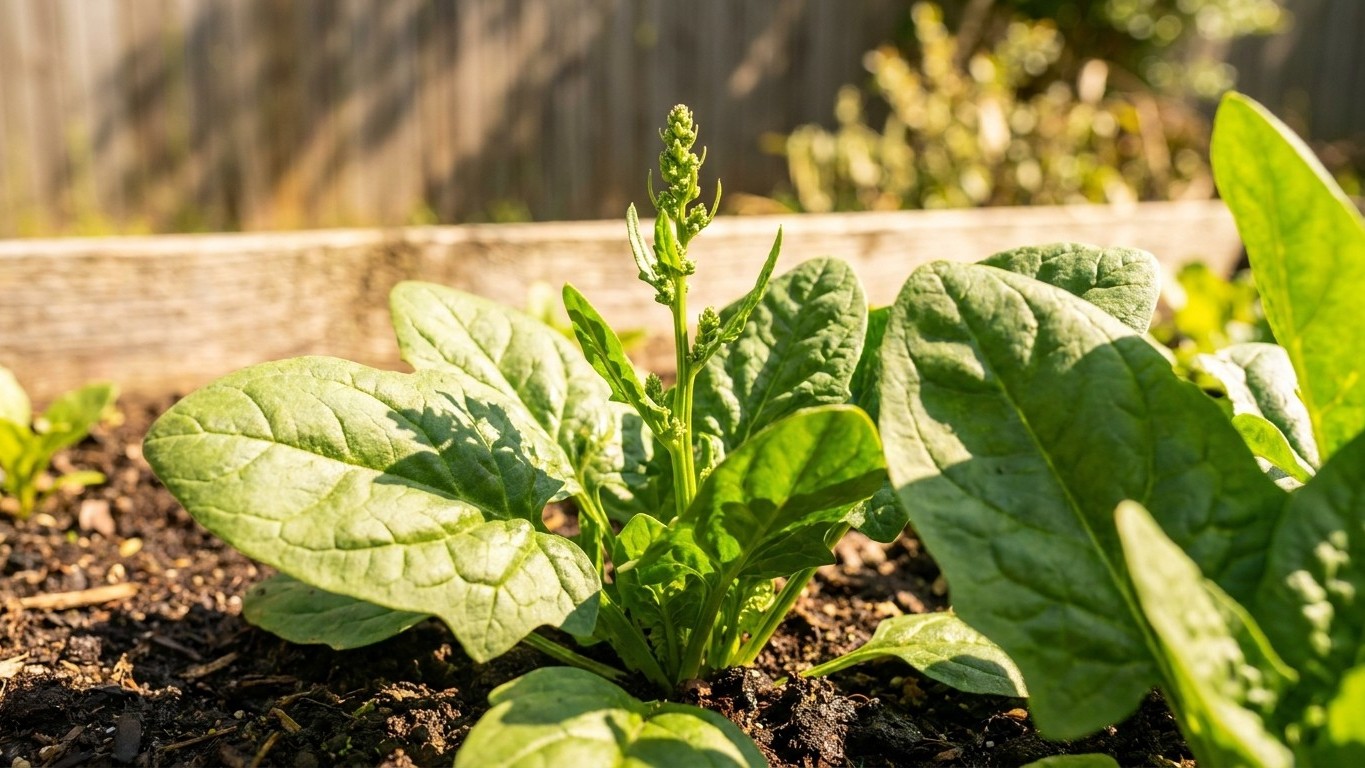

Two things eat spinach’s season in South Dakota, and neither is an insect. Long days push the plant toward flowering no matter how cool the weather stays, and heat above 75 F stops good growth. In spring, you sow before the last frost and harvest before both arrive. In fall, warm soil blocks the sowing, then frost closes the door.
The short answer
On the longest day of the year, the reference city of Sioux Falls gets 15 h 15 of daylight. That figure matters more than any thermometer reading, because spinach flowers (bolts) in response to long days as well as warmth. Utah State University Extension, the source for everything on this page about spinach’s limits, says plainly that spinach bolts during long days and warm temperatures. Daylight alone can start the process.
That is why a cool summer does not buy extra weeks here. You can have a June with highs in the 60s, and the plant still reads the calendar through the length of the day. The cold does not cancel the signal. Gardeners in cooler parts of the country sometimes assume that mild weather means a long leafy season. In a state where June days stretch past fifteen hours, that assumption fails.
So is the limit day length, heat, or both? Both, and they work in different seasons. Day length is the fixed part. It follows the sun, it is the same every year, and no weather pattern changes it. Heat is the variable part. The same source says spinach grows best where temperatures do not exceed 75 F, and that number does double duty: it is the growth ceiling and also the point where leaves turn bitter. It is a temperature, not a date, so it arrives earlier in some springs and later in others.
How often does heat show up? The reference station averages 13.8 days a year at 90 F or more. That sounds modest, and it is, but spinach has been unhappy for weeks before the thermometer touches 90. The 90-degree days measure the summer heat load. They do not mark where spinach quits.
Two more numbers frame the season. At the reference station, the last spring freeze falls between April 29 and May 9, and the first fall freeze between September 24 and October 4 (NOAA NCEI 1991-2020 Climate Normals, 30-70% probability band). Those are airport figures. Suburban and rural gardens typically see the last spring frost one to two weeks later and the first fall frost one to two weeks earlier, so check your own county before you commit seed to the ground.
The practical result is two short windows, not one long one. For a deeper look at how the plant reacts when those windows close, see Will Spinach Bolt Early in South Dakota?. For the full crop plan, start with Growing Spinach in South Dakota.
How long the spring window really is
Utah State University Extension says to sow spinach 2 to 3 weeks before the last frost. Here is how that turns into a usable stretch of weeks for a South Dakota garden, step by step.
- Find your last frost. The reference-city range is April 29 to May 9. Your county may run a week or two later, so use your own local number if you have it.
- Count back 2 to 3 weeks. Three weeks before April 29 is April 8. Two weeks before May 9 is April 25. At the reference city, sowing runs from roughly April 8 to April 25.
- Watch for 75 F. This is the end of the good growing weather, and no calendar date is attached to it. It comes when daytime highs start sitting around 75 F, not when a single warm afternoon spikes above it.
- Count the weeks in between. If highs settle near 75 F in late May, a seed sown in mid-April has about six weeks. If a warm spell arrives early in May, that drops to about three. These are illustrations, not forecasts.
- Add the daylight clock. Days keep lengthening toward the 15 h 15 solstice. Even in a cool spring, the long-day signal is building underneath the crop.
The answer is a short window, set at the front end by frost and at the back end by heat and growing daylight. Nothing in the sources gives a fixed number of weeks for South Dakota, so the honest answer is the one the steps produce: a few weeks, shorter in warm springs, and entirely dependent on when your highs climb.
The sowing end is the part you can control. Seed that goes in at the early edge of the range gets the most cool days. Seed that waits for the soil to feel comfortable and the garden to look ready tends to land closer to the heat, with less runway.
One gap to be upfront about: Utah State publishes no days-to-maturity figure for spinach, and this page will not borrow one from another crop. The source names four varieties, Bloomsdale, Melody, Teton and Olympia, and publishes no data about any of them, so there is no variety ranking here. Seed packets carry their own numbers, and those are the ones to trust.
The autumn crop, and when the soil lets you sow
Fall spinach runs on the same two limits as spring, but flipped. Instead of cold holding back the start, warm soil does. Utah State’s guidance for a fall crop is to plant 50 to 75 days before the date you want to harvest. Work backward from a realistic harvest date and you land on a sowing window, which then runs into the soil.
Warm soil blocks germination
Seed germination is reduced above 80 F soil. Cold is not the obstacle in late summer. The ground in July and August can stay warm well after a cool night, and a bed that was sunlit all afternoon holds that heat. Seed sown into it sits, germinates poorly, or not at all.
That makes the soil, not the calendar, the real gate. A soil thermometer pushed an inch or two into the bed tells you more than a date on a seed packet. When the reading falls below 80 F, the window opens, and in a state with days that reach 90 F or more about 13.8 times a year, that moment tends to arrive later than gardeners expect. Many people wait until the weather feels like fall. By then the countdown may already be too short.
For the timing details, see When to Sow Autumn Spinach in South Dakota.
Frost ends the season
Now count back. The reference-city first freeze falls between September 24 and October 4. Treating that window as the harvest deadline is a planning choice, since the facts here carry no cold-tolerance number for spinach. Fifty days before October 4 is August 15. Seventy-five days before September 24 is July 11. So the full backward range runs from about July 11 to August 15 at the reference city.
Those are the dates the arithmetic produces, and the soil may not cooperate for the early end. Early to mid-July soil is likely to sit above 80 F. The workable stretch is closer to the later part of that range, once soil temperature falls, and it leaves little room for slow germination or a delayed start.
Rural and higher-elevation gardens should shorten this. A frost one to two weeks earlier than the airport figure pulls the whole count forward, and the sowing window shrinks from the late side. If your county sees its first freeze around mid-September, a mid-August sowing may already be too late for the 75-day end of the range.
Common questions
Does a cool summer give South Dakota spinach more time?
No. The longest day at the reference city brings 15 h 15 of daylight, and long days can trigger flowering by themselves. Cool weather helps with the 75 F growth ceiling, but it does not cancel the daylight signal.
Can I sow spinach in midsummer?
You can count back to July, but the soil is the problem. Germination drops when soil is above 80 F. Check the bed with a thermometer, and plan around the soil reading rather than the date.
Which variety should I grow?
Utah State names four: Bloomsdale, Melody, Teton and Olympia. It publishes no data about any of them, so this page can’t rank or describe them. Read the days-to-harvest and bolt-resistance notes on the seed packet you buy.
How long does harvested spinach keep?
UC Davis Postharvest says optimum storage is 32 F at 95 to 98 percent humidity, and that spinach will not maintain good quality for more than 2 weeks. Treat that as a ceiling, not a plan. A home refrigerator door sits near 41 to 50 F, where leaves yellow in days. Put the bag at the back of the bottom shelf, the coldest spot.