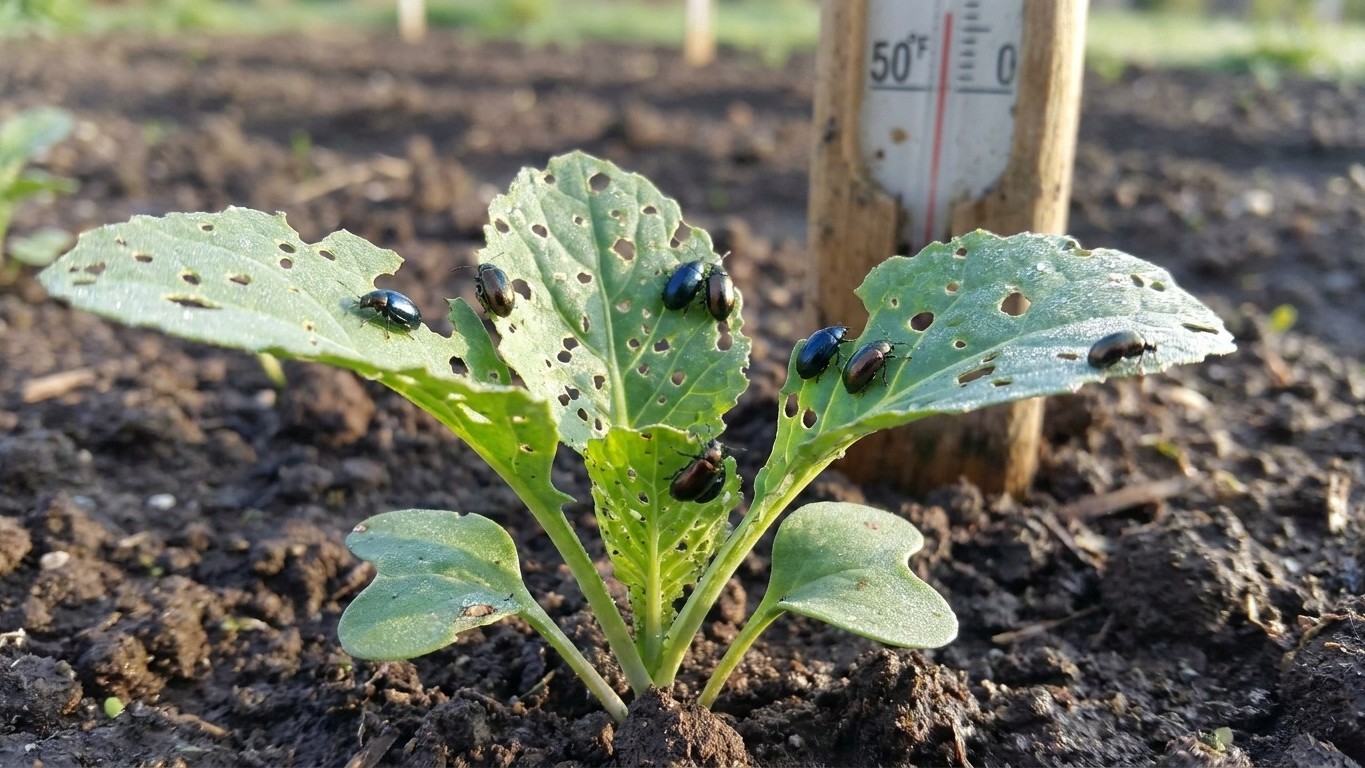

Flea beetles start showing up across South Dakota as soon as soil temperatures climb into the low 50s, which typically means mid-April in the southeastern part of the state and late April to mid-May farther west and north. They target brassica family plants first: radishes, cabbage, broccoli, and canola seedlings barely out of the ground. Stopping them comes down to three moves that actually work: floating row covers timed before emergence, sticky traps for early detection, and targeted insecticide applications only when populations cross a real damage threshold.
When Flea Beetles Arrive in South Dakota

South Dakota’s climate splits into two rough halves for pest timing purposes. East River, around Sioux Falls, Brookings, and Yankton, warms up faster thanks to lower elevation and more humidity held over from spring rains. Flea beetles there can be active by the second week of April in a mild year. West River, including Rapid City and the Black Hills foothills, sits at higher elevation with cooler nights well into May, which pushes beetle activity back by two to three weeks most seasons.
The trigger isn’t a calendar date. It’s soil temperature. Adult flea beetles overwinter in leaf litter, fence rows, and grassy field edges, then become active once soil hits a sustained 50 to 55 degrees Fahrenheit. That’s roughly the same window South Dakota gardeners use to direct-seed cool-season crops like spinach and peas, which unfortunately means the pest and the planting window overlap almost exactly.
Central South Dakota, around Pierre and the Missouri River corridor, tends to land in between, with activity picking up by late April. A late frost or a cold, wet spring, common in this region, can delay emergence by a week or two, but it rarely eliminates the population. The beetles just wait it out.
Second Generation in Late Summer
Most South Dakota gardeners only think about flea beetles in spring, but a second generation often appears in late July through August, especially in years with a warm, dry June. This wave targets fall brassica plantings and any potato or eggplant foliage still in the garden. It’s usually smaller than the spring outbreak but can still shred young fall cabbage or kale transplants if nobody’s watching for it.
What Flea Beetles Actually Damage
The name comes from how these beetles move: they jump like fleas when disturbed, which is often the first clue a gardener notices before spotting any actual damage. Adults are tiny, about one-sixteenth to one-eighth of an inch long, shiny black or bronze, and easy to mistake for specks of dirt until they hop.
Damage shows up as a distinctive “shotgun” pattern: dozens of small, round holes peppered across a leaf, as if someone fired birdshot through it. On seedlings this is far more serious than it looks. A cabbage or radish transplant with two true leaves can lose enough leaf tissue in 48 hours to stall growth permanently, even if the plant technically survives.
In South Dakota, the crops most commonly hit include:
- Radishes and turnips, often the very first casualties of the season
- Cabbage, broccoli, kale, and other brassica transplants
- Potatoes, where beetles feed on foliage rather than tubers
- Eggplant and tomato seedlings, usually a secondary target
- Canola and other oilseed crops in rural and farm-adjacent areas
Canola deserves a specific mention because South Dakota grows meaningful acreage of it in the north-central counties, and crucifer flea beetle pressure on emerging canola is one of the more closely watched pest issues for growers in that region, separate from backyard vegetable damage but driven by the same biology.
What Actually Stops Flea Beetles
Chasing adult beetles with a spray bottle after the damage is visible rarely solves the problem. The beetles that did the damage may already be gone, and new ones keep arriving from field edges. Control works better as a sequence: block them before planting, monitor early, then treat only if the population justifies it.
Row Covers Are the Single Best Tool
Floating row covers, the lightweight spun fabric sold at most garden centers, physically block adult beetles from reaching seedlings. Install them at planting time, before the first true leaves appear, and seal the edges with soil or landscape staples so beetles can’t crawl underneath. This single step prevents more damage in South Dakota vegetable gardens than any pesticide, mainly because it stops the problem before it starts rather than reacting to it.
The catch: brassicas need pollinators once they flower, so covers have to come off before bloom on crops grown for seed or fruit. For root crops like radishes that are harvested young, the cover can often stay on the entire growing cycle.
Yellow Sticky Traps for Monitoring
Placing a few yellow sticky cards at seedling height gives an early warning that doesn’t rely on spotting shotgun holes after the fact. Checking traps twice a week from the moment soil hits 50 degrees lets a gardener catch a population spike before it defoliates a whole row. This matters more in South Dakota than in milder climates, because the short, intense spring window means damage can escalate fast once temperatures stabilize.
Diatomaceous Earth and Kaolin Clay
A light dusting of food-grade diatomaceous earth on leaf surfaces damages the beetle’s exoskeleton on contact and works well for small home gardens. Kaolin clay, sold under various trade names for organic pest management, coats leaves in a fine particle film that confuses beetles looking for a host plant. Both need reapplication after rain, which is a real consideration during South Dakota’s typically wetter May stretch.
Targeted Insecticide Use
When populations are heavy enough to threaten seedling survival, spinosad and pyrethrin-based products labeled for flea beetles offer knockdown without the persistence of older broad-spectrum chemicals. Apply in early morning or evening when beneficial pollinators are less active, and only on the affected plants rather than blanket-spraying the whole garden. For larger plantings or field-scale canola, growers typically follow labeled thresholds tied to percentage of leaf area damaged rather than spraying on a fixed schedule.
Cultural Habits That Reduce Pressure Year After Year
Flea beetles overwinter in garden debris, so clearing brassica residue and nearby weedy grass in fall reduces the local population that emerges the following spring. Crop rotation matters too: planting radishes or cabbage in the same bed year after year builds up a resident beetle population that finds the new seedlings almost instantly. Moving brassica plantings to a different part of the yard, even a modest 15 to 20 feet, disrupts that pattern enough to notice.
Delayed planting is another option specific to South Dakota’s climate. Since flea beetle activity tracks soil temperature so closely, pushing brassica seeding back by even one to two weeks, once early activity is confirmed on sticky traps, sometimes lets seedlings establish thicker leaf tissue before the peak beetle wave hits. It’s a tradeoff against the short growing season, but for gardeners who’ve lost radish crops twice in a row, it’s worth testing.
Interplanting with strong-smelling companions like radish alongside cabbage (used as a sacrificial trap crop, planted a week earlier) draws early beetle activity away from the main crop. It’s not a guarantee, but combined with row covers and fall cleanup, it closes most of the gaps a single method leaves open.
Related guides
- Flea beetles in Wyoming: When It Shows Up and What Stops It
- Flea beetles in Utah: When It Shows Up and What Stops It
- Flea beetles in Vermont: When It Shows Up and What Stops It
- Flea beetles in Ontario: When It Shows Up and What Stops It
- Flea beetles in British Columbia: When It Shows Up and What Stops It