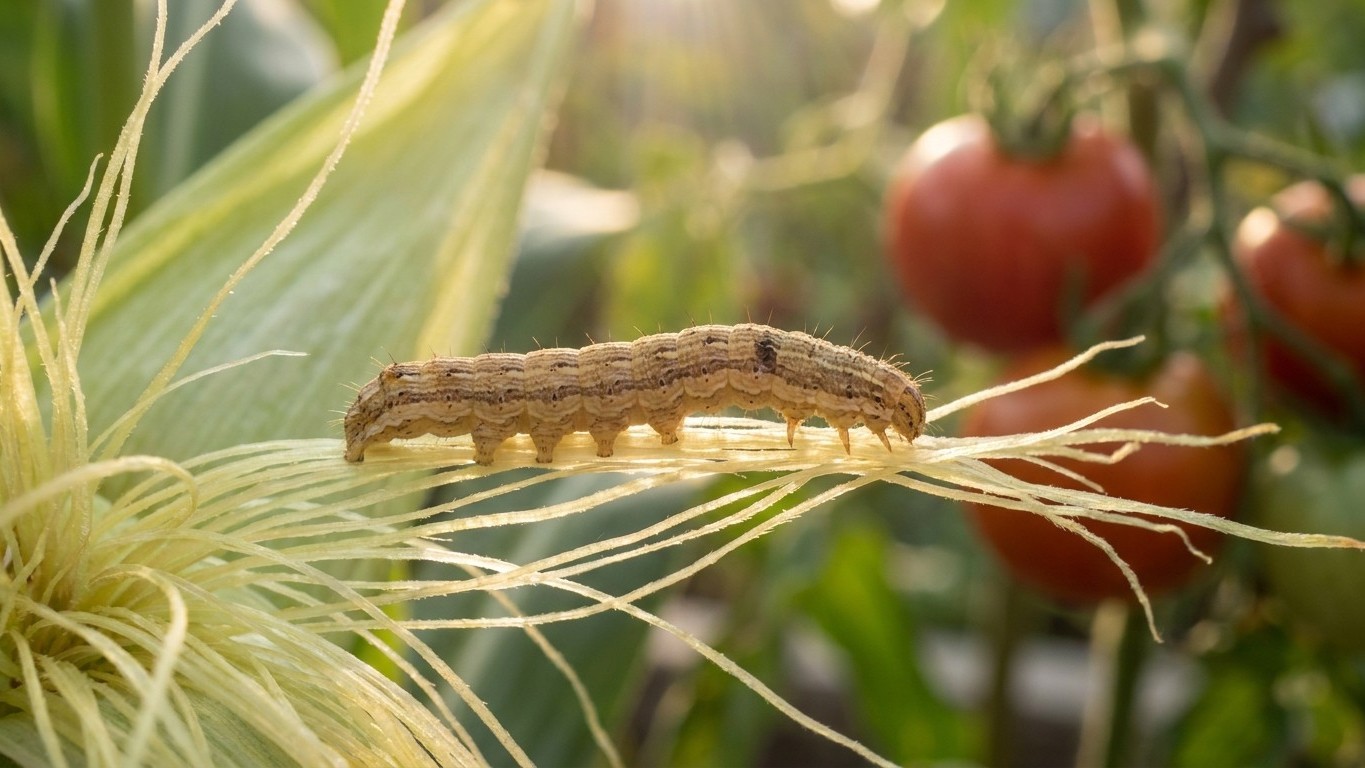

Corn earworm shows up in Tennessee from late May through the first frost, with the heaviest pressure hitting sweet corn and tomatoes between mid-July and early September. That window lines up with silking corn and ripening tomato fruit, the two things this pest can’t resist. Farmers and backyard gardeners across the state deal with two to four overlapping generations each season, which is why a crop that looked clean in June can turn wormy by August.
The insect behind the damage, Helicoverpa zea, goes by other names depending on the crop it’s attacking. On cotton it’s the bollworm. On tomatoes it’s the tomato fruitworm. Same moth, same caterpillar, different menu. Tennessee sits in a transition zone: some pupae survive mild winters in the soil of West Tennessee, but a large share of the state’s population blows in on weather fronts from the Gulf Coast each spring. That’s part of why outbreaks feel unpredictable from one year to the next.
Corn Earworm Timing in Tennessee’s Growing Season

Adult moths are strong fliers and can travel over 100 miles on a single weather system, riding low-pressure fronts north out of Texas, Louisiana, and Mississippi. That’s how populations reach Middle and East Tennessee even in years when local overwintering survival is poor. Once they arrive, females go straight for fresh corn silk or the calyx of a developing tomato, laying single eggs rather than clusters.
Degree-day accumulation drives the timing more than the calendar does. University extension programs across the Southeast track corn earworm development using a base temperature around 55°F, and in most of Tennessee that math produces the first significant moth flight by late May in the west, two to three weeks later in the higher elevations of the east. The second and third generations, which do the most damage to late-planted sweet corn and fall tomatoes, typically peak in late July and August.
Hot, dry summers push generations faster and can compress what would normally be three flights into a tighter, more intense window. That’s exactly what growers saw during the drought stretches of recent seasons, when earworm pressure on late corn spiked hard in a matter of two or three weeks.
How to Spot Damage Before It Spreads
On corn, the giveaway is chewed silk and a caterpillar tunneling down through the tip of the ear, feeding on kernels as it goes. The larvae range from pale yellow to green to nearly black, with dark stripes running the length of the body, and they can grow to about an inch and a half before pupating. Only one caterpillar usually occupies a single ear, because the first one to hatch tends to eat any competitors it encounters.
On tomatoes, the entry hole is often small and easy to miss until you slice the fruit open and find a tunnel packed with dark frass. Unlike corn, where damage stays contained to the tip, tomato fruitworm can bore straight into the core, ruining the whole fruit and opening a path for rot organisms to move in behind it.
A few signs separate earworm damage from other common Tennessee garden pests:
- Frass (caterpillar droppings) visible at the entry point on the ear tip or fruit
- A single wide tunnel rather than the multiple thin trails left by fall armyworm
- Damage concentrated at the silk end of corn, not scattered along the stalk
- Fresh silk browning prematurely on ears that haven’t been pollinated yet
Monitoring Tools That Actually Work
Pheromone traps remain the most reliable early warning system, and they’re not complicated to run. A trap baited with the right lure catches male moths, giving a count that correlates with how many eggs are likely being laid nearby. Extension programs in Tennessee and neighboring states recommend checking traps twice a week starting when corn approaches the pre-silk stage, since a jump in moth counts usually means eggs will hatch within five to seven days.
Black light traps work too, though they’re less selective and catch a wider mix of night-flying insects, which makes counting more tedious. For a home garden with just a few dozen corn plants, walking the rows and checking silks by hand every two or three days during silking season often catches problems just as fast as a trap would, without the equipment.
Weather tracking matters almost as much as trap counts. A warm front moving through from the Gulf states in June or July is a reasonable cue to check traps more often over the following week, since that’s often when new moths arrive on the wind.
Control Methods That Stop Corn Earworm
No single tactic handles corn earworm on its own. The insect lays eggs over an extended period, larvae hide inside the ear or fruit almost immediately after hatching, and repeated generations mean a clean field in June doesn’t guarantee a clean field in August.
Timing insecticide applications correctly
For growers who use insecticides, timing beats product choice almost every time. Sprays only work while eggs and newly hatched larvae are exposed on the silk, before the caterpillar tunnels into the ear. That typically means applying every three to five days from the start of silking through about a week past full silk, adjusting the interval based on trap counts and rainfall (since heavy rain washes off residue faster than dry weather does). Once a larva has burrowed a half-inch into the ear, no spray reaches it.
Rotating between different insecticide classes helps slow resistance, which corn earworm has developed to several older chemistries in parts of the Southeast over the past two decades. Growers who rely on the same product every application cycle tend to see control quality drop off within a few seasons.
Non-chemical and cultural controls
Home gardeners without access to commercial-grade sprays have a few practical options. A few drops of mineral oil or a small amount of Bt (Bacillus thuringiensis) applied directly to the silk tip just after pollination has finished can smother or poison newly hatched larvae before they tunnel in, without harming the kernels or pollinators. The trick is timing it after pollination, not before, since oil applied too early can interfere with kernel set.
Tight-husk sweet corn varieties give the caterpillar a harder path to the kernels and reduce damage rates noticeably compared with loose-husk types, though they don’t eliminate the problem entirely. Planting corn as early as the local frost date allows makes a real difference too, since early-planted corn often finishes silking before the heaviest August moth flights arrive.
Fall tillage that turns and breaks up soil in fields where corn or tomatoes grew disrupts overwintering pupae, cutting down the local population available to emerge the following spring. It won’t stop moths blowing in from farther south, but it reduces the homegrown share of the problem.
Biological controls worth encouraging
Tennessee fields and gardens already host natural enemies that put a dent in earworm numbers without any input from the grower. Parasitic wasps in the genus Trichogramma lay their own eggs inside earworm eggs, killing the pest before it ever hatches. Lacewing larvae, minute pirate bugs, and several ground beetle species prey on young caterpillars as well.
Broad-spectrum insecticides applied out of caution, without checking trap counts first, tend to wipe out these predators along with the target pest, which can make the following generation’s outbreak worse rather than better. Growers who scout before spraying, rather than spraying on a fixed calendar, generally end up using fewer applications and preserve more of that natural control over a full season.
Sweet corn destined for market faces the strictest tolerance for damaged ears, which is why commercial growers lean harder on tight spray schedules during silking. Home gardeners, who can tolerate trimming a chewed tip off an otherwise good ear, have more room to rely on cultural methods and biological controls first, saving insecticide for years when trap counts spike unusually high.
Related guides
- Corn earworm in North Carolina: When It Shows Up and What Stops It
- Corn earworm in Georgia: When It Shows Up and What Stops It
- Corn earworm in Texas: When It Shows Up and What Stops It
- Corn earworm in Utah: When It Shows Up and What Stops It
- Corn earworm in Oklahoma: When It Shows Up and What Stops It