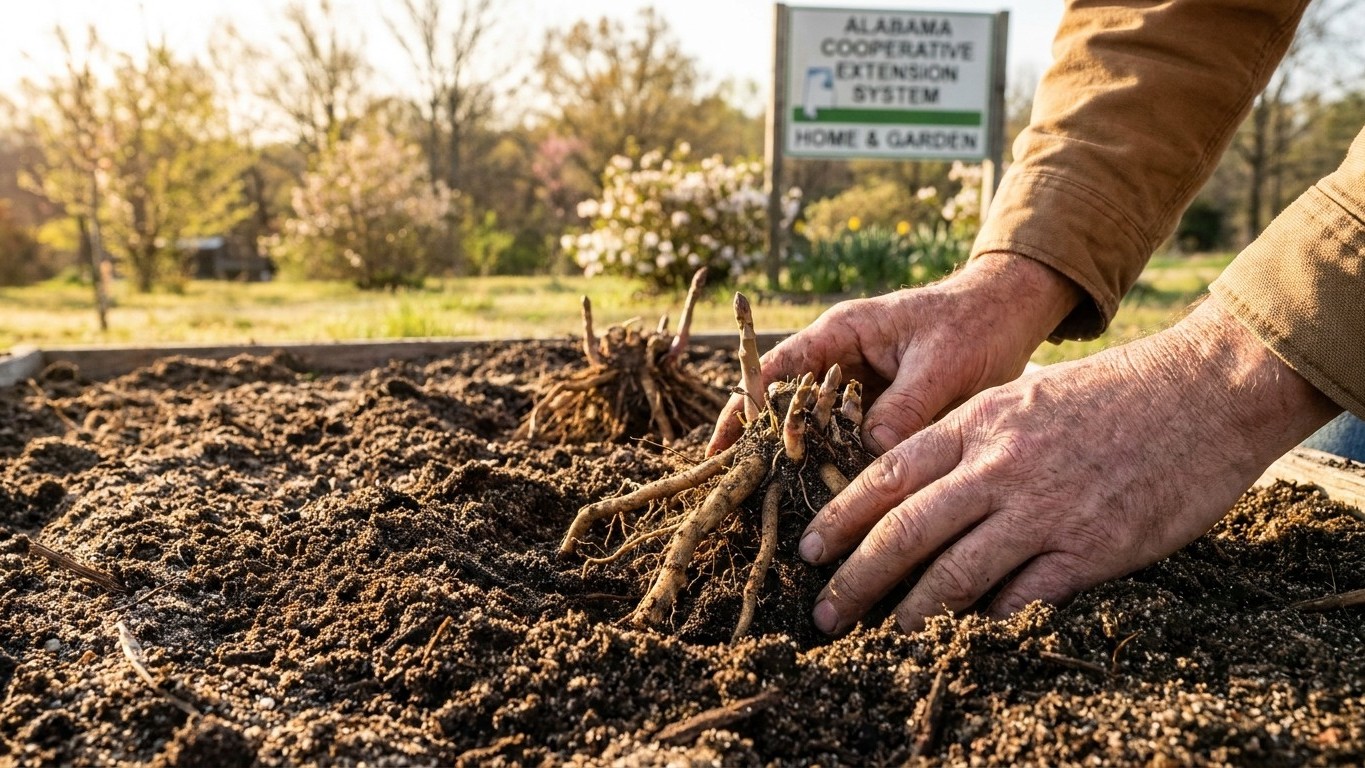

Vermont gardeners can put Asparagus Crowns in the ground around late April into mid-May, timed to the region’s last spring frost window. That’s the short version. What decides whether the bed thrives for the next decade, though, has less to do with the calendar and everything to do with what’s under the soil surface, and how much water falls on it once the crowns are down.
The short answer
An Asparagus Bed isn’t a crop you replant each spring. Once the crowns go in, they stay put for 10 to 15 years, producing spears every year after the third. That single fact changes how a gardener should think about the spot they choose. Utah State University Extension, which supplies the planting guidance behind this article, is blunt about the one soil requirement that matters: the ground has to drain. Almost any soil will grow asparagus, the source notes, as long as water doesn’t sit on it.
Vermont’s official state soil, the Tunbridge series, actually works in the gardener’s favor here. It’s classified as well drained, formed from sandy, strongly leached material typically found under conifer stands, with about 79 percent sand and 21 percent clay in its makeup and a surface pH around 3.5, which is strongly acid. That drainage rating is good news for a 15-year planting decision. A bed that sheds excess water in spring and after summer storms is exactly what keeps asparagus crowns from rotting in their first fragile seasons.
But the state soil is a snapshot of a mapped surface horizon, not a report card on any one backyard. Vermont spans hundreds of distinct soil series, and a garden plot near a river bottom, a hillside terrace, or ground a builder has graded and filled can behave nothing like the Tunbridge profile. The organic matter figure recorded for that surface horizon, about 75 percent, is itself a tell: a cultivated garden bed almost never carries that much organic material, since a reading that high usually reflects a natural forest litter layer rather than tilled soil. The pH of 3.5 belongs to that same undisturbed profile, and the source for the asparagus planting guidance is silent on what pH the plant actually prefers, so neither number should be treated as a stand-in for what a gardener will find with a shovel.
The practical move is a soil test on the actual planting site, not an assumption borrowed from a state symbol. If that test or simple observation shows water pooling after rain, standing puddles, or a heavy clay feel, the fix isn’t to pick a different crop; it’s to build up. A raised bed, or a trench backfilled with looser, sandier material, gives the crowns the drainage they need regardless of what lies underneath. Given that this bed will still be producing spears well over a decade from now, that upfront correction is worth the extra weekend of work.
Will the summer here water it for you?
Once crowns are settled, the target is specific: 1 to 2 inches of water every other week for the first two growing seasons, tapering to roughly every three weeks once the bed is established. Vermont’s summer rainfall, measured at the reference station used for these normals, averages about 11.9 inches across June, July and August combined, a total built from 4.26 inches in June, 4.06 in July, and 3.54 in August, the driest of the three. Here’s how that compares to what the bed actually needs, and what to do about the gap.
- June: at 4.26 inches for the month, rainfall lands close to what a newly planted bed wants on the every-other-week schedule. A rain gauge on the plot is still the only way to know if a given two-week stretch actually delivered its share, since a single storm can dump most of a month’s total in one afternoon and run off rather than soak in.
- July: similar story at 4.06 inches, generally enough to cover the target range if rainfall is spread through the month. Long dry stretches inside July, which do happen in Vermont summers, still call for supplemental watering to keep the every-other-week rhythm intact.
- August: this is the month to watch. At 3.54 inches, it’s the driest of the summer, and combined with peak evaporation on hot days, a new bed in its first two seasons may fall short of its 1 to 2 inch target without help from a hose or drip line.
- Year three and beyond: once the bed shifts to watering roughly every three weeks, Vermont’s summer rainfall generally covers that lighter demand on its own, though a dry August still deserves a check with a rain gauge rather than a guess.
None of these normals describe any single yard. They’re averages from 1991 to 2020 at one reference station, and a slope, a tree canopy, or a spot exposed to wind will all shift the real number. A cheap rain gauge staked next to the bed remains the only tool that settles the question for a particular plot.
When to put the crowns in
Crowns go into the ground in early spring, and for Vermont that window sits around April 30 to May 10, the range where the region’s last spring frost normally falls. That’s a mean date built from freeze-probability records at one reference station, not a guarantee, so “around” is the operative word rather than a hard deadline. Burlington, sitting along the mild shoreline of Lake Champlain, tends toward the earlier end of that window and the mildest conditions the state offers. Gardeners working higher ground in the Green Mountains or up in the Northeast Kingdom should expect the safe planting date to land noticeably later, since both regions run a shorter frost-free season than the lakeside corner the reference station represents.
The planting method itself is straightforward: crowns are set into furrows about 8 inches deep. Instead of filling the trench all at once, the soil goes back in gradually, roughly 2 inches every other month across the season as the emerging shoots gain height. That staged backfill protects the tender new growth while still letting the crown settle into firm ground by year’s end.
Starting from seed is the alternative route, though it costs a year the crown method doesn’t. A crown is already a year-old root system, so setting it directly in the furrow gets a gardener to that first light harvest a season sooner than starting from seed and transplanting later. Either way, the harvest clock doesn’t start ticking until the planting is in: no spears come off the bed in year one or two, no matter which method was used.
Variety choice adds another layer, though the published information here is limited to a single trait: sex. Utah State University Extension names four options, and nothing beyond this distinction is documented by that source.
| Variety | Sex |
|---|---|
| Jersey Giant | All-male |
| Jersey Knight | All-male |
| UC 157 F1 | Male/female |
| Purple Passion | Male/female |
No flavor comparison, yield figure, or reason to prefer one variety over another appears in that source, so any preference beyond male versus mixed sex is a gardener’s own call rather than published guidance.
If you follow the almanac, here is when to plant asparagus by the moon. It is a tradition, not a proven method.
Common questions
Can I plant asparagus from seed instead of crowns in Vermont?
Yes, though it adds a year to the timeline compared with planting crowns, since a crown is already a year-old root system and a seedling has to catch up to that stage before it can be treated the same way in the bed.
How deep should the planting furrow be?
About 8 inches, backfilled gradually over the season rather than in one pass, roughly 2 inches added every other month as the shoots grow.
When can I harvest the first spears?
Not until year three. After that, harvest windows lengthen in stages: about 4 weeks in the earliest harvest year, then 6, then 8 in following years as the crowns mature.
How do I know when to stop cutting spears each spring?
Stop when most of the spears coming up are thinner than a pencil. That’s the signal the plant needs to switch from producing spears to building energy in its fern growth for next year, rather than a fixed date on the calendar.