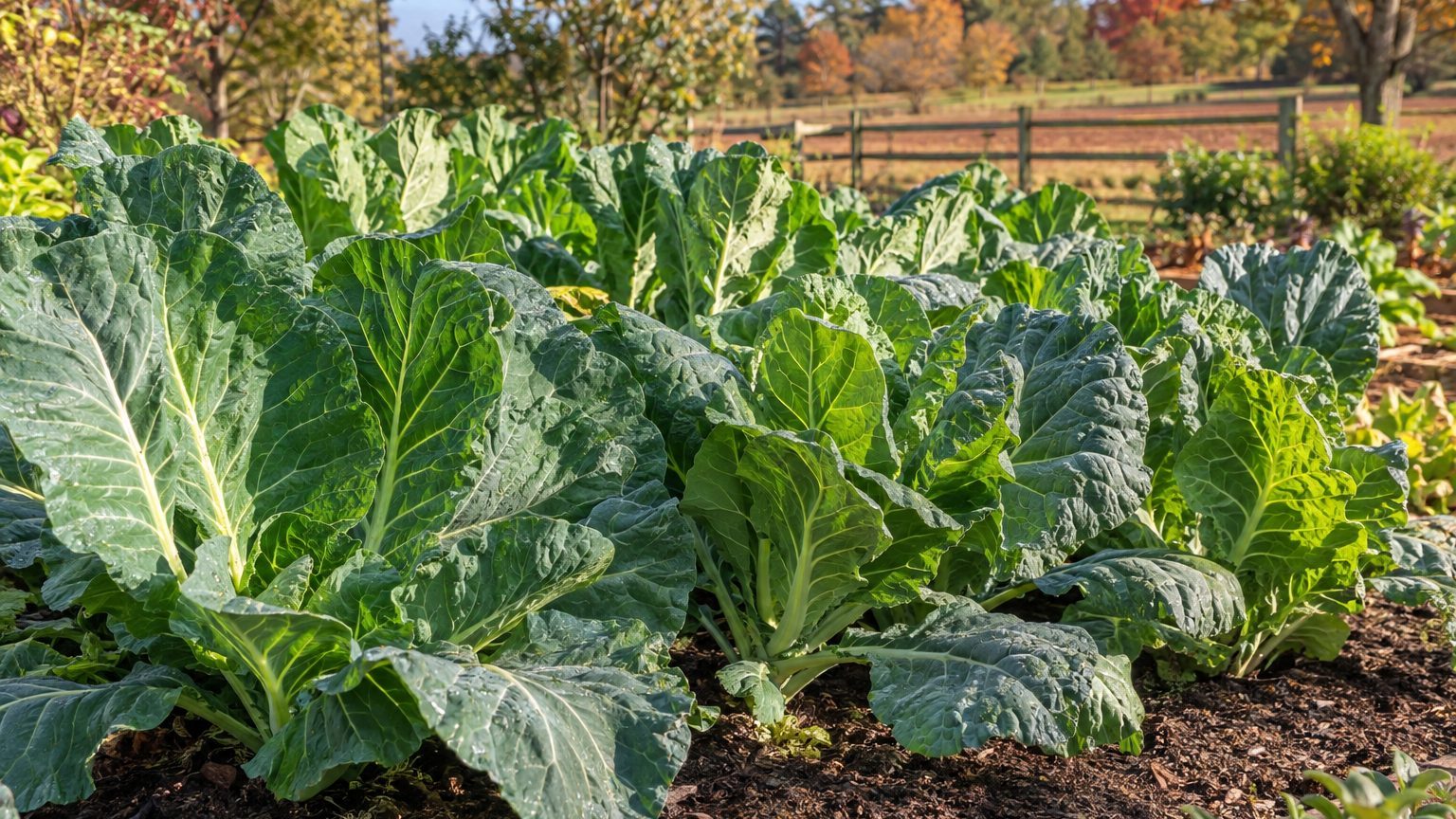

The best collards for Utah are quick-maturing, non-heading types that stand up to cold, planted so they reach size well before the fall freeze. Kale, mustard, turnip greens and chard fill in around them. Long-season Southern heirlooms bred for a nine-month growing year are the ones to skip. Here is how to sort the choices by type.
The short answer for Utah
Choose non-heading, open-leaf collards that mature fast, and treat them as a spring crop and a fall crop rather than one long summer planting. The reason is the calendar. At the Salt Lake City reference station, NOAA’s 1991-2020 Climate Normals put the last spring 32°F freeze between April 12 to April 29, and the first fall freeze between October 18 and October 29. Both ranges are the 30-70% probability band, meaning they mark where the odds of that freeze having happened sit in the middle of the distribution. They are odds, not promises.
Count the gap between the late end of spring and the early end of fall and you get about 24 weeks. That is plenty for a collard that sizes up quickly and a poor fit for a variety that needs a long, steady run of warmth. Collards also tolerate light frost and taste better after a cold snap, so the frost dates matter less for collards than for tomatoes. Your window really opens a few weeks before the last freeze and closes a bit after the first. For the sowing dates themselves, see When to Plant Collards in Utah. For the full crop guide, see Growing Collards in Utah.
The decision by type
This page does not have trial results for named cultivars in Utah, so the sorting below is by type, which is the choice that counts most.
| Type | Fit for Utah | Why |
|---|---|---|
| Fast, non-heading collards | Best first choice | Reach harvest size inside the frost-free window and tolerate light freezes |
| Slow, tall Southern collards | Poor at Salt Lake, worse higher up | Need a longer season than the frost band leaves |
| Heading (cabbage-like) collards | Worth a small trial | Compact, but the head takes extra time to form |
| Kale | Excellent companion | Cold-hardy and quick; a reliable stand-in where collards struggle |
| Mustard and turnip greens | Excellent for speed | Fast cool-season crops for early spring and late fall gaps |
| Swiss chard | Good for summer | Handles heat better than the leafy brassicas |
What will not work here
The slowest collards fail first. A variety that wants a long run of warm weather gets its clock cut short at both ends in Utah, and the fall freeze band of October 18 to October 29 is measured at a mild valley station. Higher ground closes sooner. Plant a slow type in late June and you may be picking small leaves just as the season ends.
Overwintering is the second thing to rule out. The mean daily minimum of the coldest month at Salt Lake City is 24.2°F. That is an average, so plenty of nights run colder. Collards handle a light freeze, but a cold snap on top of that average will finish them in an open bed, and Salt Lake is the mild reference point. Higher valleys are colder. Anyone hoping to harvest collards through January without protection is betting against those numbers. Plan on replanting each year, and treat any survivor as a bonus.
Heat is the third problem, though this page has no summer temperature or rainfall data, so I will not quote figures. What I can say is that Utah is a dry state, and the leafy brassicas sulk in hot, dry stretches, turning tough and bitter. A weekly soak works against you. Shallow-rooted greens dry out between waterings, and the swings between drought and drenching push them to bolt. A mulch layer and steadier watering matter more here than in a humid state, where rain does the smoothing.
Last, don’t start collards at the wrong end of the year and expect the variety to compensate. A fast type sown too late will still stall when the days shorten and the soil cools. Spring sowings that sit through a cold snap can bolt or stunt. Timing beats variety choice when the two conflict.
What changes across Utah
There is no single answer for the state. The USDA Plant Hardiness Zone Map (2023 edition, built on 1991-2020 normals) runs from 4a to 9a across Utah, six numbered zones, from cold mountain valleys to the warm southwest. The system rests on one number, the average annual extreme minimum temperature. It says nothing about summer heat or season length, so treat it as a guide to winter survival only.
Everything dated on this page comes from the Salt Lake City station, which the data itself flags as a mild valley. Most of Utah is higher and colder, and southern Utah is warmer. If you garden at altitude or in the northern mountain valleys, expect the spring dates to slip later and the fall dates to arrive earlier, which squeezes the window and pushes you toward the fastest types, transplants rather than direct sowing, and the hardier kale. If you garden in the warm south, the opposite pressure applies. Your problem becomes heat, so a fall-heavy schedule and shade cloth for the spring crop make more sense, and overwintering becomes a real possibility.
Which zone you fall into is not something this page can tell you. Look up your address on the USDA Plant Hardiness Zone Map, then compare it with the Salt Lake City reference to see whether you should shift your dates earlier or later.
Where to check this for your own county
The state extension service is the next stop. Utah’s is at https://extension.usu.edu/, run through Utah State University. Look there for two things: the local planting calendar for your county, and any vegetable variety trials run in your area. Local trial results are worth more than any generic list, because they show what actually grew where you live.
A county recommendation beats a state one. This page is the state one, built from a single valley station and a zone range that spans six zones. It can tell you what type of collard makes sense and what will fail. It cannot tell you the right week to transplant in a particular canyon or on a particular bench.
The most useful move is to contact your county’s USU Extension office and ask what leafy greens do well locally and when the office advises setting them out. Ask about frost dates for your specific elevation too, since those can differ sharply from Salt Lake City’s within a few miles. This page does not carry a Utah-specific collard calendar from the extension service, so use their county material to check or overrule the dates here.
Checking this against your own garden
Your own observations outrank every date above. Three things are worth watching, and none needs equipment.
- Soil warmth by feel. In spring, push your finger into the bed. Soil that feels cold and clammy is telling you the site is slow to warm, common in shaded or low, cold-air spots. If it crumbles easily and feels neutral, you can work earlier there.
- The first true leaves. After the seed leaves, the first true leaves show how fast a sowing is moving. A slow pace on a cool bed tells you to give the crop extra weeks, or start transplants indoors.
- The first frost damage in fall. Note when tender plants, such as tomatoes and basil, get blackened. If it happens well before the Salt Lake range of October 18 to 29, your microclimate is colder, and your fall crop needs an earlier start.
Jot the dates in a notebook for a season or two. A record from your own yard will beat any regional table.
Common questions
Can collards survive a Utah winter?
Not reliably. The coldest-month mean daily minimum at Salt Lake City is 24.2°F, and higher areas run colder. Some plants may survive in a sheltered bed or under cover, but plan to replant each year.
Should I grow kale instead of collards?
Grow both if you have room. Kale is cold-hardy and quick, so it is a safe hedge where the season is short. Collards give you a different leaf and flavor, provided you pick a fast type.
Do I need a special heat-tolerant variety?
Speed and cold tolerance matter more than heat tolerance for most of the state. Heat is a concern mainly in the warm south. There, dodge the hottest stretch by growing in spring and fall, and use steady watering and mulch.
When should I start a fall crop?
Count backward from the fall freeze range of October 18 to October 29 at the Salt Lake City station, and allow extra margin if you garden higher. The exact sowing dates are in When to Plant Collards in Utah.