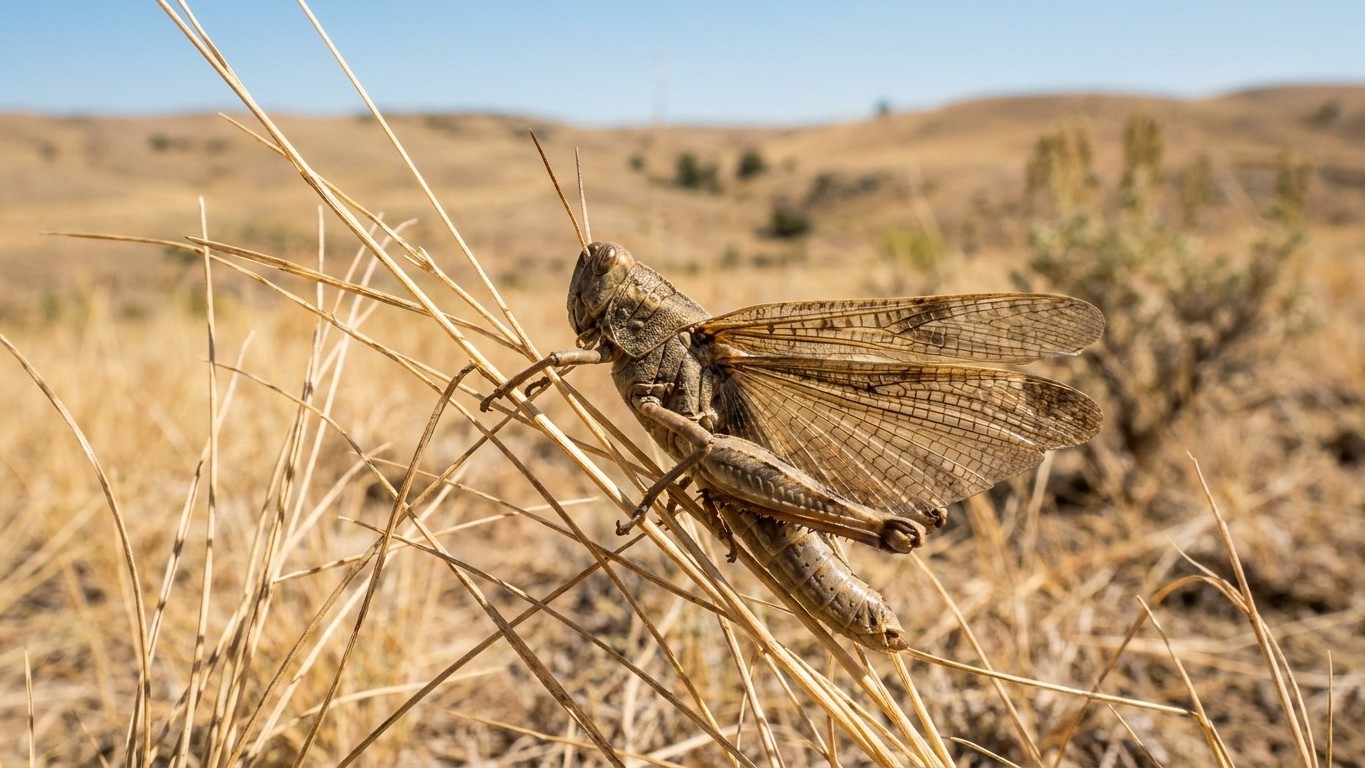

Grasshoppers turn up across Wyoming from late May through September, with numbers peaking in July and August when nymphs finish molting into flying adults. Most years bring a manageable background population. Every five to ten years or so, though, dry springs and mild winters line up just right and the state sees a genuine outbreak, the kind that can strip a hayfield down to stubble in a matter of weeks.
Wyoming’s Grasshopper Season: Timing and Triggers

Eggs laid in late summer overwinter in the top few inches of soil, insulated just enough to survive Wyoming’s cold snaps. Hatching starts as soon as soil temperatures climb into the mid-60s, usually sometime in May across the lower elevations around Cheyenne, Casper, and the Bighorn Basin. Higher country in the Wind River and Teton areas lags two to three weeks behind.
Warm, dry conditions the previous fall matter more than anything happening in spring. Grasshopper eggs need dry soil to survive the winter without rotting or drowning. A wet fall followed by a wet spring knocks populations down fast. A dry fall followed by a dry spring is the exact recipe that pushed several counties into outbreak territory during past cycles, including the widely reported flare-ups in the early 2020s across the eastern plains.
By late June, nymphs are already several molts in and start doing real feeding damage. Adults appear by mid-July, and that’s when the swarming behavior people associate with real infestations becomes visible, especially along roadsides, fence lines, and the edges of alfalfa fields where vegetation stays green longest into the dry season.
Which Species Show Up Most in Wyoming
Not every grasshopper species causes economic damage, but a handful dominate Wyoming’s rangeland and account for nearly all the crop and pasture losses reported by ranchers.
- Migratory grasshopper (Melanoplus sanguinipes), the species most responsible for large-scale outbreaks and long-distance movement between fields.
- Differential grasshopper, common in irrigated hay and alfalfa ground, with a strong appetite for broadleaf plants.
- Two-striped grasshopper, one of the largest species in the state, often found near riparian corridors and irrigation ditches.
- Bigheaded grasshopper, a grass specialist that thrives on native rangeland rather than cultivated crops.
Wyoming rangeland typically hosts a mix of grass feeders and broadleaf feeders at the same time, which is part of why outbreaks hit both native pasture and cultivated hay ground simultaneously. Ranchers running cattle on native grass and farmers growing alfalfa a few miles away can face the same infestation for different reasons.
Why Wyoming Rangeland Is Grasshopper Country
Wyoming has roughly 30 million acres of rangeland, more than almost any other state relative to its size. That much open, semi-arid grassland is close to ideal grasshopper habitat: sparse tree cover, well-drained soil, and long stretches of native grass that dry out predictably by midsummer.
The state’s elevation and climate also work against natural population caps that exist in wetter regions. Fungal pathogens that keep grasshopper numbers in check in the Midwest, for example, need humidity to spread efficiently. Wyoming’s low humidity limits how much these natural diseases can do the job on their own, which is part of why outbreaks here tend to run longer once they start.
Grazing pressure adds another layer. Rangeland that’s been grazed hard the previous year often has shorter, drier vegetation going into fall, which happens to be exactly the kind of ground grasshoppers prefer for egg-laying. It’s a feedback loop ranchers in the Powder River Basin and parts of southeastern Wyoming have dealt with directly, since heavier grazing years sometimes set up bigger grasshopper years two seasons later.
What Actually Stops a Grasshopper Outbreak
No single tool ends a grasshopper year on its own. Control in Wyoming works as a layered system, part biology, part weather, part deliberate intervention.
Natural Predators and Weather
Birds do a lot of the unpaid work. Meadowlarks, horned larks, and various sparrows feed heavily on nymphs in May and June, before the grasshoppers get big enough to be a problem. Predatory insects like robber flies and certain wasp species target nymphs too, though not in numbers large enough to stop a true outbreak once it’s underway.
Weather remains the single biggest natural check. A cold, wet spring kills a large share of newly hatched nymphs outright, since young grasshoppers have almost no cold tolerance and can’t regulate body temperature well in soaked ground. A hard, well-timed frost in late September can also cut short the egg-laying window for the year, reducing the following spring’s hatch before it even starts.
Coordinated Suppression Programs
When populations cross a damage threshold on rangeland, most large-scale response in Wyoming runs through coordinated survey and treatment efforts involving state agriculture officials, county weed and pest districts, and federal partners. These programs rely on early-season surveys, typically walking transects and counting nymphs per square yard, to decide whether a given block of rangeland needs treatment before adults emerge and start moving.
Reduced Agent Area Treatments, a strip-spraying method that treats only alternating swaths of land rather than blanket-covering entire pastures, have become standard practice on large rangeland tracts. The approach cuts chemical use significantly while still achieving effective control, since grasshoppers moving through treated strips pick up enough exposure even in untreated gaps.
Farm, Ranch, and Home Defense
On a smaller scale, individual landowners have several practical options, and timing matters more than product choice.
- Treating in the nymph stage (typically early to mid-June) uses far less product and gets much better results than waiting for winged adults.
- Mowing field margins and roadside ditches removes egg-laying habitat and food sources before females deposit eggs in late summer.
- Bait formulations containing carbaryl remain widely used on rangeland and pasture edges, since grasshoppers actively seek out the bait rather than requiring direct contact.
- Row covers protect vegetable gardens and small specialty plots where broad insecticide use isn’t practical or desired.
Home gardeners in towns bordering open rangeland, places like Sheridan, Gillette, or Douglas, tend to see the heaviest pressure in years when surrounding native grass has already dried out by July. Grasshoppers move toward whatever’s still green, and a watered backyard garden can look like an oasis to a hungry adult grasshopper searching a browned-out pasture.
Reading a Wyoming Grasshopper Year Early
The University of Wyoming Extension and county weed and pest offices publish seasonal outlooks based on fall egg surveys, and those reports are the most reliable early signal available to landowners. A survey showing high egg density in a given county in September is a strong indicator that the following July will bring pressure worth planning for, regardless of what spring rainfall ends up looking like.
Checking those county-level forecasts before making input decisions for hay or pasture, rather than waiting to see grasshoppers in the field, is what separates a manageable year from a scramble in mid-July when nymphs have already done a month of feeding damage no treatment can undo.
Related guides
- Grasshoppers in Montana: When It Shows Up and What Stops It
- Grasshoppers in South Dakota: When It Shows Up and What Stops It
- Grasshoppers in Alberta: When It Shows Up and What Stops It
- Grasshoppers in Arizona: When It Shows Up and What Stops It
- Grasshoppers in Utah: When It Shows Up and What Stops It