
Wisconsin summers run short and intense: only about seven days a year top 90°F at the Milwaukee reference station, and the growing season is bracketed by frost dates that can still bite in late April and return by mid-October. That narrow window means water management matters most in July, when heat and plant demand peak together, and this guide breaks down how much to give a garden, how often, and where local rules step in — including specific guidance on Watering Pots and Containers in Wisconsin.
What the climate asks of you

Start with the one number that’s actually pinned down for this state: 7.0 days a year reach 90°F or hotter, measured at the Milwaukee station over the 1991-2020 normals period. That’s not a lot of scorching days compared to the Sun Belt, but it’s enough to stress shallow-rooted vegetables and newly planted perennials during the stretch when they hit. Heat stress in Wisconsin tends to arrive in short, sharp bursts rather than as a long grinding heat wave, which changes how a gardener should respond: instead of a constant watering schedule all summer, you’re watching for those hot spells and adjusting around them.
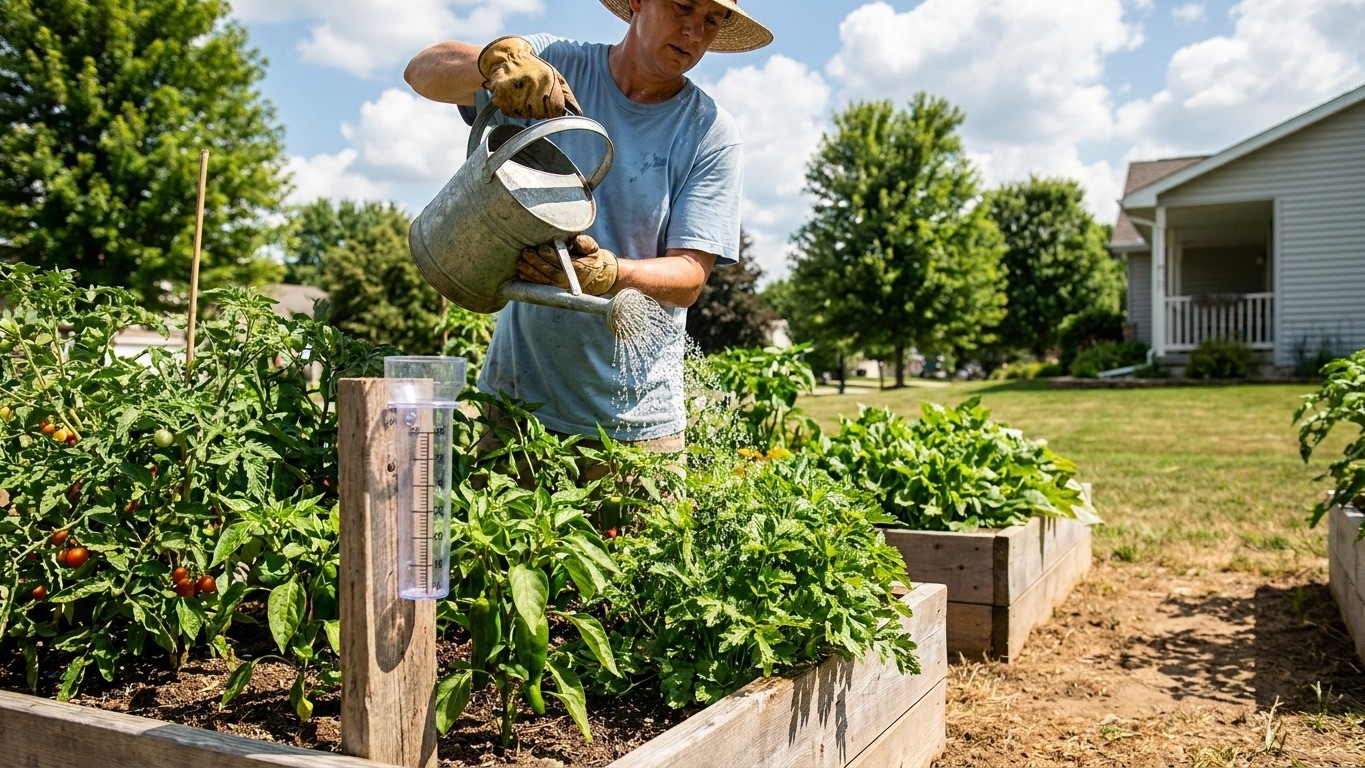
Rainfall totals for June, July, and August aren’t part of the verified figures here, so rather than guess at inches, the safer approach is to watch the pattern: Wisconsin summer precipitation typically arrives as scattered thunderstorms, meaning one part of a county can get soaked while a garden ten miles away stays dry. That unevenness is exactly why a rain gauge in your own yard beats any statewide average. If you’re not tracking rainfall directly, treat every week without a soaking storm as a week you need to make up the difference yourself, and Watering Through a Dry Spell in Wisconsin lays out exactly how to do that.
Soil across the state varies enough that it changes the math almost as much as the weather does. The central sands region holds water about as well as a colander, draining fast and forcing more frequent watering even after a decent rain. Southeastern Wisconsin, by contrast, carries more clay-heavy ground that holds onto moisture for days, sometimes to the point of drowning roots if you add water on top of what’s already there. Knowing which side of that line your yard falls on matters more than any single average rainfall number, because it decides whether your garden is thirsty two days after a storm or still soggy a week later.
The frost calendar bookends all of this. Last spring frost typically falls between April 16 and April 29, first fall frost between October 17 and October 29, both drawn from the same reference station used for the heat data. That gives most of southern Wisconsin a growing season of roughly five months, though Lake Michigan’s moderating effect pushes the lakeshore’s first freeze later, while inland and northern parts of the state can see frost arrive noticeably earlier.
| Climate factor | Figure | What it changes for watering |
|---|---|---|
| Days above 90°F | 7.0 days/year | Short, sharp heat spells demand quick response, not constant heavy watering |
| Last spring frost | April 16-29 | Sets when tender seedlings can go in without frost protection |
| First fall frost | October 17-29 | Marks when watering demand tapers off for the season |
| USDA zones | 3b-6a (statewide) | Northern Wisconsin gardens work with a shorter season than the south |
How much, how often
The standard advice for a vegetable or flower bed is about an inch of water a week, delivered all at once or in two sessions rather than a little every day. Deep, infrequent watering pushes roots downward, chasing the moisture that’s sunk below the surface. Daily light sprinkling does the opposite: it keeps roots shallow and close to the surface, right where the sun bakes them during one of those seven 90-degree days. A garden watered this way looks fine for a week, then wilts fast the moment a hot spell hits, because there’s no reserve of moisture sitting deeper in the soil.
The simplest way to know whether it’s actually time to water is to check, not guess. Push a finger two inches into the soil near the base of a plant, or use a trowel to peek at the top few inches. If it’s dry at that depth, water. If it’s still damp, wait. This beats any fixed schedule because it responds to what your specific yard is doing that week, not what a general rule assumes.
The sequence that works
- Check soil moisture two inches down at the base of the plant before watering at all.
- Water early in the morning, before the heat of the day, so moisture soaks in rather than evaporating off the surface.
- Apply water directly at the base of the plant, not overhead onto the leaves, to avoid fungal issues that thrive in Wisconsin’s humid summer air.
- Deliver roughly one inch of water per week for most vegetable and flower beds, split into one or two deep sessions rather than daily sips.
- On sandy soil, common in the central part of the state, shorten the interval and water more often since the ground holds little moisture between sessions.
- On clay-heavy soil, common in southeastern counties, water less often but never while the ground is still wet from a prior soaking, since clay drowns roots quickly and shouldn’t be worked or watered when saturated.
Tie all of this back to the season’s shape: with only about seven days a year reaching real heat extremes, most weeks don’t demand emergency watering. The exception is exactly those hot stretches, when evaporation accelerates and even clay soil can dry out at the surface within a couple of days. Watch for those spells specifically rather than watering on autopilot through a calm, cooler week in June.
Restrictions and rules
Watering restrictions exist in many Wisconsin communities, particularly municipal water utilities that manage summer demand spikes, but the specifics (odd/even day schedules, time-of-day bans, outright hose restrictions during drought) vary by city and change from year to year depending on conditions. There’s no single statewide watering law that applies uniformly, so a rule that applies in one county or city may not exist next door.
Because Wisconsin’s summer rainfall arrives unevenly in scattered storms rather than steady soaking rain, some areas run drier stretches than others in a given year, and that’s exactly when local utilities are most likely to introduce temporary restrictions. A yard that hasn’t seen rain in two weeks during a hot July stretch is a much more likely candidate for a watering advisory than one that just got a thunderstorm.
Rather than guess at what applies to your address, check directly with your local water utility or municipality before setting an irrigation timer or scheduling regular hose use. Many Wisconsin municipalities post current restrictions on their utility websites, and some adjust them week to week during dry periods. The University of Wisconsin-Madison Division of Extension is also a reliable starting point for region-specific guidance on both watering practices and where to find your local utility’s current rules.
Using less
Cutting water use in a Wisconsin garden doesn’t mean cutting corners on plant health. It means putting the water you do use where it counts and losing less of it to evaporation, runoff, or thirsty soil that can’t hold onto it. A few techniques do most of the work:
- Mulch, two to three inches deep: cuts surface evaporation dramatically and keeps soil temperature more even, which matters most during those seven annual days above 90°F when bare soil bakes fast.
- Drip irrigation or soaker hoses: deliver water directly to the root zone instead of spraying it into the air where wind and heat can carry off a good portion before it ever reaches the soil.
- Grouping plants by water need: keeps thirsty vegetables separate from more drought-tolerant natives, so you’re not overwatering the tough plants just to keep up with the needy ones next to them.
- Adding organic matter to soil: compost worked into sandy central-Wisconsin ground helps it hold moisture longer between waterings, while the same amendment in clay-heavy southeastern soil improves drainage so water doesn’t pool at the roots.
- Rain barrels, where local rules allow them: a rough rule of thumb is that an inch of rain falling on 1,000 square feet of roof yields about 600 gallons of runoff. Given how unevenly Wisconsin summer rain falls, a barrel can fill fast during a single thunderstorm and then sit half-empty through a dry stretch that follows, so it’s a supplement to a watering routine, not a replacement for it.
None of these techniques work in isolation as well as they do together. Mulch keeps the water that drip irrigation delivers from evaporating right back out, and organic matter worked into either soil type makes every gallon applied stretch further, whether the ground underneath is sand that drains too fast or clay that holds too much.
Common questions
How often should I water a Wisconsin vegetable garden in summer?
Check soil moisture two inches down before watering rather than following a fixed schedule. Most beds want about an inch of water a week total, delivered in one or two deep sessions. Sandy soil, common in the central part of the state, needs more frequent watering than clay-heavy ground in the southeast.
What time of day should I water?
Early morning is best. It gives water time to soak into the soil before the heat of the day increases evaporation, and it lets any moisture that lands on foliage dry off before evening, reducing the risk of fungal disease in Wisconsin’s humid summer air.
Are there watering restrictions in Wisconsin?
Restrictions vary by municipality and change based on local conditions, so there’s no single statewide rule. Check directly with your local water utility before setting up a regular irrigation schedule, especially during dry stretches in July or August.
Do rain barrels make sense in Wisconsin?
Where local rules permit them, yes, as a supplement. A roof catching an inch of rain over 1,000 square feet sheds around 600 gallons, but Wisconsin’s scattered summer storm pattern means a barrel can fill quickly and then run dry during longer gaps between rain events. It won’t replace a full watering routine but it takes pressure off it.