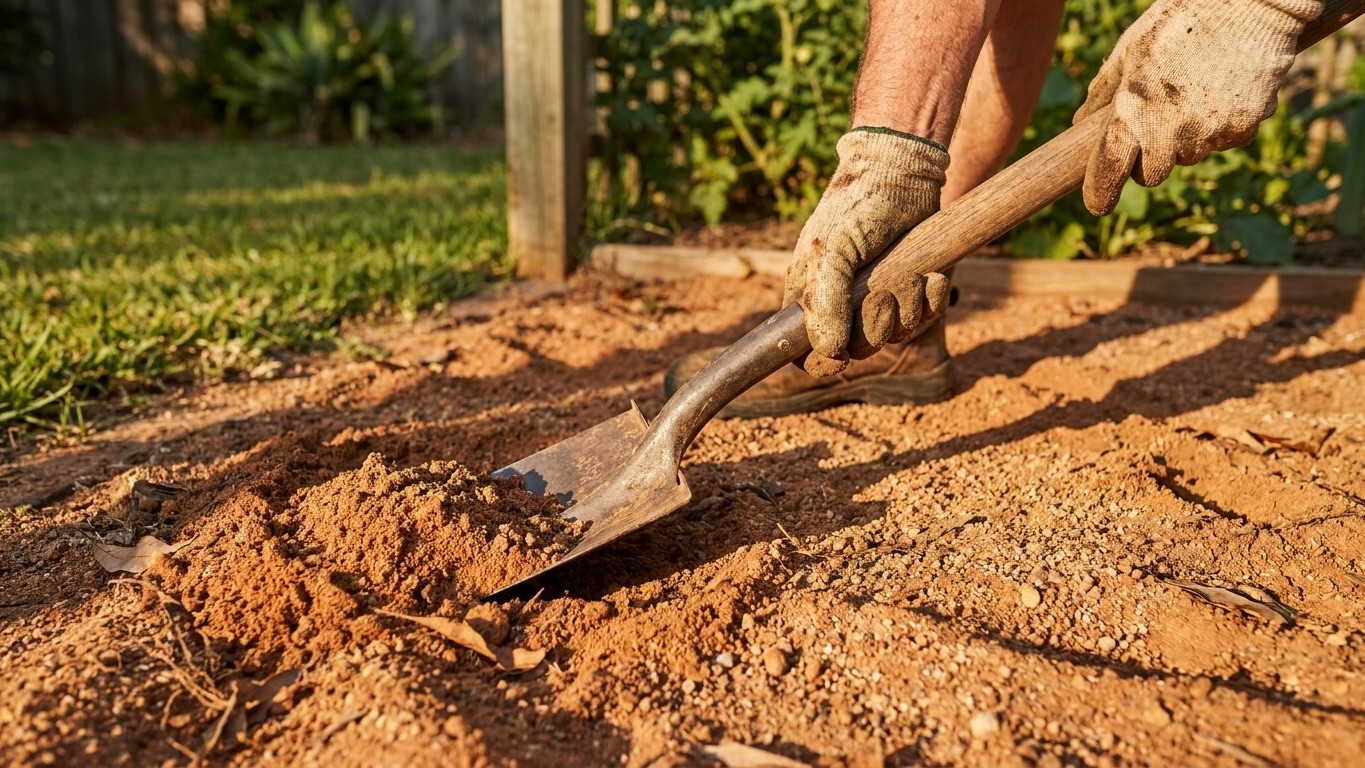

Dig a shovel into most Alabama ground and you’ll hit sandy, reddish soil that drains fast but holds almost no fertility on its own. The state’s official soil, the Bama series, is acidic, low in organic matter, and naturally poor in nutrients. Knowing that tells you what you’re working against before you plant a single seed.
What is under your garden

Alabama’s official state soil is the Bama series, an Ultisol. That classification matters more than it sounds like it should: Ultisols are old, heavily weathered, leached soils that have spent thousands of years losing minerals to rainfall. They are naturally acid and naturally low in nutrients, and the Bama series is a textbook example of the type. Alabama law named it the official state soil in 1997, and USDA’s National Resources Conservation Service tracks it as one of the soils that best represents the state’s agricultural land.
The numbers behind that name are specific. According to USDA NRCS Soil Data Access, the representative surface horizon of the Bama series runs a surface pH around 5.3, which is strongly acid. Texture is sandy: 67 percent sand, 14 percent clay, and 19 percent silt. Organic matter sits around 0.8 percent, and the series is classified as well drained. Those figures come from measurements across 103 mapped components of the series, so they are not a guess. They are also not your backyard’s number.
The gap between the state soil and your soil
The Bama series describes ground that represents Alabama broadly. It does not describe every garden bed in the state, and it certainly does not describe the compacted fill dirt behind a house built in 2015, or the heavy river-bottom clay two counties over. A state soil is a summary, not a survey of your yard. If a builder scraped your topsoil during construction, or trucked in fill, you’re gardening in something that has no relationship to the Bama series at all.
You can find out what you’re actually standing on in about five minutes, no lab required. Take a handful of moist soil and squeeze it between your thumb and forefinger, pushing it upward to form a ribbon. Sandy soil won’t ribbon at all, it just falls apart, gritty and loose. Loam forms a short ribbon, maybe an inch, before breaking. Heavy clay ribbons out two inches or more and feels slick, almost like modeling clay. The other test takes overnight: fill a clear jar about a third full of soil, top it off with water, shake it hard, and let it sit. Sand settles first, within a minute or two. Silt follows over the next hour. Clay stays suspended and settles last, often not until the next morning, leaving distinct layers you can measure with a ruler. Do both tests and you’ll know, in plain terms, what you’re digging into.
Testing before you amend
Buying lime or sulfur before you test is the gardening equivalent of taking medicine for symptoms you haven’t diagnosed. A soil test tells you the actual pH of your bed, the phosphorus and potassium levels, and often the organic matter percentage. None of that is visible to the eye. Soil that looks rich and dark can still be short on phosphorus, and soil that looks pale and sandy can sometimes surprise you with decent fertility if it’s been amended over the years.
How to take a sample that means something
One scoop from one spot tells you almost nothing useful. A proper sample comes from several cores, eight to ten if you can manage it, taken from different spots across the bed and mixed together in a clean bucket. Dig each core to the depth where roots actually live, which for most vegetable and flower beds is six to eight inches, not just the top inch of mulch and topsoil. Mix the cores thoroughly, pull about a pint of the blended soil, let it air dry, and that’s your sample. Testing separate beds separately is worth the extra few dollars if your yard has an old garden spot and a newer one, since they can read completely differently.
Given what the Bama series shows for the region, a fair expectation going in is that your result will lean acid, likely somewhere in the 5 to 6 range, with organic matter on the low side. But that’s an expectation, not a number. The whole point of testing is replacing what you’d guess with what’s actually true of your ten square feet of dirt, and the lab report will tell you exactly how much lime or sulfur to add, in pounds per hundred square feet, rather than leaving you to eyeball it.
Amending it
The Bama series pH of about 5.3 falls well under the 5.5 threshold where lime becomes the obvious tool. If your own test comes back in that same acid range, lime is the lever to pull, not sulfur. Adding sulfur to already-acid ground pushes the pH further in the wrong direction and can stress or kill plants that need a more neutral root zone. Acid soil in this range locks up phosphorus so plants can’t absorb it even when it’s present in the ground, and it makes life miserable for brassicas like broccoli and cabbage, which are especially prone to clubroot disease in acid conditions. The fix is agricultural lime, applied at the rate your soil test recommends, worked into the top six inches. Here’s the part gardeners don’t want to hear: lime works over seasons, not weeks. Expect a meaningful pH shift to take six months to a year, since lime has to dissolve gradually and react with the soil.
If your particular ground tests the other direction, above about 7.3 (which can happen near old foundations, driveways, or anywhere concrete has leached lime into the bed for decades), the rule flips completely. Lime must never go on ground that’s already alkaline. The honest, slow route there is elemental sulfur plus steady additions of organic matter, both of which nudge pH down gradually. High pH locks up iron, and that’s exactly what’s behind yellow leaves with green veins, a classic sign of iron chlorosis in alkaline soil.
Working with the texture you’ve got
The Bama series runs sandy, 67 percent sand against just 14 percent clay, and a lot of Alabama gardens share that lean. Sandy ground doesn’t hold water or nutrients, so everything you add tends to wash through before roots can use it. Organic matter, compost, aged manure, leaf mold, worked in every season, is what actually fixes that, along with shorter and more frequent watering instead of long soaks that just drain past the root zone. If your own soil turns out heavier and clay-dominant instead, the fix is the same ingredient with different rules: organic matter, worked in gradually, never sand mixed into clay (that combination can set up almost like concrete), and never dug or tilled while wet, since working wet clay destroys its structure for a full season. Organic matter fixes both extremes but on different timelines. Sandy soil shows improvement within a single growing season. Heavy clay takes closer to three seasons of steady additions before the structure genuinely changes.
Drainage and compaction
The Bama series is classified as well drained, which in practice means water moves through it steadily without pooling for long after a storm. If your own garden holds standing water an hour after rain, or stays soggy for a day or two, you’re not dealing with anything close to the state soil’s drainage behavior, regardless of what the survey map says about your area.
Testing it yourself
The percolation test is simple and takes about an hour of your afternoon. Dig a hole roughly a foot deep and a foot wide, fill it completely with water, and let it drain once to saturate the surrounding soil. Fill it a second time and start timing how fast the water level drops. A drop of one to three inches per hour is good garden drainage. Under an inch per hour means the soil is holding water tight and you’re looking at a drainage problem, often clay-driven. More than four inches an hour means water is running through so fast that nutrients and moisture are gone before roots get a chance at them, typical of sandy ground.
Compaction is a separate issue from natural drainage, and it’s usually caused by foot traffic, wheelbarrows, or equipment compressing the soil structure over years. Double digging, once the standard fix, has fallen out of favor because it disrupts soil biology and earthworm activity more than it helps, and the compaction often returns within a season anyway. For ground that’s genuinely compacted, tight clay, or draining poorly no matter what you add, a raised bed is often the more honest answer than years of amendment. Building up six to twelve inches of good soil above grade sidesteps the underlying problem entirely instead of fighting it season after season, and for anyone dealing with heavy, poorly draining ground, that’s usually the faster and less frustrating path to an actual harvest.
Local help
Alabama gardeners can get their soil tested through the Alabama Cooperative Extension System, which runs the state’s soil testing lab and keeps costs low. County extension offices help interpret the results in person, walking through what the pH and nutrient numbers mean for whatever you’re planting, which takes the guesswork out of the amendment step entirely.
Common questions
Is all Alabama soil acidic like the Bama series?
Most native Alabama soil leans acidic because the state’s Ultisols are old and heavily leached, but exceptions exist near limestone deposits, old concrete, and certain river bottoms. A soil test is the only way to know your own number.
How often should I retest my soil after amending it?
Every two to three years for an established bed, or annually if you’re actively correcting a pH problem with lime or sulfur, since those amendments shift the number slowly and you’ll want to track progress rather than guess at it.
Can I use the Bama series pH of 5.3 as my own garden’s number?
No. That figure describes the mapped surface horizon of a representative series, not a cultivated bed. Fill dirt, disturbed ground, and ordinary variation across a county can all produce a very different result, which is exactly why testing your own soil matters.
What’s the fastest way to improve sandy Alabama soil?
Organic matter worked in every season, paired with shorter and more frequent watering. Sandy ground responds within a single growing season, faster than clay, because it doesn’t need the structural rebuild that heavy soil requires.
Related guides
- Mississippi Soil: What You Are Digging Into, and How to Improve It
- Tennessee Soil: What You Are Digging Into, and How to Improve It
- Alaska Soil: What You Are Digging Into, and How to Improve It
- Arkansas Soil: What You Are Digging Into, and How to Improve It
- Missouri Soil: What You Are Digging Into, and How to Improve It