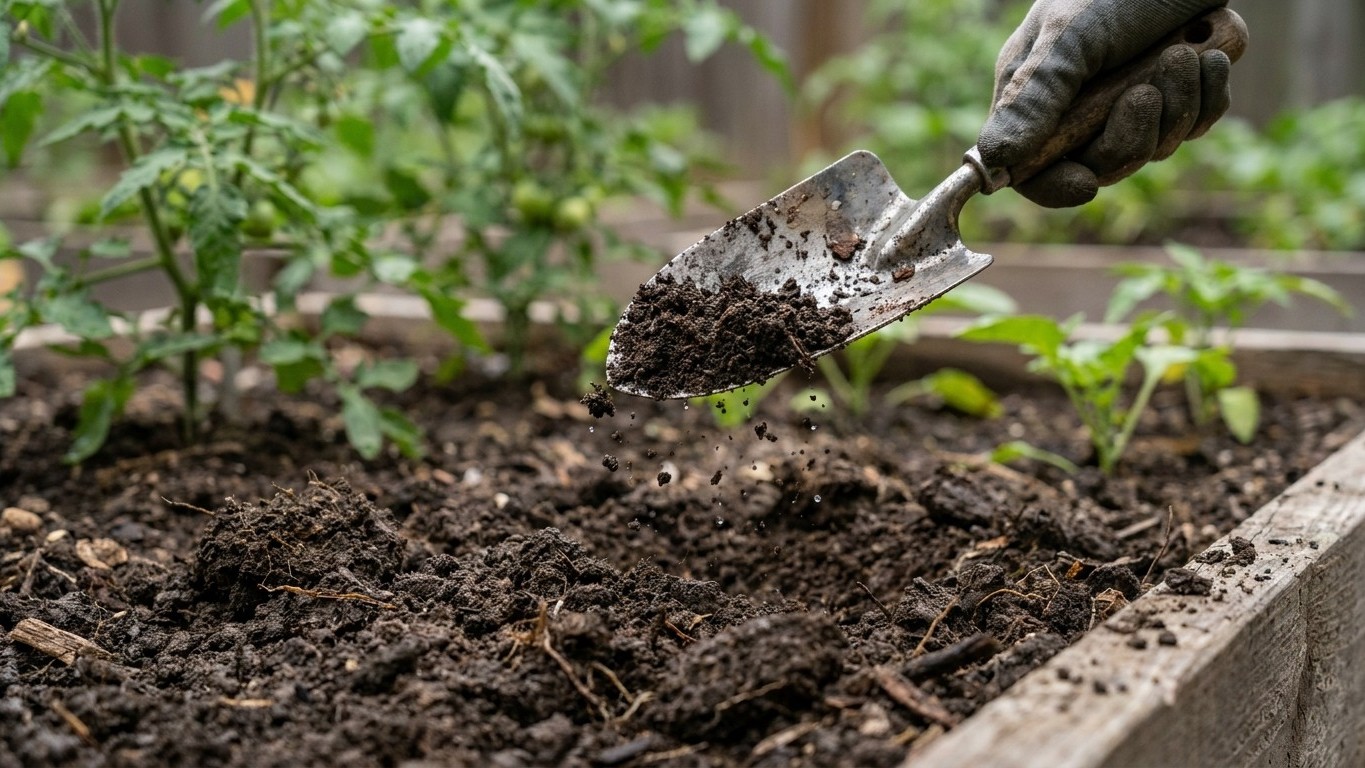

Dig a shovel into Arkansas ground and you’re most likely hitting something related to the Stuttgart series, a slightly acid, silt-heavy loam that drains slower than you’d like. But “Arkansas soil” isn’t one thing. The state’s official soil tells you what the region tends toward, not what’s under your particular tomatoes. Here’s what the state soil actually is, how to check your own dirt in five minutes, and what to do once you know the real numbers.
What is under your garden

Arkansas’s official state soil is the Stuttgart series, named by state law in 1997 as part of the USDA NRCS State Soils programme. It’s an Alfisol, a forest soil classification that generally holds nutrients better than the more heavily weathered soils found further south. That’s the good news baked into its chemistry: an Alfisol isn’t stripped bare of fertility the way tropical soils can be.
The numbers USDA records for the surface horizon of the Stuttgart series’ major components are specific. Surface pH runs about 5.6, which is slightly acid. Texture comes in at 30 percent sand, 16 percent clay, and 54 percent silt, a loam-to-silt profile. Organic matter sits around 1.8 percent. Drainage is classified as somewhat poorly drained, meaning water doesn’t move through it quickly.
Put those together and you get a picture: a silty soil that feels smooth rather than gritty, holds moisture longer than sandy ground, runs mildly acid, and doesn’t have a lot of decayed organic material working in its favor. That’s a soil that can grow good vegetables and grass, but one that will puddle after a hard rain and benefit from steady organic inputs over the sand percentage.
Why this isn’t necessarily your yard
Here’s the honest part. The Stuttgart series represents the state on paper, not the ground under your specific raised bed or backyard plot. Arkansas contains river bottoms, hill country, and delta flats that behave nothing alike. And any ground a builder has scraped, graded, or filled during construction is essentially a different material entirely, often subsoil with none of the topsoil structure a native series describes. If your house is newer than about fifteen years, assume your “soil” started as fill dirt.
You can get a fast read on what’s actually in your yard without waiting on lab results. Grab a small handful of moist soil and try to roll it between your thumb and forefinger into a ribbon. Silt and loam soils, like Stuttgart’s surface layer, will form a short ribbon that breaks easily, maybe an inch or two before it snaps. Heavy clay stretches into a long, shiny ribbon over two inches. Sandy soil won’t ribbon at all, it just falls apart.
The second test takes overnight but tells you more. Fill a clear glass jar about a third full with soil, top it off with water, shake it hard, and let it sit undisturbed for a full day. Sand settles first and forms the bottom layer within minutes. Silt follows, settling within a few hours. Clay stays suspended longest and forms the top layer, sometimes taking most of a day to fully settle. Measure the layers and you’ve got a rough texture reading of your actual dirt, not the state’s.
Testing before you amend
Guessing at soil amendments is how gardeners end up with land that’s worse off than when they started. Your eyes can tell you if soil is compacted or sandy, but they can’t tell you the actual pH, phosphorus level, or potassium level. Dumping lime on soil that’s already neutral, or sulfur on ground that’s already acid, can set a garden back a full season or more.
A proper sample isn’t one scoop from one spot. Take eight to ten small cores from across the planting area, using a trowel or soil probe, digging to about six to eight inches, which is roughly where most vegetable and lawn roots actually live. Mix those cores together in a clean bucket, remove any rocks or roots, and pull about a pint of the blended soil for the sample. Testing one corner of the yard and assuming it represents the whole space is a common mistake that skews results.
When results come back, the report typically shows pH, along with phosphorus, potassium, and sometimes organic matter and micronutrients. The lab usually adds specific lime or fertilizer recommendations based on what you’re planning to grow, since a lawn and a vegetable bed need different targets.
Given the state soil’s surface pH of about 5.6, it’s reasonable to expect many Arkansas yards to run on the acid side too, particularly in areas with similar parent material. But expecting isn’t knowing. Fill dirt, decades of lime application by a previous owner, or naturally alkaline pockets can all throw that expectation out the window. The only way to know your actual number is to test it.
Amending it
The state soil’s pH of about 5.6 points in one clear direction: if your own test comes back below roughly 5.5, lime is the tool that works, not sulfur. Acid soil in that range locks up phosphorus so plants can’t access it even when it’s present in the ground, and it makes life hard on brassicas like broccoli and cabbage, which prefer a pH closer to neutral. The catch is patience. Lime doesn’t move fast. It reacts with soil moisture and existing acidity over months, not weeks, so a fall application is working toward a spring planting, not an immediate fix.
If your test comes back above about 7.3, the correction runs the opposite direction entirely, and the rule here is absolute: lime should never go on that ground. Adding lime to already-alkaline soil pushes pH higher and locks up iron even further. Elemental sulfur, worked in gradually along with regular additions of organic matter like compost or aged manure, is the slow and honest way to bring alkaline soil back down. If you’re seeing yellow leaves with the veins still green, that’s classic iron chlorosis, and it’s what high pH does to iron availability. More fertilizer won’t fix it. Lower pH will.
Texture tells you the other half
The state soil’s texture, 16 percent clay against 54 percent silt, leans toward heavy and slow-draining rather than loose and sandy. If your own soil tests out closer to heavy clay, organic matter is the fix, worked in as compost or leaf mold over repeated seasons. Never add sand to clay soil hoping to lighten it; that combination tends to set up like poor concrete instead of loosening anything. And never work clay soil while it’s wet. Digging or tilling wet clay creates compacted clods that can take a year or more to break back down.
If your soil runs sandy instead, the fix is also organic matter, but the watering strategy changes too. Sandy soil drains so fast that nutrients and moisture wash through before roots can use them, so shorter, more frequent watering sessions work better than the deep occasional soaking that clay tolerates.
Here’s the timeline difference worth knowing upfront: pH correction with lime or sulfur is a multi-season project, often two to three years before you see the full swing. Organic matter improvements to texture and drainage show partial results within a single growing season, though the full structural change, better crumb, better water-holding, better root penetration, builds over three seasons of consistent additions.
Drainage and compaction
The state soil carries a somewhat poorly drained rating, and that classification has a real, visible consequence: water sits. After a hard rain, somewhat poorly drained ground can stay soggy for a day or more rather than soaking through within hours. If you’ve noticed standing water in a low spot of your yard well after the storm has passed, that’s the drainage class talking.
You can measure your own drainage with a simple percolation test. Dig a hole about a foot deep and roughly the same width, fill it completely with water, and let it drain once so the surrounding soil is saturated. Then fill it a second time and time how fast the water level drops. A drop of one to two inches per hour is generally good drainage for most garden plants. Anything under half an inch per hour signals slow, poorly draining ground, similar to what the somewhat poorly drained classification describes. Anything over three inches per hour usually means sandy, fast-draining soil that will need more frequent watering.
When digging deeper makes it worse
Compaction from foot traffic, lawn mowers, or construction equipment squeezes air pockets out of soil, and that’s often a bigger problem than texture alone. Double digging, the old practice of turning soil two shovel-depths deep, has fallen out of favor among experienced gardeners because it disturbs soil layers and can actually bring compacted subsoil up to the surface while burying the better topsoil below it. A single pass of loosening, paired with a thick layer of compost worked into the top several inches, generally does more good with less disruption to soil structure.
Sometimes the honest answer isn’t more amendment at all. On ground that’s testing slow drainage, heavy clay, and low organic matter all at once, a raised bed filled with quality garden soil sidesteps years of correction work. If your percolation test comes back under half an inch per hour and you’re not willing to spend three seasons building organic matter, building up is the faster, more reliable bet than fighting the ground you’ve got.
Local help
The University of Arkansas Division of Agriculture runs soil testing through its Cooperative Extension Service. County extension offices collect samples and can walk through the results with you once the report comes back, translating lab numbers into an actual plan for your lawn or garden bed rather than leaving you to interpret a spreadsheet alone.
Common questions
Is all Arkansas soil acidic?
Not necessarily. The state soil’s surface pH runs about 5.6, slightly acid, but individual yards vary widely depending on parent material, fill dirt, and past lime applications. Testing your own soil is the only way to know for sure.
Can I use the state soil’s numbers instead of testing my yard?
No. The Stuttgart series figures describe representative surface conditions across mapped components of that series, not any single garden. Fill dirt, grading, and regional variation mean your actual soil could differ completely.
How long does it take to fix acidic soil with lime?
Lime works over months, not weeks, since it needs to react with soil moisture and existing acidity. Most gardeners apply it in fall for a spring planting, and full correction on heavily acid ground can take more than one season.
What does yellowing between green leaf veins mean?
That pattern, called iron chlorosis, usually points to high soil pH locking up iron rather than a lack of fertilizer. Adding more nutrients won’t help; lowering the pH with elemental sulfur and organic matter addresses the actual cause.
Related guides
- Missouri Soil: What You Are Digging Into, and How to Improve It
- Tennessee Soil: What You Are Digging Into, and How to Improve It
- California Soil: What You Are Digging Into, and How to Improve It
- Alabama Soil: What You Are Digging Into, and How to Improve It
- Nevada Soil: What You Are Digging Into, and How to Improve It