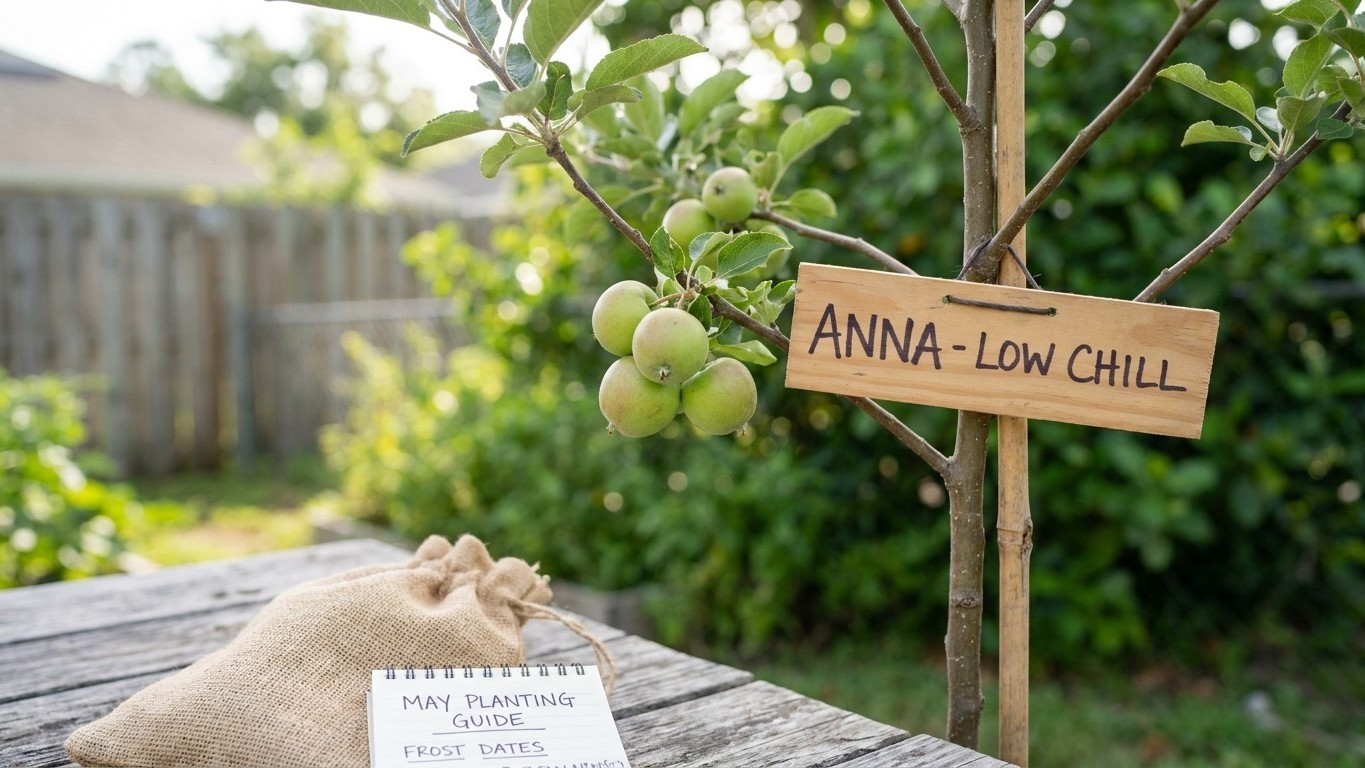

Yes, apples grow in Florida, but only in the northern part of the state and only with low-chill varieties bred for a short winter. USDA’s Plant Hardiness Zone Map (2023 normals) puts the state at zones 8b to 11b, and near Jacksonville the coldest month averages a nightly minimum of 41.4°F, NOAA’s NCEI 1991-2020 climate normals show, cold enough most winters to satisfy a low-chill cultivar’s dormancy needs. Start by choosing a variety bred for a low winter-chill requirement, not a cultivar off a northern nursery’s bestseller list.
Can you grow apples in Florida
A Gala tree planted in Miami will leaf out, flower thin, and never size a decent crop, no matter how carefully you guard it from frost. The grower did everything right for cold snaps and still lost the season, because the tree never actually went to sleep. Frost was never the threat. Chill was, and south and central Florida rarely bank enough of it. That’s the mistake worth naming before picking a variety or a planting date.
That chill, not frost, is the real dividing line for apples in Florida. Apples are one of the few temperate fruits that actually want a cold winter, not just a mild one that stays above freezing. The farther south you go, the less winter chill accumulates, and central and south Florida rarely see the sustained cool stretch an apple tree needs, even from its warmest-adapted cultivars. That doesn’t make apples impossible in south Florida. It means no widely documented local program grows them there, and a home gardener attempting it is working without a map.
Other parts of the state differ
North Florida, roughly the band from Jacksonville toward Tallahassee and inland from there, is where growers actually get fruit. It is still a marginal apple climate by national standards. You are choosing among a short list of low-chill cultivars, not the hundreds of varieties available to a New England or Appalachian orchard. This Florida apple Best varieties guide narrows that list further, and pairing it with a Florida apple Calendar helps time the chill window correctly. But it is a real option, not a stretch.
The panhandle sits at the cooler end of Florida’s zone range and gets closer to a normal winter than any other part of the state. The central peninsula, around Orlando, runs warmer and the chill window narrows further. South Florida, from around Lake Okeechobee down through Miami, essentially does not go dormant in a typical winter, and the whole idea of a chill-driven calendar stops applying there. Any of the frost figures in this article, all measured near Jacksonville, do not transfer south of the panhandle and north-central band.
Which varieties suit this climate

Almost every classic apple you’d find at a nursery counter in the North is bred for a winter far colder than north Florida delivers, even at the cooler Jacksonville end of the state’s range. Hardiness zone tells you whether the wood survives a Florida winter. It says nothing about whether the tree actually flowers well the following spring, and that second filter, winter chill, is the one most general planting guides skip.
Winter chill: the filter hardiness alone misses
A tree that gets too little chill for its breeding wakes up in a ragged, uneven bloom spread over weeks instead of days, sometimes leafing out before it flowers at all. That is a pollination failure waiting to happen, not a cosmetic quirk. North Florida sits at the low-chill end of the national spectrum, which means the varieties worth planting here are the ones nurseries catalog specifically for the Deep South and similar mild-winter regions: ‘Anna’, ‘Dorsett Golden’, ‘Ein Shemer’ and ‘TropicSweet’. All four are cataloged with chill requirements in the low hundreds of hours, roughly a third to a tenth of what a Honeycrisp or a Fuji is bred to expect, and all four are known for early bloom that fits a short Florida winter.
| Variety | Published chill need | Ripening season | Pollen |
|---|---|---|---|
| ‘Anna’ | Low (catalogued for mild-winter regions) | Early to midsummer | Partially self-fertile, crops better with a partner |
| ‘Dorsett Golden’ | Very low | Early summer | Fertile, good partner for Anna |
| ‘Ein Shemer’ | Low | Early summer | Self-fertile, also pollinizes Anna |
| ‘TropicSweet’ | Low | Early to midsummer | Bred as a low-chill alternative to Anna |
Compare that to the classic apple belt of north Georgia, where mountain elevation delivers far more chill and growers can plant the standard nursery lineup; our guide to growing apples in Georgia covers that very different set of varieties. Florida’s list is short because the filter is strict, not because fewer people have tried.
No source in our records shows the University of Florida’s IFAS Extension publishing its own ranked variety list for home orchards, so treat the cultivars above as the low-chill types most commonly cataloged for the Deep South rather than an official state recommendation. Check with your local extension office before planting, since chill accumulation and disease pressure both shift noticeably from the panhandle to the coast.
Planting a pair that works here
Apples need cross-pollination from a second, compatible variety blooming at roughly the same time, and among Florida’s short list of low-chill cultivars the realistic pairing is ‘Anna’ with ‘Dorsett Golden’ or ‘Ein Shemer’. All three are catalogued as early, low-chill bloomers, which in a north Florida spring means they tend to open within the same window, and both Dorsett Golden and Ein Shemer carry fertile pollen that Anna’s flowers can use.
Watch for sterile-pollen varieties before you buy a second tree. Some apple cultivars, typically triploid types, produce pollen that can’t fertilize anything, even though the tree itself still needs a pollinizer of its own. None of the four low-chill cultivars named above fall into that group, but if a nursery tree from a different climate zone tempts you as a second variety, check its pollen fertility first. A sterile-pollen tree adds a second problem instead of solving the first one.
Plant the two trees close enough that bees and other pollinators move between them on the same visit, ideally within sight of each other rather than at opposite ends of the yard. Prune both to an open, low-branched shape from the start. Low branches catch more of the fruit in a short-stature, low-chill tree, and they’re easier to cover if a late freeze threatens the flowers.
The frost that costs a crop here

NOAA’s NCEI 1991-2020 climate normals put the last spring freeze at 32°F near Jacksonville somewhere between February 16 and March 7, with the same data putting the first fall freeze between November 26 and December 13. That spring window is the one that matters most for apples, because low-chill varieties in north Florida often reach pink bud or full bloom by mid-to-late February, uncomfortably close to the tail end of that freeze range.
What a pink-bud frost actually kills
A freeze that arrives after the buds show pink usually does not kill the tree. It kills the flowers inside the bud, and with them the whole year’s crop, while the wood and leaves that follow look completely normal a week later. That is the trap: the tree looks fine, so it’s easy to assume nothing happened, until there’s no fruit set six weeks on.
Where local frost risk extends into the bloom window, the standard fix elsewhere is a late-blooming variety, one whose bud break is bred to lag the freeze window by design. Florida’s low-chill list doesn’t offer that option. These cultivars are selected for early bloom precisely because they need to fit a short winter, which is exactly why frost protection during the pink-to-bloom stretch matters more here than variety choice alone. Practical steps that actually help:
- Track bud stage rather than the calendar date. Bud break can run a week or two either side of average in a warm or cool winter.
- Keep frost cloth or old blankets ready to drape over young or low-branched trees whenever a night near 32°F is forecast during the pink-to-bloom window.
- Hold off on heavy nitrogen feeding in January, which can push bud break earlier before the freeze window has passed.
- Site young trees in the warmest spot available, near a south-facing wall and away from low ground where cold air settles.
The apple year in Florida
Timing an apple tree by the month is how growers get caught out. The tree runs on stage, not on date, and each stage should be checked against Jacksonville’s own frost windows rather than a generic calendar.
Reading the calendar by stage, not by date
- Dormancy: from leaf drop in fall through the coldest weeks of winter. This is when the tree banks the chill hours a low-chill cultivar needs, and the right time for any dormant-season pruning.
- Green tip: buds swell and show the first green. In a north Florida winter this can arrive well before the last-freeze window of February 16 to March 7 that NOAA’s NCEI normals record near Jacksonville, which is the first sign frost risk is no longer just theoretical.
- Pink bud: flower buds show color but haven’t opened yet. This is the single most frost-vulnerable stage, and it often lands inside or just before that same freeze window.
- Bloom: flowers open and pollinators move pollen between the two trees. A freeze at this stage costs the crop even when the tree itself comes through undamaged.
- Petal fall: petals drop and tiny fruit begin to swell. Frost risk is largely behind you by this point in most years.
- Fruit set: the tree naturally sheds some of its young fruit. That thinning is normal and needs no intervention.
- Harvest: early to midsummer for the low-chill varieties suited to this climate, well ahead of the long, humid stretch of Florida summer that follows.
Compare that short, compressed season to a state like Nebraska, where dormancy runs nearly half the year and the whole growing calendar is built around a much longer, colder winter. Our guide to growing apples in Nebraska lays out that opposite case, with a totally different set of varieties and risks.
Local help
For an updated variety list and spray guidance specific to your county, contact the University of Florida’s UF/IFAS Extension office. County agents can confirm which low-chill cultivars are actually performing in your area and flag current disease and pest pressure, which shifts noticeably from the panhandle down to south Florida.
Common questions
Can I grow a regular Honeycrisp or Fuji in Florida?
Not reliably. Honeycrisp and Fuji are bred for far more winter chill than north Florida receives, even at the cooler Jacksonville end of the state’s range, so the tree may survive but bloom poorly or not at all. Stick to low-chill cultivars bred for the Deep South, such as ‘Anna’ or ‘Dorsett Golden’.
Do I need two apple trees, or will one produce fruit alone?
Plan on two trees. Apples are not reliably self-fertile, and even the more self-fertile low-chill types like ‘Ein Shemer’ crop far better with a second, compatible variety nearby for cross-pollination.
What happens if a freeze hits after the flowers have already opened?
Open flowers are even more sensitive to cold than pink buds, so a freeze at full bloom can wipe out fruit set for the whole season. A freeze after petal fall, once tiny fruit have set, is usually far less damaging to the crop.
Can I grow apples in south Florida, like Miami or the Keys?
No documented local program covers it. That region essentially never goes fully dormant in a typical winter, so even the low-chill varieties bred for the Deep South don’t reliably get enough winter chill to flower well there.
How long before a newly planted apple tree bears fruit in Florida?
Most nursery-grown apple trees, including the low-chill varieties suited to this climate, begin bearing a useful crop two to four years after planting. The exact timeline depends on the rootstock and the size of the tree at planting, not on the region.