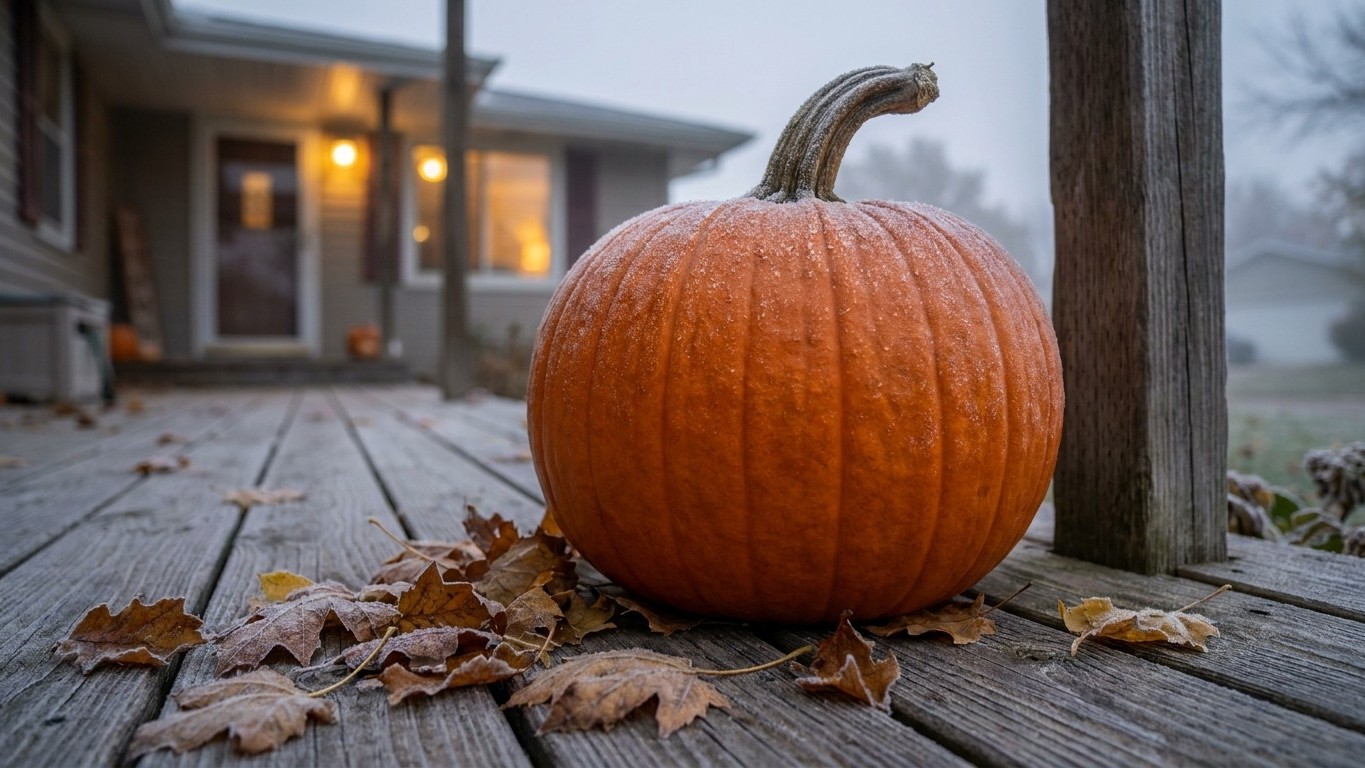

Nebraska’s mean first fall frost lands somewhere between October 15 and October 26, which is well ahead of Halloween on October 31. That gap matters: it decides whether your pumpkin sits outside safely or needs to come in before the cold arrives, and it shapes when carving actually makes sense.
The short answer

Around Omaha, the reference station NOAA tracks for Nebraska’s Climate Normals, the mean first fall frost falls somewhere in that October 15 to October 26 window. That’s an average built from three decades of data, not a promise for any single year, but it tells you something useful: frost in Nebraska tends to show up five to sixteen days before Halloween, not on it and not after it.
For a pumpkin sitting on a porch, that timing matters more than most people realize. A whole, uncarved pumpkin can handle a light chill just fine, but once temperatures start dropping toward freezing on a regular basis, the skin and stem are exposed to damage that shortens how long the pumpkin will keep. If your area follows the typical pattern, that means the smart move is bringing the pumpkin indoors, or into a sheltered spot, sometime in that mid-to-late October stretch, well before Halloween itself.
That doesn’t mean you should carve it early. Carving opens the pumpkin up in a different way than frost does, and there’s no research published on how long a carved pumpkin holds up once the flesh is exposed to air. What Nebraska’s frost timeline does tell you is when the whole pumpkin needs protection, and that’s a separate question from when to cut into it.
Putting those two pieces together gives a practical window. Keep the pumpkin whole and stored properly once frost risk sets in, likely starting somewhere in the back half of October depending on your specific location, and save the actual carving for the final couple of days before Halloween, or even the morning of. That keeps the exposed cut surface out in the open air for the shortest time possible, which is the one thing within your control since nobody publishes a shelf life for a jack-o’-lantern.
So the window isn’t really about counting days before Halloween for carving itself. It’s about protecting the whole pumpkin starting well before Halloween, because frost gets here first, and then compressing the carving itself into the last stretch before the holiday.
Frost or heat: which one gets it here
A whole pumpkin keeps best in a spot that holds steady between 45 and 50 degrees Fahrenheit, according to University of Illinois Extension. That band sits right in the middle of what a lot of climates struggle to hit naturally in late October. Nebraska’s issue isn’t heat. It’s the opposite.
The cold end
With the mean first fall frost landing between October 15 and October 26, Nebraska nights are already dipping toward or below 32 degrees well before Halloween most years. That’s colder than the 45-50 degree storage band a whole pumpkin wants, which means an uncovered pumpkin left outside on a porch or stoop risks frost damage before the holiday even arrives. Frost itself is a lighter event than a hard freeze, a surface chill that can nip skin and stems without necessarily driving deep into the flesh, but repeated exposure still speeds up soft spots and rot. Separately, the coldest month of the year in the Omaha area averages a daily minimum of 15.2 degrees, a figure that describes how cold the deep winter gets here in general, not what late October looks like specifically. It’s useful context for how much colder things get after Halloween, but it’s not a frost date, and it shouldn’t be read as one.
The warm end
In warmer states, the challenge runs the other direction: temperatures stay above that 45-50 degree band well into November, and pumpkins left out are more likely to soften from heat than from cold. That’s simply not the pressure Nebraska deals with. Here, the risk sits squarely on the cold side of the ledger, and the practical response is protecting the pumpkin from frost, not from warmth.
Where to keep it until you carve
Finding a spot in a Nebraska home that naturally sits in the 45-50 degree range takes a little thought, since most living spaces run warmer once the furnace kicks on. Here’s a practical order to work through.
- Start with an unheated attached garage. It’s usually the closest thing to that storage band in a typical Nebraska house, especially before the coldest stretch of the season sets in, and it keeps the pumpkin out of direct sun.
- Try an enclosed, unheated porch or mudroom if the garage isn’t an option. These spaces often run cooler than the rest of the house without dropping to outdoor frost temperatures.
- Check a basement, particularly an older, less-insulated one. Basements tend to hold steady temperatures and stay dark, both of which help a whole pumpkin last.
- Avoid the kitchen counter, a sunny windowsill, or anywhere near a heating vent. These spots run too warm and will age the pumpkin faster than the cooler options above.
- Keep the pumpkin away from any ripening fruit or vegetables, including apples, potatoes, or tomatoes. Ripening produce gives off a gas that speeds up aging in the pumpkin sitting next to it, which is exactly why the classic porch display next to a bushel of apples works against you.
- Handle the pumpkin by its body, not its stem. Look for a pumpkin with 1 to 2 inches of stem left when you buy it, since that stem acts as a seal over the top. Once it breaks off, that spot is exposed and spoils faster, so treat the stem as a seal to protect, never as a handle to lift or carry the pumpkin by.
Checking this against your own county
The frost figures here come from the Omaha weather station, and that’s a starting point, not a final answer for every yard in Nebraska. Suburban and rural properties commonly see their first fall frost arrive earlier than an airport station shows, sometimes by one to two weeks, and elevation pushes that even further in some parts of the state.
Nebraska Extension, part of the University of Nebraska-Lincoln, runs county offices across the state and is the best next step for anyone who wants numbers specific to their own location. Visit extension.unl.edu to find your county’s contact information and local growing and frost guidance rather than relying only on the single reference point this article uses.
Common questions
Can I carve my pumpkin before frost hits my area?
Yes. Frost timing affects a whole, uncarved pumpkin sitting outside, not when you’re allowed to carve. Many people bring the pumpkin in ahead of frost and carve it later, closer to Halloween, once it’s been stored properly indoors.
How long will a carved pumpkin actually last?
No university extension publishes a shelf-life figure or a preservation protocol for a carved pumpkin, so any specific number of days you’ve seen elsewhere isn’t research-backed. What is established: choose a pumpkin with an intact stem, keep it whole as long as possible in a cool, dark spot, and carve it close to the day you plan to display it.
Does bringing the pumpkin inside protect it from frost?
It does, as long as the indoor spot stays reasonably cool and dark rather than warm. A pumpkin left in a heated living room won’t freeze, but it will age faster than one kept in an unheated garage, porch, or basement closer to that 45-50 degree range.
What if my county’s frost date is different from Omaha’s?
That’s likely, especially outside the immediate metro area or at higher elevation. Contact your local Nebraska Extension office through extension.unl.edu for frost information specific to your county rather than assuming the Omaha reference station applies exactly to your yard.