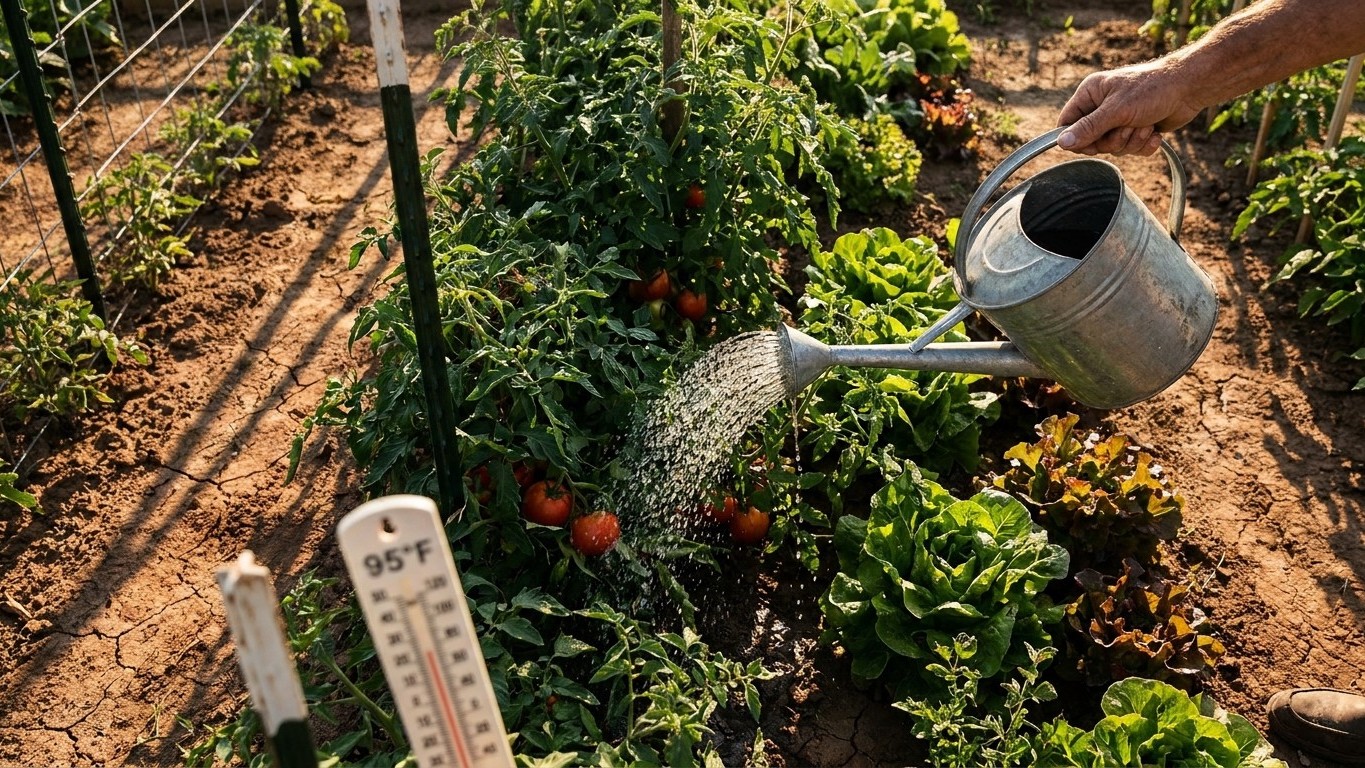

Nebraska gardeners face a blunt math problem every summer: the ground heats up fast, water demand climbs, and the sky doesn’t always cooperate. Knowing how much to water, how often, and which local rules apply can mean the difference between a productive plot and a stressed one by August.
What the climate asks of you

Start with the number that shapes the entire growing season: at the Omaha reference station, Nebraska averages 28.1 days a year at 90F or hotter, based on NOAA’s 1991-2020 Climate Normals. That’s not a handful of hot afternoons, it’s nearly a month of high-evaporation days spread across the growing season, and it’s the figure that rules out treating a Nebraska garden like one in a milder climate.
Summer rainfall itself varies too much across the state to boil down to a single honest number. Western Nebraska sits in a semi-arid belt while the eastern third gets noticeably more moisture, and the gap between a wet June and a dry July in the same county can be dramatic. Rather than guess at a figure that doesn’t hold up statewide, the more useful move is to pull the actual monthly normals for your own area from NOAA or from your local University of Nebraska-Lincoln Extension office, which tracks these figures by region.
What you can plan around is the arithmetic every gardener eventually learns: a vegetable or flower bed wants roughly an inch of water a week during the growing season. When 28.1 days a year push past 90F, evaporation eats into whatever rain does fall, so even a week that gets close to that inch on paper often leaves the top few inches of soil bone dry by the time you check it. That gap between what falls and what the plant actually gets to use is why irrigation planning matters here regardless of which part of the state you garden in.
Soil texture changes that equation further. Nebraska’s ground runs from the sandy soils of the Sandhills region to the heavier clay-loam and loess soils common across the eastern plains. Sandy ground lets water pass straight through, so a rainy week doesn’t buy you as many dry days as you’d expect. Clay and loess hold water longer but also compact and puddle if you work them while wet, which means the same storm that solves one gardener’s problem creates a different one two counties over.
How much, how often
The rule that holds up almost everywhere: water deep and infrequently rather than a little every day. Shallow daily sprinkles keep roots shallow too, right at the surface where the day’s heat bakes them. A deep soak a couple of times a week trains roots to grow down toward moisture that stays put longer, which matters on a day that’s pushing toward that 90F mark. This approach becomes especially critical when rain disappears for extended stretches, as detailed in this guide on Watering Through a Dry Spell in Nebraska. That said, this deep-and-infrequent logic applies mainly to in-ground beds; potted plants dry out on a different schedule entirely, so if you’re gardening on a patio or balcony it’s worth checking the specifics of Watering Pots and Containers in Nebraska.
The simplest test for when to water doesn’t involve a gauge at all. Push a finger, or the tip of a trowel, about two inches into the soil near the base of the plant. If it’s dry at that depth, it’s time to water. If it’s still cool and moist, wait another day and check again. This beats watering on a fixed schedule, because it responds to what’s actually happening in the ground rather than what the calendar says.
A practical watering sequence
- Check soil moisture first. Two inches down, at the base of the plant, before deciding whether to water at all.
- Water in the early morning. Cooler temperatures mean less water lost to evaporation before it reaches the roots, and leaves dry off before evening, which cuts down on fungal problems.
- Aim at the base, never the leaves. Overhead watering wastes a large share of the water to evaporation and wets foliage in ways that invite disease.
- Deliver roughly an inch a week, split into two sessions rather than one on sandy soil, since it drains fast and holds little between waterings.
- Stretch the interval on clay or loess ground, and never soak or work these soils while they’re already wet, doing so compacts them and can suffocate roots for a season.
- Adjust upward during heat stretches. On stretches near or above 90F, check soil moisture daily rather than every few days, since those are the days evaporation outruns whatever rain has fallen.
The frost-free window frames when any of this matters. At the Omaha reference station, the last spring frost typically falls between April 12 and April 23, and the first fall frost between October 15 and October 26. That’s the growing season most Nebraska gardens work within, though it’s worth remembering that suburban and rural gardens away from the airport station often see frost arrive a week or two earlier in fall and linger a week or two later in spring, sometimes more at higher elevation. Check your own county’s dates before setting a watering routine around them.
Restrictions and rules
Watering restrictions aren’t uniform across Nebraska, and they change from year to year depending on drought conditions, reservoir levels, and local water supply. Some municipalities set odd-even day schedules by address during dry stretches; others ask for voluntary reductions rather than enforced limits. None of that is fixed enough to state as a blanket rule for the whole state.
What is worth stating plainly: given how many days a year push past 90F here, and how uneven summer rainfall can be across the state’s regions, restrictions are a real possibility in any given year, not a rare exception. The only reliable source for what applies to your address is your local water utility or municipal website, since rules differ from one city or rural water district to the next and can shift mid-summer.
The Nebraska Extension network is also a solid starting point if you’re unsure who to contact, since local extension offices typically track which water districts have active restrictions and can point you toward the right agency for your county.
Using less
Cutting water use in a Nebraska garden doesn’t mean cutting yields, it usually means being more deliberate about where the water goes instead of how much you pour on. A few techniques do most of the work.
- Mulch, two to three inches deep. A layer of straw, shredded bark, or compost slows evaporation from the soil surface, which matters most during those 90-plus-degree stretches when bare soil dries out within hours of watering.
- Drip irrigation or soaker hoses. Delivering water directly at the root zone instead of overhead cuts the amount lost to evaporation and wind drift, and it works especially well on sandy soils that need frequent, targeted watering rather than broad overhead soaking.
- Group plants by water need. Keep thirsty vegetables like tomatoes and squash in one zone and drought-tolerant natives or perennials in another, so you’re not overwatering the tough plants to satisfy the thirsty ones.
- Build organic matter into the soil. Compost worked into sandy ground helps it hold moisture longer between waterings; worked into clay or loess, it improves drainage and structure so water soaks in rather than pooling and running off.
- Rain barrels, where local rules allow them. An inch of rain falling on 1,000 square feet of roof works out to roughly 600 gallons of runoff. That’s a meaningful amount to capture, but given Nebraska’s uneven summer rainfall and its stretch of 90-plus-degree days, don’t count on a barrel staying full through a dry spell, it can empty fast during the hottest weeks and needs a backup plan for those stretches.
None of these replace a watering routine built around soil checks and the local frost and heat data, they reduce how much water that routine actually requires.
Common questions
How do I know if my Nebraska soil is sandy or clay?
Squeeze a handful of moist soil. If it falls apart immediately, it’s sandy, common across the Sandhills region. If it holds a ball shape and feels sticky, it’s closer to clay or loess, typical of much of the eastern plains. This distinction changes both how often you water and how careful you need to be about not working the soil while it’s wet.
What USDA hardiness zone is Nebraska in?
Nebraska spans USDA zones 4a to 5b according to the 2023 Plant Hardiness Zone Map, with colder zones toward the northwest and milder zones toward the southeast. Since this is a statewide range, check your specific county rather than assuming a single zone applies everywhere.
Does watering restrictions status change every year?
Yes. Restrictions typically tighten during drought years and ease during wetter ones, and they’re set locally rather than statewide. Check with your municipal water provider or rural water district each spring rather than relying on last year’s rules.
Should I water my garden the same amount all summer?
No. Watering needs climb during stretches near or above 90F, which happen roughly 28.1 days a year on average at the Omaha reference station, and ease during cooler, wetter spells. Basing your schedule on a soil check rather than a fixed calendar accounts for that swing automatically.