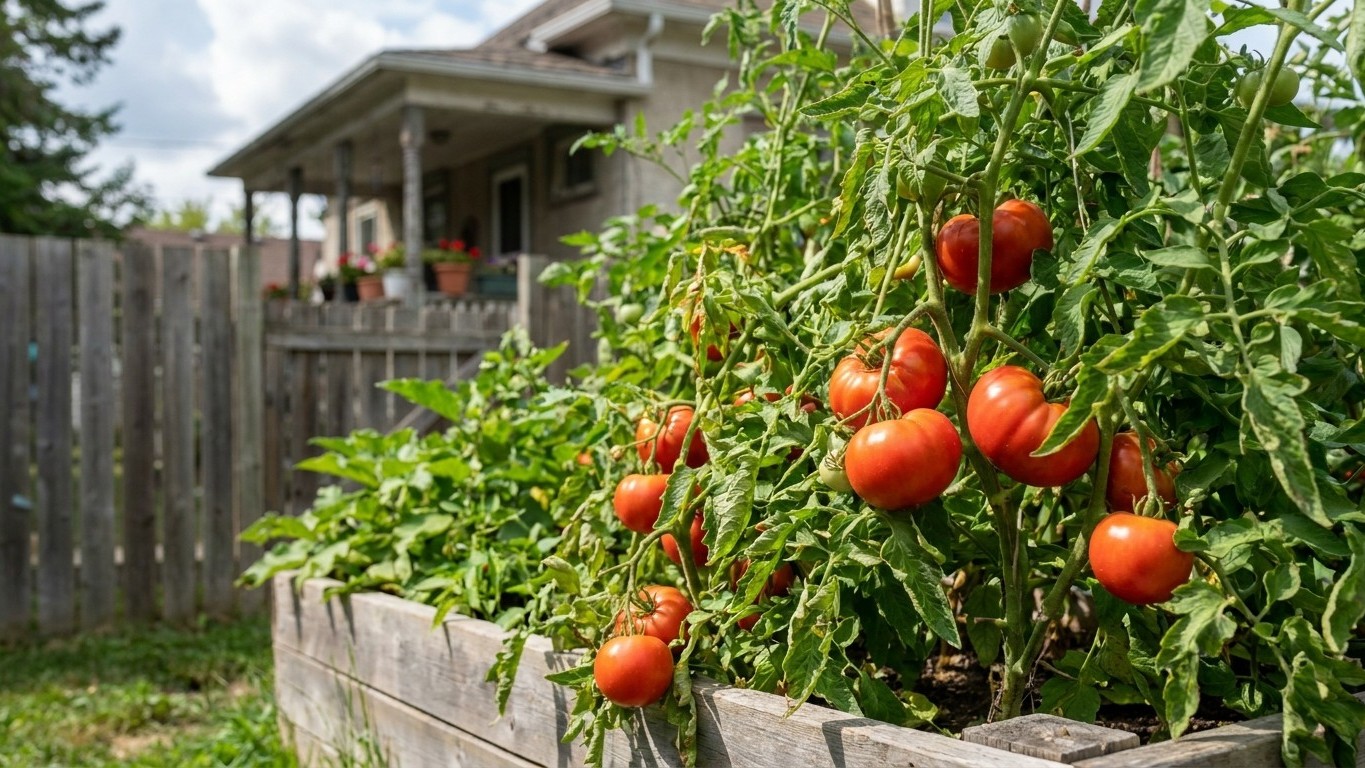

At Winnipeg, Environment and Climate Change Canada’s 1981-2010 climate normals put the average frost-free season at about four months, running from a last spring frost near May 23 to a first fall frost near September 22. That window rules out the slowest tomatoes on the seed rack before you even pick a spot in the garden. Check the days-to-maturity number on the packet against that window before you buy, not after.
What this comes down to in Manitoba

At Winnipeg, Environment and Climate Change Canada’s 1981-2010 climate normals put the average last spring frost at May 23 and the average first fall frost at September 22, a frost-free window of roughly four months. That figure is a mean, not a promise. In one year out of two, frost at Winnipeg arrives later than May 23 in spring or earlier than September 22 in fall, and a district north or west of the city runs behind that clock by more still. The variety you plant has to fit inside that window with margin left over, which is why the days-to-maturity number on the seed packet matters more here than in almost any warmer growing region.
Once the basics of growing tomatoes in Manitoba are sorted, the choice of variety is what decides whether the harvest happens before the plant freezes on the vine. Cultivars rated at 55 to 68 days from transplant, set out in early June, ripen with five to seven weeks of margin before the average fall frost. Cultivars at 72 to 78 days cut that margin to a month or a little more, which is workable in a warm year and tight in a cool one. Anything past 78 days from transplant is not worth the risk at this latitude unless the plan is to pick green and ripen fruit indoors.
Sakura

Sakura is a red cherry tomato at 55 days from transplant, among the fastest on this list. Set out in early June, it ripens by late July and carries about 53 days of margin before the September 22 average frost at Winnipeg, the widest cushion of any variety here. It also resists nematodes, tomato mosaic virus and two races of fusarium wilt, which matters in a bed that has grown tomatoes for several seasons running.
Glacier

Glacier reaches its first red fruit at 55 days from transplant, ripening by late July with the same roughly 53-day margin as Sakura. It stays compact as a determinate plant and needs no staking, which suits a raised bed or a spot with limited support. It carries no listed disease resistance, so give it fresh soil rather than a bed that grew tomatoes the year before.
Sun Gold

Sun Gold needs 57 days from transplant and ripens its first orange fruit in early August, about 51 days ahead of the average fall frost. It resists tobacco mosaic virus and one race of fusarium wilt, and the sweetness that makes it a favorite for snacking holds up even in a cooler Manitoba summer.
Juliet
Juliet is a grape-type tomato at 60 days from transplant, ripening in early August with about 48 days of margin left before frost. It resists both early and late blight at an intermediate level, useful in a wet season, and its small oblong fruit holds well for sauce or for drying whole.
Amalfi
Amalfi needs 68 days from transplant and ripens by mid August, leaving about 40 days before the average frost. It is a determinate plum tomato bred for sauce, and its intermediate resistance to late blight, early blight and nematodes covers three of the problems most likely to show up in a humid Manitoba August.
Cherokee Purple
Cherokee Purple takes 72 days from transplant and ripens by mid August with about 36 days of margin, the point on this list where the cushion starts to matter. It carries no listed disease resistance and is grown for flavor rather than for a long shelf life, so treat the shorter margin as a reason to grow it alongside a faster variety rather than as the only tomato in the bed.
Celebrity Plus
Celebrity Plus is a 78-day determinate slicer, ripening in late August with roughly 30 days left before the average frost. That margin holds at Winnipeg in most years, but it leaves little room if the season runs cool or frost arrives ahead of schedule, and less room still farther from the city. Its resistance to nematodes, gray leaf spot and tomato mosaic virus is a real advantage where those problems are already established in the soil.
San Marzano II
San Marzano II is the longest-season variety on this list at 78 days, ripening its long red paste fruit in late August with the same tight 30-day margin as Celebrity Plus. It carries no listed disease resistance, which combined with the narrow margin makes it the variety most likely to leave green fruit on the vine in a late or cool year. Grow it only once the rest of the garden is already covered by faster varieties.
| Variety | Days from transplant | Habit | Approx. margin before Sept 22 average frost* |
|---|---|---|---|
| Sakura | 55 | Indeterminate | ~53 days |
| Glacier | 55 | Determinate | ~53 days |
| Sun Gold | 57 | Indeterminate | ~51 days |
| Juliet | 60 | Indeterminate | ~48 days |
| Amalfi | 68 | Determinate | ~40 days |
| Cherokee Purple | 72 | Indeterminate | ~36 days |
| Celebrity Plus | 78 | Determinate | ~30 days |
| San Marzano II | 78 | Indeterminate | ~30 days |
*Margins are worked out from an early June transplant date and Winnipeg’s average first fall frost of September 22, as recorded by Environment and Climate Change Canada. A garden that transplants later, or sits in a cooler district, should shave a week or two off every figure in that column.
Working it out for your own garden
The arithmetic behind every date starts with the frost window, not with a variety name. Environment and Climate Change Canada’s normals put Winnipeg’s average last spring frost at May 23 and its average first fall frost at September 22, which gives a frost-free season of about four months in an average year, and a shorter or longer one depending which side of the mean a given year falls on. For the reasoning behind the early June transplant date that follows from that window, see Tomato Planting Dates in Manitoba: Counting Back From Your Frost Window.
Running the numbers on one variety
Take Sakura, rated at 55 days from transplant. Set it out in early June and count forward 55 days: the first ripe fruit lands in late July, which leaves roughly eight weeks, about 53 days, before the September 22 average frost at Winnipeg. Even if that year’s frost arrives two or three weeks ahead of the mean, as it does in a poor year, Sakura still has fruit on the vine well before the cutoff. That gap is what ripening in time actually means. It is not just crossing the finish line, it is crossing it with slack to spare for a year worse than average.
Now run the same arithmetic on San Marzano II, rated at 78 days. Early June transplant plus 78 days lands the first ripe fruit in late August, with about 30 days left before the average frost. That is enough in a year that runs on schedule or warm. It is not enough in a year where frost arrives early, and it is not enough at all in a district that lags Winnipeg’s normals by even a week or two. Run this same calculation, transplant date plus days to maturity, checked against the fall frost window, on any variety not listed here before committing a row to it.
The mistakes this state punishes

The most expensive mistake is planting a long-season variety because the catalog photo looked good, without doing the days-to-maturity arithmetic first. A 78-day paste tomato and a 55-day cherry tomato are both “tomatoes,” but only one of them has margin to spare if September turns cold early.
- Setting transplants out during a warm stretch in May, before the soil has caught up, even though the average last frost at Winnipeg is not until May 23
- Filling the whole garden with 72-to-78-day varieties, so everything ripens at once in the last two weeks before frost with no cushion if the weather turns
- Skipping disease-resistance ratings on a bed that has grown tomatoes for several years running, then losing weeks of season to fusarium or verticillium wilt instead of ripening fruit
- Treating the September 22 average as a hard deadline instead of the midpoint it is, with no plan for a frost that lands two weeks early
The fix for all four is the same: treat the frost dates as a range with real spread on both ends, and weight the lineup toward the shorter end of the days-to-maturity scale, with one or two longer-season varieties added as a bonus rather than the backbone of the harvest. A garden built entirely around 78-day varieties has no backup if the season runs short.
Checking this against your county
Every figure above comes from the Winnipeg Richardson station, and a province the size of Manitoba does not share one climate. A garden in the Interlake, the Parkland, or anywhere north of the Trans-Canada corridor should expect a shorter frost-free window than Winnipeg’s, which pushes every margin in the table above down further still. Manitoba Agriculture, the provincial extension service, publishes crop and regional guidance at gov.mb.ca/agriculture, and a call to the local office is worth more than any province-wide table for a county-specific read on frost risk.
Common questions
Can I grow a 78-day tomato in Manitoba?
Yes, but the margin is tight. Celebrity Plus and San Marzano II both leave about 30 days between first ripe fruit and Winnipeg’s average fall frost, workable in an average or warm year and short in a cool one, especially outside the city.
What’s the fastest tomato I can grow here?
Among the varieties covered here, Sakura, Edox, Valentine and Glacier all mature in 55 days from transplant, the shortest on this list, and ripen by late July from an early June transplant.
Does disease resistance make a tomato ripen faster?
No. Resistance and days to maturity are separate traits printed separately on the seed packet. A resistant variety like Amalfi still needs its full 68 days to ripen. Resistance only means it is less likely to lose that time to blight or wilt along the way.
Should I start seeds indoors earlier to squeeze in a longer-season variety?
Starting seed a week or two earlier indoors buys a longer-season variety extra size before it goes outside, but it does not move the transplant-out date, which is set by soil temperature and frost risk rather than by how early the seed was started. If the season still feels too tight after that adjustment, a shorter-season variety is the more reliable fix.