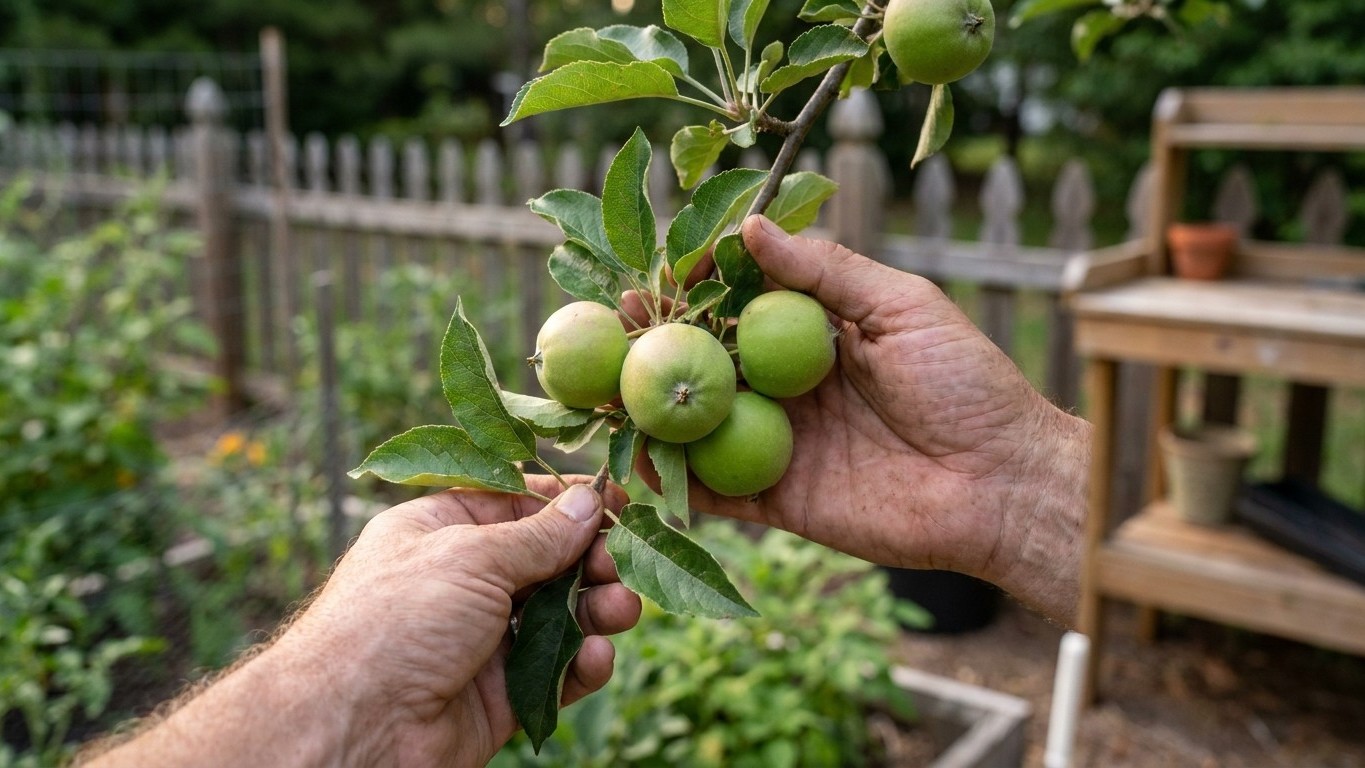

Apples grow well across most of North Carolina, though not on the same terms everywhere. USDA’s Plant Hardiness Zone Map places the state across zones 5b to 8b, and NOAA’s 1991-2020 climate normals for Charlotte put the coldest month’s average daily minimum at 29.6°F, mild enough that chill accumulation, not winter survival, is usually the limiting factor. Check your own elevation against that zone range before ordering trees: a mountain site behaves nothing like a Piedmont backyard thirty miles away.
Can you grow apples in North Carolina
Henderson County’s orchards are the reason most people picture North Carolina apples as a mountain crop, full stop. But that reputation travels badly. Take the same variety list to a slope outside Charlotte and the shorter, milder winter changes what actually flowers and fruits well. Push toward the coast and chill hours get thin enough to limit the choice further still. The state doesn’t grow one apple crop — it grows three, depending on where you’re standing.
The classic apple country in North Carolina sits in the western mountains, where cold winters and cool summer nights favor fruit that colors well and stores hard. Henderson County and the surrounding Blue Ridge counties have grown commercial apples for generations for exactly that reason. Piedmont growers around Charlotte and Raleigh can still get a good crop, but they are working with a shorter, milder winter, and the choice of variety matters more there than it does in the mountains. Coastal growers face the mildest winters in the state and the least reliable chill, which limits which varieties will flower well.
Site matters as much as zone
Apples want full sun, at least six to eight hours a day, and soil that drains fast enough that roots aren’t sitting in standing water after a heavy rain. A slope helps in two ways: it improves drainage, and cold air drains downhill past the trees on a frosty spring night instead of pooling around the blossoms. Low spots and valley bottoms are the first place a home orchard loses a crop to a late frost, wherever in the state you plant.
None of this rules out a home orchard anywhere in North Carolina. It means the checklist changes with elevation and distance from the coast. Confirm your USDA zone against a local map rather than the statewide range, and treat the Charlotte figures as a Piedmont baseline rather than a number that applies from Murphy to Manteo. A month-by-month North Carolina apple Calendar can help you match these regional differences to the right timing for planting, pruning, and harvest wherever you are in the state, and pairing it with a regional list of North Carolina apple Best varieties will narrow that checklist down to trees that actually suit your site.
Which varieties suit this climate

Start with hardiness, then check chill. Hardiness tells you whether the tree survives winter, and most of the widely sold varieties are rated for zones 5 through 8, which covers the range USDA’s map assigns to North Carolina overall. ‘Honeycrisp’, ‘Gala’, ‘Liberty’ and ‘Arkansas Black’ all carry published hardiness ranges that reach across the 5b to 8b range the state spans, so winter survival is not usually the limiting factor for a Piedmont or mountain orchard.
Winter chill is the filter most guides skip
Apple varieties need a minimum number of hours below roughly 45°F each winter to break dormancy evenly and flower on schedule. A high-chill variety planted somewhere too mild gets a thin, stretched-out bloom instead of a full one, and a poor bloom means a poor crop even though the tree itself looks perfectly healthy. Catalog figures for chill requirement run roughly: ‘Fuji’ around 400 to 500 hours, ‘Gala’ around 500 to 600 hours, ‘Winesap’ around 700 hours, and ‘Honeycrisp’ and ‘Arkansas Black’ up toward 800 to 1,000 hours. These are published nursery figures and shift a little between catalogs.
North Carolina’s winters run milder toward the coast and in the lower Piedmont, and colder with elevation in the mountains, so the low end of that chill scale is the safer bet away from the mountains, and the high end suits higher elevation sites better. No source in our records publishes a specific chill-hour figure for a North Carolina reference city, so treat this as a general rule rather than a number to plan against, and confirm actual local chill accumulation with the state extension service before committing to a high-chill variety at a low, mild site. Growers just across the state line face the same tradeoff pushed further toward the low-chill end. The guide to growing apples in South Carolina walks through varieties suited to that milder climate, which is a useful comparison if you’re near the border.
Disease resistance is worth weighing alongside chill in a humid state. ‘Liberty’ and ‘Enterprise’ carry strong scab resistance bred in, which matters where wet, humid summers keep fungal disease pressure constant. ‘Honeycrisp’ and ‘Gala’, by contrast, need a regular fungicide program to look presentable by harvest.
Planting a pair that works here
A single apple tree, whatever the variety, rarely sets a full crop on its own. Apples need a second variety nearby that blooms at the same time and carries pollen the bees can move between the two. Get this wrong and you get a tree full of flowers and a handful of apples.
Pairs that make sense for this state’s variety list
Among the varieties that suit North Carolina’s zone range, ‘Gala’ and ‘Fuji’ bloom close enough together to work as a pair, and both are diploid, meaning both produce fertile pollen that can pollinate the other. ‘Liberty’ and ‘Enterprise’ make a similarly workable pair for a grower who wants scab resistance built in on both sides, and their bloom windows overlap enough to rely on the same bees.
Some popular varieties, including ‘Arkansas Black’ and ‘Winesap’, are triploids with sterile pollen. They need a second variety to pollinate them, but they cannot return the favor, so a planting of just those two will not pollinate each other no matter how well the bloom times line up. A triploid needs two other, pollen-fertile varieties in the vicinity, whether on your own lot or a neighbor’s, to get a crop.
Plant the two trees within reasonable reach of each other for reliable bee traffic, and check the bloom-group chart most nurseries publish next to each variety before ordering. Two varieties in adjacent bloom groups can still overlap enough to pollinate, but two in distant groups usually won’t.
The frost that costs a crop here

The frost that matters for apples is not the deep cold of January, it’s the one that lands after the buds have already opened in spring. NOAA’s 1991-2020 climate normals for Charlotte put the last spring freeze at 32°F somewhere between March 23 and April 5, the window in which freeze odds run from 30 to 70 percent. That is a Piedmont figure. The Blue Ridge mountains to the west typically run later into spring, and the coastal plain runs earlier, so a mountain orchard needs to shift this whole picture later and a coastal one earlier.
What makes this window dangerous for an apple crop is timing against bloom, not against the tree itself. A frost that arrives once the buds show pink kills the open flowers, not the wood, and a killed flower cannot set fruit. The tree leafs out and looks completely healthy for the rest of the season while carrying a fraction of its normal crop, or none at all, because the damage happened silently at bloom and only shows up at harvest. The first fall freeze matters far less to the crop. NOAA’s Charlotte normals place it between October 30 and November 8, well after most varieties are already picked.
What a grower can actually do
- Delay bloom timing by choosing a later-flowering variety rather than trying to outrun the frost with an earlier one.
- Watch a forecast closely once buds reach the pink stage, since that is the point flowers become vulnerable.
- Cover small, young trees with row cover or a sheet on a night a freeze is forecast during bloom, though this is only practical on trees small enough to reach.
- Site trees on a slope rather than a low spot, since cold air pools in the lowest ground on a still, clear night.
Where the Charlotte window runs into early April most years, a later-blooming variety is the most reliable insurance available to a home grower, more reliable than any frost-night scramble with sheets. Growers far north of North Carolina deal with the same problem on a different calendar. The guide to growing apples in Maine covers a spring frost window that runs weeks later than Charlotte’s, which shows how much this single date moves with latitude and elevation.
The apple year in North Carolina
Apple timing follows the tree’s stage, not a date on the calendar, but the stages line up loosely with the frost dates already given for the Charlotte area.
Dormancy through green tip
Trees sit fully dormant through winter and should be pruned during this window, while the wood is bare and the tree’s framework is easy to see. Green tip, the first sign of buds swelling and leaf tissue showing, generally arrives in the weeks before the Piedmont’s last frost window of March 23 to April 5, per NOAA’s Charlotte normals, though the exact week shifts with the particular winter and with elevation.
Pink and bloom
The pink stage, when the unopened flower buds show color, is the point real frost risk begins, since it means bloom itself is imminent. Once flowers open, they stay vulnerable to a freeze until petal fall, so this stretch usually straddles the tail end of the Piedmont frost window. Mountain orchards, blooming later, clear their frost risk later in the season for the same reason their last frost date runs later.
Petal fall through fruit set
Once petals drop and the tiny fruit begin to swell, the frost risk to that year’s crop has mostly passed. This is the point to thin the young fruit, leaving one or two apples per cluster spaced apart, so the tree isn’t carrying more fruit than it can size up well.
Harvest
Harvest dates depend on variety more than on any single frost date. Early varieties come off in mid to late summer, and later varieties like ‘Arkansas Black’ and ‘Pink Lady’ hang on into fall, well ahead of the first fall freeze that NOAA’s Charlotte normals place between October 30 and November 8.
Local help
For variety lists suited to specific counties, current spray schedules, and disease pressure updates through the growing season, contact North Carolina State Extension. County agents can also confirm local chill accumulation and frost timing more precisely than a single Piedmont reference station can, which matters most for a grower in the mountains or on the coast, well outside Charlotte’s climate profile.
Common questions
Can I grow apples near the coast in North Carolina?
Yes, but the mild winters near the coast limit chill accumulation, so lower-chill varieties like ‘Fuji’ and ‘Granny Smith’ are a safer bet than ‘Honeycrisp’ or ‘Arkansas Black’ in that setting. Coastal growers should also expect an earlier last frost than the Charlotte figures used in this guide.
How many years before a new apple tree fruits?
Most standard nursery trees take several years of growth before they flower heavily enough to produce a real crop, and a young tree that blooms in its first year or two often benefits from having those early flowers thinned off. Rootstock affects the timeline too, with dwarfing rootstocks generally reaching bearing age faster than a full-size seedling rootstock.
Do I have to spray fungicide on apples in North Carolina?
Most varieties need some fungicide program to get clean fruit through a humid Piedmont or coastal summer, since scab and other fungal diseases build up fast in wet conditions. Scab-resistant varieties like ‘Liberty’ and ‘Enterprise’ cut down on how much spraying is needed, but they don’t eliminate the need entirely in a wet year.
What if I only have space for one apple tree?
A single apple tree still needs a pollen partner within bee range, so if there’s no other apple tree nearby, a flowering crabapple like ‘Dolgo’ planted as a pollinator can fill that role instead of a second full-size apple. Without some second bloom source nearby, a lone tree will set very little fruit.
My tree bloomed and then a frost hit. Do I need to replace it?
No, a frost during bloom kills the open flowers, not the tree itself, so a healthy tree that lost its crop to a late freeze will typically leaf out fine and bloom normally again the following year. The loss is that season’s fruit, not the tree.