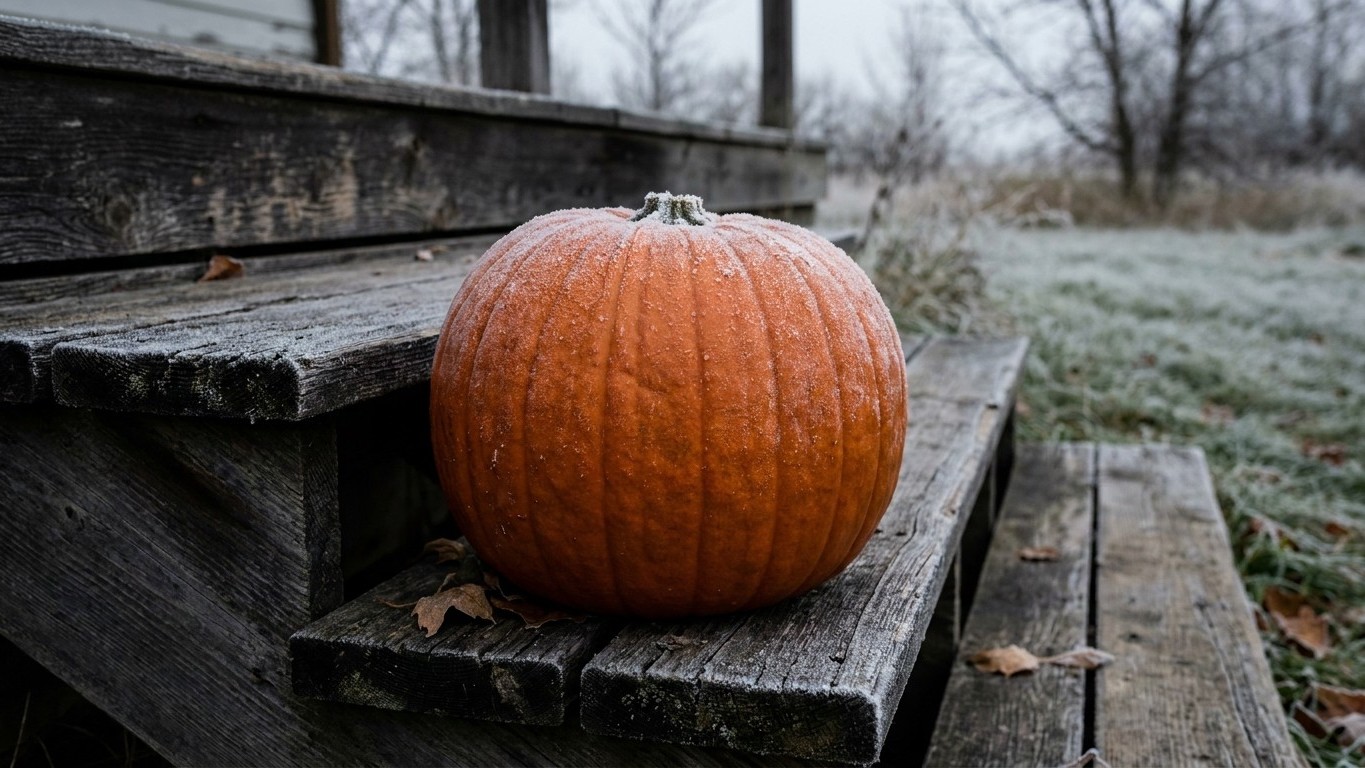

Saskatoon’s mean first fall frost lands around September 18, more than a month before Halloween. That gap changes the question entirely: the pumpkin on your steps isn’t racing frost, it’s racing time and temperature swings that stretch from six weeks before Halloween right up to the night you carve it. Here’s how to read that window and what to do with it.
The short answer

Environment and Climate Change Canada’s 1981-2010 normals put the mean first fall frost at the Saskatoon SRC station around September 18. That’s a mean, not a guarantee: in roughly half the years on record, frost arrives later than that, sometimes weeks later. So treat September 18 as the midpoint of a window, not a date circled on the calendar.
What does that mean for a pumpkin sitting outside until October 31? By the time Halloween rolls around, Saskatchewan has typically already had its first frost, often more than a month earlier. Frost isn’t the event you’re planning around on carving day itself; it’s already come and gone by then, and the ground has usually settled into a colder pattern that includes freezing nights on a regular basis. The real question shifts from “will frost hit before Halloween” (almost certainly yes) to “how do I keep a whole pumpkin from freezing solid or drying out during the weeks between buying it and cutting into it.”
That reframes the carving window. Since the cold arrived weeks ago, the practical move is to carve close to Halloween itself, in the last few days beforehand, once the pumpkin comes in from wherever you’ve been storing it. Carving early and leaving a cut pumpkin outside in Saskatchewan’s late-October air invites a different problem: exposed flesh reacts fast to freezing temperatures, going soft and collapsing well before Halloween night even arrives. Waiting until close to the day keeps that exposed surface out of the cold for the shortest possible stretch.
None of this changes the storage math for the whole, uncarved pumpkin. That part of the calendar is generous, on the order of months, provided the pumpkin stays whole and stays cool. The narrow part of the calendar is the carved stage, and Saskatchewan’s late-October temperatures are exactly why that stage should be short and should happen near the day itself rather than a week or two ahead.
Frost or heat: which one gets it here
A whole pumpkin keeps best between 45-50 F, according to University of Illinois Extension. Saskatchewan’s late-October weather rarely sits inside that band for long. The question is which direction it misses on, and here the answer is clearly the cold end, not the warm one.
The cold end
Saskatoon’s coldest month averages a daily minimum of -5.3 F, a figure that says nothing about October specifically but says a great deal about how fast and how hard winter sets in across the province. Combined with a mean first fall frost around September 18, it points to a stretch from late September through October where overnight lows regularly drop below the 45-50 F storage band, and often below freezing entirely by the back half of October. A pumpkin left outside unprotected on a Saskatchewan porch in the final week of October risks a hard freeze, not just a light frost, and a hard freeze on the pumpkin’s flesh causes the collapse and mush that ruins a jack-o’-lantern before it ever gets lit.
The warm end
Heat isn’t the concern here the way it might be in a milder region. By late October, Saskatchewan afternoon highs typically don’t push consistently above the 45-50 F band, so there’s little risk of the pumpkin sitting in warmth that speeds up softening or mold growth. The whole province’s late-October pattern runs cold, not warm, which is exactly why cold protection, rather than shade or ventilation, is the thing to plan for.
In short: here, cold is the threat, not heat. Plan storage around keeping the pumpkin above freezing, not around keeping it cool enough.
Where to keep it until you carve
- An unheated but insulated porch or entryway. If it stays above freezing on cold nights, this is often the closest match to the 45-50 F range without hauling the pumpkin indoors to a heated room.
- A cold cellar or unheated basement corner. Many Saskatchewan homes still have a cooler basement zone, away from furnace ducts, that runs closer to that target range than an attached garage does once temperatures drop hard in October.
- An attached garage, but only if it doesn’t freeze overnight. Check it with a thermometer rather than assuming; an unheated detached garage in Saskatchewan can drop well below freezing once the season turns, which is too cold for a whole pumpkin.
- Away from apples, potatoes, and tomatoes. Ripening fruit and some vegetables give off a gas that speeds up a pumpkin’s aging, according to University of Illinois Extension. A porch shelf next to a crate of fall apples is a common but poor choice.
- Out of direct sun and away from heat vents. A sunny windowsill or a spot near a furnace duct is the opposite of the dark, stable-temperature environment a pumpkin needs to hold for weeks.
- Bring it in only when you’re ready to carve. Move it to a warmer room a day or so before carving, then cut it close to Halloween itself, given how quickly the exposed flesh reacts to Saskatchewan’s late-October cold once it’s opened up.
Checking this against your own county
Saskatoon’s normals are a solid reference point for the middle of the province, but Saskatchewan stretches from the northern forest edge to the southern grain belt, and frost timing shifts across that distance. A garden in the Peace River country or the far north can see frost arrive noticeably earlier than Saskatoon’s mean date, while some southern pockets run a little later.
For a reading closer to your own soil, the Saskatchewan Ministry of Agriculture is the right stop. Their agribusiness and farmer resources cover regional growing conditions across the province in more local detail than a single provincial station can, and can help confirm whether your area tends to run ahead of or behind the Saskatoon normals: Saskatchewan agribusiness, farmers and ranchers resources.
Common questions
Does frost ruin a whole, uncarved pumpkin sitting outside?
A light frost on the tough outer rind usually isn’t fatal to a whole pumpkin, but a hard freeze can be, especially with repeated exposure. Since Saskatchewan’s late-October nights often drop well below freezing, moving the pumpkin somewhere protected once that pattern sets in is safer than leaving it exposed.
How long does a carved pumpkin actually last in Saskatchewan’s cold?
No extension service publishes a tested timeline for a carved pumpkin, and there’s no verified preservation method to extend it. What’s actually documented is how to choose and store the whole pumpkin well; carving close to Halloween, rather than days ahead, is the practical response to that gap in the research.
What should I look for when buying the pumpkin in the first place?
University of Illinois Extension recommends a pumpkin with 1 to 2 inches of stem still attached, since that stem seals off the top; once it breaks, that spot becomes an entry point for spoilage. Skip pumpkins with soft spots or blemishes, and don’t worry about the shape.
Can I carry the pumpkin by its stem?
No. The stem is a seal, not a handle, and lifting a pumpkin by it is a common way to snap it off before you’ve even gotten it home, which then leaves that exposed section prone to spoiling early.