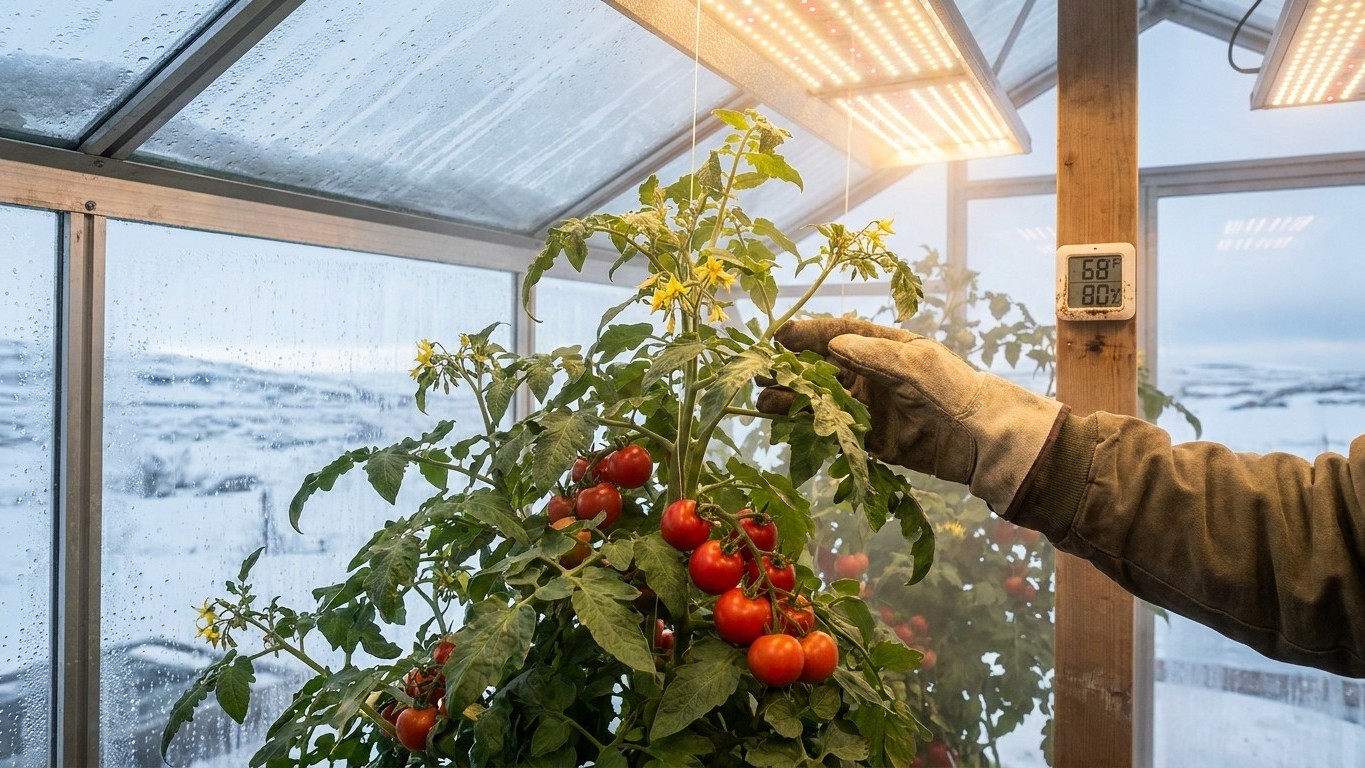

In Nunavut, the pests that actually damage tomato plants almost never come from the outdoors. Between an average frost-free window of roughly June 19 to September 13 at Rankin Inlet and a Canadian hardiness zone of 0a, field tomatoes simply don’t survive long enough to attract the classic garden insects. Nearly every tomato grown in the territory lives in a heated greenhouse, a hoop house, or a windowsill container, and that changes which pests show up entirely.
What this comes down to in Nunavut

At Rankin Inlet, the frost-free stretch averages about June 19 to September 13, roughly 86 days, and the surrounding hardiness zone sits at 0a on the Canadian scale. That combination rules out an outdoor tomato season for practical purposes, so the pest question in Nunavut isn’t “what’s crawling through the garden bed” but “what’s living in the greenhouse air.” The cold that keeps field pests from ever establishing outdoors also means the territory skips most of the insect pressure that gardeners in southern Canada or the northern US states deal with every summer.
Community greenhouses, plastic hoop structures, and heated grow rooms are where tomatoes get their season here, and those enclosed, warm, humid spaces are exactly the conditions that a small group of indoor-adapted pests thrive in. They arrive on transplants shipped in, on used soil, on second-hand pots, or simply by hitching a ride on a gardener’s clothing between one greenhouse and another. Once inside, with no hard frost to knock them back and a steady warm environment, they can build populations fast.
The four pests below are listed in the rough order they tend to appear across a typical indoor or greenhouse tomato cycle in Nunavut, from the seedling stage through to full fruiting.
Fungus gnats
These show up first, often within days of starting seedlings indoors. The adults are small, dark, mosquito-like flies about an eighth of an inch long that hover near the soil surface, but the damage comes from the larvae: tiny, translucent, worm-like maggots with black heads living in the top inch of wet potting mix. They chew on root hairs and the base of young stems, stunting seedlings that never seem to bulk up. Letting the soil surface dry out between waterings and switching to bottom-watering usually breaks the cycle.
Aphids
Aphids follow once seedlings are transplanted into their growing containers. Look for small, soft-bodied insects, often pale green or yellowish, clustered on the undersides of young leaves and along new growth. Both nymphs and adults feed by piercing the leaf and sucking sap, leaving curled, yellowing foliage and a sticky residue called honeydew that can turn black with sooty mold. A strong spray of water followed by insecticidal soap knocks populations down without harming the plant.
Two-spotted spider mites
These arrive as the greenhouse heats up through the brighter, longer days of the growing stretch. They’re barely visible without a hand lens, pale yellow to reddish specks with two dark spots on their backs, and the giveaway is fine webbing on the undersides of leaves along with a stippled, dusty-looking discoloration on the leaf surface. Both nymphs and adults feed on leaf cells, and heavy infestations bronze and dry out the foliage. Raising humidity and rinsing leaves regularly discourages them, since they favor hot, dry air.
Whiteflies
Whiteflies tend to show up later in the fruiting stage, once plants are dense and warm air has settled in the greenhouse. Adults are tiny, moth-like insects with pure white wings that flutter up in a cloud when a leaf is disturbed, while the damage comes from the flat, scale-like nymphs feeding on the underside of leaves. Both stages drain sap and leave the same sticky honeydew problem as aphids. Yellow sticky traps hung near plant height catch adults early, and insecticidal soap applied to leaf undersides handles the nymphs.
| Pest | Stage that causes damage | Where to look | What works |
|---|---|---|---|
| Fungus gnats | Larvae | Top inch of soil | Let soil surface dry, bottom-water |
| Aphids | Nymphs and adults | Underside of new leaves | Water spray, insecticidal soap |
| Spider mites | Nymphs and adults | Leaf undersides, fine webbing | Raise humidity, rinse leaves |
| Whiteflies | Nymphs | Underside of mature leaves | Sticky traps, soap on undersides |
Working it out for your own garden
Since almost nobody in Nunavut is fighting an outdoor pest population, the useful skill isn’t matching a bug to a calendar date, it’s matching symptoms to a cause fast enough to act before a small problem becomes a greenhouse-wide one. Start with location on the plant. Damage concentrated at the soil line on young seedlings points to fungus gnat larvae, not an adult flying insect. Curled new growth with a sticky film points to aphids. A dusty, bronzed look on older leaves with fine threads underneath is almost always spider mites, and a cloud of small white insects rising when you brush a leaf is whiteflies, full stop.
A hand lens or even a phone camera zoomed in on the underside of three or four leaves, taken from different spots on the plant, does more diagnostic work than guessing from a distance. Yellow sticky cards, the kind used in commercial greenhouses, are cheap and worth hanging near the tops of plants from the seedling stage onward. They catch adult fungus gnats, whiteflies, and winged aphids before an infestation is visible to the eye, which matters in a space where a fast-breeding pest has nothing stopping it once it gets a foothold.
Timing also helps narrow the list. A pest showing up in the first two or three weeks after sowing is almost certainly fungus gnats, since they’re tied to wet soil rather than to plant maturity. Something appearing on stems and new leaf tips a few weeks into transplant life, especially with visible honeydew, is more likely aphids. Spider mites tend to build later, once the greenhouse has been running warm and dry for a stretch, and whiteflies are the pest most associated with a mature, leafy canopy near fruiting.
Isolating any new plant material for a week or two before it joins the main greenhouse population catches most problems before they spread, since the majority of these pests arrive as hitchhikers rather than developing from nothing.
What changes across the state
Nunavut spans roughly a fifth of Canada’s landmass, and the Rankin Inlet numbers describe one community in the Kivalliq region, not the whole territory. Communities farther north, such as those on Baffin Island’s high Arctic coast or in the Kitikmeut region, generally see shorter and cooler frost-free stretches than Rankin Inlet, while some southern Baffin communities with more ocean exposure and slightly milder maritime influence can run a bit closer to it. Distance from open water matters too: coastal ice that lingers longer into the season keeps nearby air cooler for weeks after inland spots have warmed.
Elevation plays a smaller but real role, and so does whether a greenhouse structure is sheltered from wind by terrain or buildings versus standing exposed on open tundra. None of that changes which pests show up, though. Because virtually all Nunavut tomato growing happens inside a heated or semi-heated structure, the pest list stays the same fungus gnats, aphids, spider mites, and whiteflies from Iqaluit to Cambridge Bay, since the deciding factor is the indoor growing environment, not the outdoor climate at any particular latitude. What differs community to community is how long the growing structure can be kept warm enough to run a full tomato cycle, which affects how many pest generations a grower has to manage in a season, not which species turn up.
The mistakes this state punishes
The biggest mistake is treating a Nunavut greenhouse like a smaller version of a southern Canadian garden and worrying about pests that need an outdoor life cycle to exist here at all, tomato hornworms and Colorado potato beetles being the two most commonly imported worries that simply don’t apply. Time spent scouting for them is time not spent checking leaf undersides for the pests that actually do arrive.
A second, more costly error is skipping quarantine on new transplants or used potting soil brought in from outside the community. Because shipping into Nunavut settlements takes time and plants often travel through several handling points, seedlings can arrive already carrying aphid nymphs or whitefly eggs that aren’t visible at a glance. Setting new plants apart from the main greenhouse population for a week or two, and checking them daily, catches this before it becomes a full infestation.
The third is letting greenhouse humidity swing too far in either direction. Running the space too dry invites spider mites, which thrive on stressed, low-humidity foliage, while running it too wet and still encourages fungus gnats and mold. Consistent, moderate humidity with airflow between the two extremes keeps both problems from finding an opening at once.
Checking this against your county
Nunavut doesn’t have county extension offices the way many US states do, so the closest equivalent is your community’s greenhouse society contact or hamlet agriculture liaison, plus the federal Agriculture and Agri-Food Canada resources, since the territorial department’s own site isn’t reliably reachable for automated checks. A territory-wide reference point is a starting line, not a guarantee for your specific greenhouse, wind exposure, or building’s heating capacity.
Common questions
Do outdoor tomato pests like hornworms ever reach Nunavut?
Not in any practical sense. The insect’s life cycle depends on overwintering in soil in a climate far milder than Nunavut’s, and with tomatoes rarely grown outdoors here in the first place, there’s no host plant available for it to find.
Can I skip pest scouting if my greenhouse is brand new?
No. New structures still receive transplants, soil, and tools from outside, and that’s how nearly all four pests on this list actually arrive. A new greenhouse just means you’re starting from zero, not that you’re protected.
Are ladybugs or other beneficial insects a realistic control option here?
They can help with aphids in an enclosed greenhouse, since the pests can’t disperse outward and neither can the predators, but sourcing and shipping live beneficial insects to remote Nunavut communities adds cost and logistics that most home growers skip in favor of soap sprays and sticky traps.
Why does my neighbor’s greenhouse have whiteflies when mine doesn’t?
Whiteflies spread mainly through infested plant material and adult flight between nearby structures, so even communities sharing the same climate can see very different pest pressure depending on what’s been brought in and how closely greenhouses sit to one another.