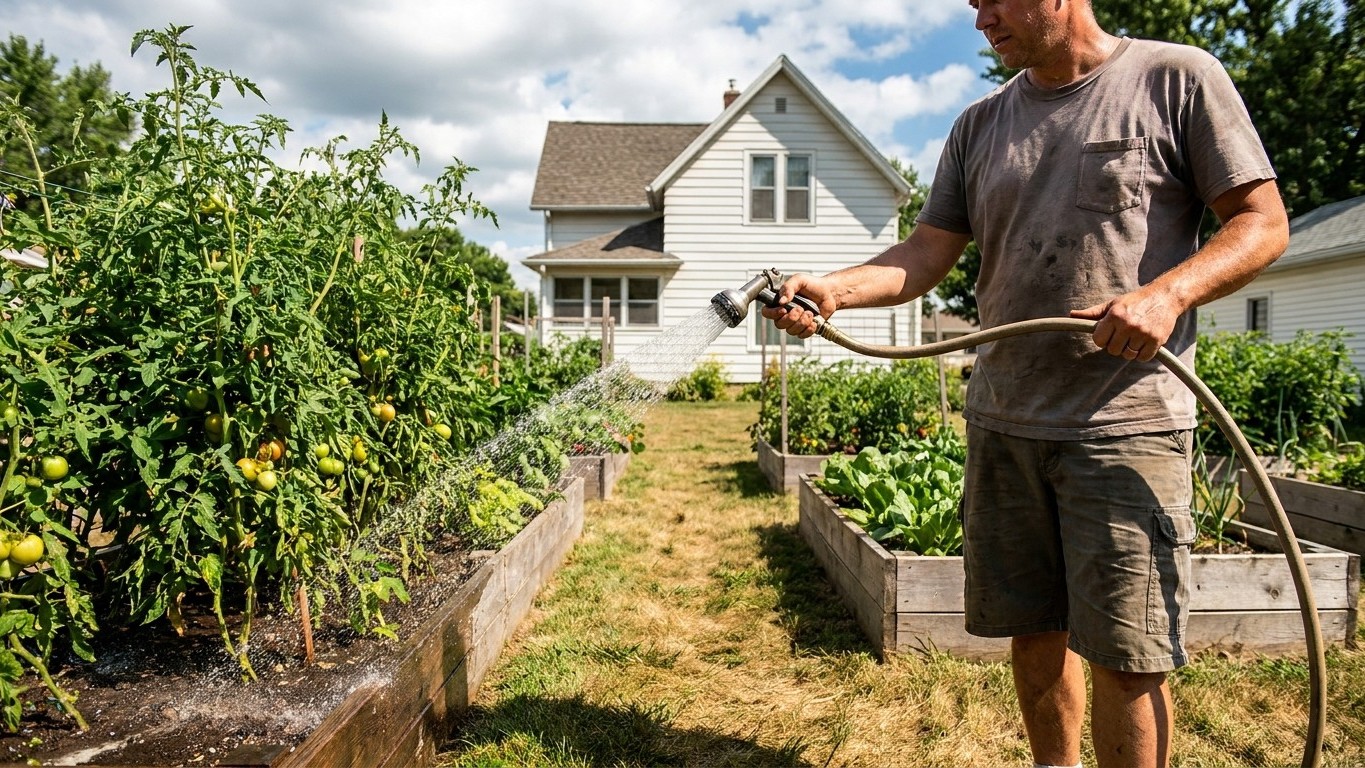

Iowa gardens need roughly an inch of water a week during the growing season, and how much of that comes from the sky depends on which week you’re in and what soil you’re standing on. Summers here run hot enough, and rain arrives unevenly enough, that most vegetable beds and new plantings need a hose at some point between June and August. Local water utilities set the actual rules, so check with yours before you settle into a schedule.
What the climate asks of you

Start with the number that rules out any illusion of a mild summer: the Des Moines reference station averages 18.4 days a year at 90F or hotter, based on NOAA’s 1991-2020 climate normals. That’s not a scorching desert tally, but it’s enough heat days, stacked mostly across July and August, to pull moisture out of a garden bed faster than most people expect. A cool-season lawn or a shallow-rooted transplant feels every one of those days.
Rain doesn’t arrive on a schedule
Iowa’s summer rain mostly comes from thunderstorms, not steady drizzle, which means totals swing hard from one week to the next and from one county to the next. A garden can get soaked on a Tuesday and then sit dry for two weeks while a storm system tracks fifty miles north or south. That unevenness is the real reason gardeners here can’t just “trust the season.” The state’s own reporting stations show wide year-to-year and month-to-month variation, so instead of leaning on a single average, check your county’s current rainfall against the National Weather Service or your local extension office before deciding whether last week’s storm bought you any slack.
Soil decides what the rain actually does
Much of Iowa’s ground is heavy, glacially deposited clay-loam, the kind of soil famous for growing corn precisely because it holds water so well. That’s good news in a dry stretch, since a soaked clay bed can carry a garden through several rainless days. It’s bad news right after a storm, because that same soil stays saturated near the surface, and working it or watering it while it’s still wet compacts it and starves roots of air. Pockets of sandier ground, especially near river bottoms, behave the opposite way: water runs through fast, and a garden on that kind of soil needs shorter, more frequent watering even in a summer that looks rainy on paper. Knowing which kind of ground is under your beds matters more than any statewide average, and if you’re gardening in pots rather than in-ground beds, the rules shift again; see this guide on Watering Pots and Containers in Iowa for specifics.
How much, how often
The rule that holds up across almost every Iowa yard: water deeply and infrequently, not a little bit every day. A quick daily sprinkle wets only the top inch or two of soil, and roots follow the water, staying shallow and vulnerable to the next hot stretch. A deep soak once or twice a week pushes moisture down six to eight inches, which trains roots to grow deeper and gives the plant a buffer against those 90F days, a habit worth building before Watering Through a Dry Spell in Iowa becomes your only option.
The simplest way to know whether it’s actually time to water is to skip the calendar and check the dirt. Push a finger, or a trowel, about two inches into the soil near the base of the plant. If it’s dry at that depth, water. If it’s still cool and damp, wait, even if it’s been several days since the last rain.
A routine that fits Iowa ground
- Check soil moisture two inches down before every watering session, rather than watering on a fixed calendar day.
- Water in the morning, before the heat of the day, so moisture has time to soak in before evaporation takes over.
- Aim at the base of the plant, never the leaves, since wet foliage overnight invites fungal disease in Iowa’s humid summers.
- On clay-heavy ground, water less often but longer, letting the surface dry between soakings so you’re not compacting saturated soil or drowning roots.
- On sandy stretches, water more often but shorter, since the ground can’t hold a week’s worth of moisture the way clay can.
- Add extra water during the hottest run of the summer, particularly across the days that push past 90F, when even well-established plants can wilt by afternoon.
None of this replaces watching the plants themselves. Wilting leaves at 7 a.m., before the sun’s had a chance to stress them, is a more reliable signal than any fixed schedule, and it means the soil moisture two inches down is worth checking again.
Restrictions and rules
Watering restrictions aren’t universal across Iowa, and they don’t work the same way from one town to the next. Some municipal water systems ask residents to water on alternating days by address number during dry stretches; others only step in during declared drought emergencies. A few smaller systems, especially those drawing on limited well capacity, restrict outdoor watering hours year-round rather than only in summer.
Why it’s worth checking before you set a timer
Because Iowa’s summer rain comes in uneven bursts rather than steady totals, dry stretches can trigger local restrictions with little warning, even in a summer that started out wet. A city that hasn’t limited watering in years can post new rules within days of a reservoir dropping or a well field running tight. The only reliable way to know what applies to your address is to call your water utility or check its website directly, since rules change from summer to summer and even a neighboring town on a different water source may have none at all. Iowa State University Extension and Outreach, at extension.iastate.edu, is also a solid starting point for county-specific guidance on both watering practices and local drought conditions.
Using less
Cutting water use in an Iowa garden isn’t about watering less carefully, it’s about losing less of what you already put down. A few practices do most of the work.
- Mulch, two to three inches deep: slows evaporation from the soil surface and keeps clay ground from crusting over between waterings, which matters most through those stretches of 90-plus-degree days.
- Drip irrigation or soaker hoses: deliver water at the root zone instead of into the air, cutting the losses that overhead sprinklers hand to evaporation and wind on a hot afternoon.
- Group plants by water need: put thirsty vegetables together and drought-tolerant perennials together, so you’re not soaking an entire bed to satisfy the one plant that actually needs it.
- Work organic matter into the soil: compost improves how sandy ground holds moisture and how clay ground drains, softening the extremes of both soil types found across the state.
- Rain barrels, where local rules allow them: capture roof runoff for later use on beds and containers.
What a rain barrel can and can’t do
An inch of rain falling on a thousand square feet of roof works out to roughly 600 gallons of runoff, which is why even a single storm can fill a barrel fast. The catch in Iowa is timing: because summer rain arrives in scattered bursts rather than steady totals, a barrel can go from full to empty and back again within the same week, and during the driest stretches of July and August it may sit dry for days at a stretch with nothing coming off the roof to refill it. Treat a rain barrel as a supplement that stretches the hose further after a storm, not as a stand-alone water source to plan a whole summer around.
Common questions
How often should I water my Iowa garden in July and August?
Most vegetable beds and new plantings need a deep soak once or twice a week during the hottest stretch of summer, when days pushing past 90F pull moisture out faster. Check soil moisture two inches down rather than watering on a fixed schedule, since a recent thunderstorm can buy several extra days.
Does Iowa clay soil need less watering than sandy soil?
Generally yes. Heavy clay-loam, common across much of the state, holds water longer and needs less frequent watering, though it should never be watered or worked while already saturated. Sandier ground, found in river-bottom areas, drains fast and needs shorter, more frequent watering even in a wetter summer.
Are there statewide watering restrictions in Iowa?
There’s no single statewide rule. Restrictions are set locally by individual water utilities and can range from odd-even day watering during dry spells to no restrictions at all. Check with your city or rural water system directly, since rules can change quickly during a dry summer.
Is it safe to water my garden every day in Iowa?
Daily light watering is generally discouraged. It keeps roots shallow near the surface, where they dry out fast on the state’s hotter days. A deep, infrequent soak, checked against actual soil moisture two inches down, builds a stronger root system that holds up better through Iowa’s uneven summer rain pattern.