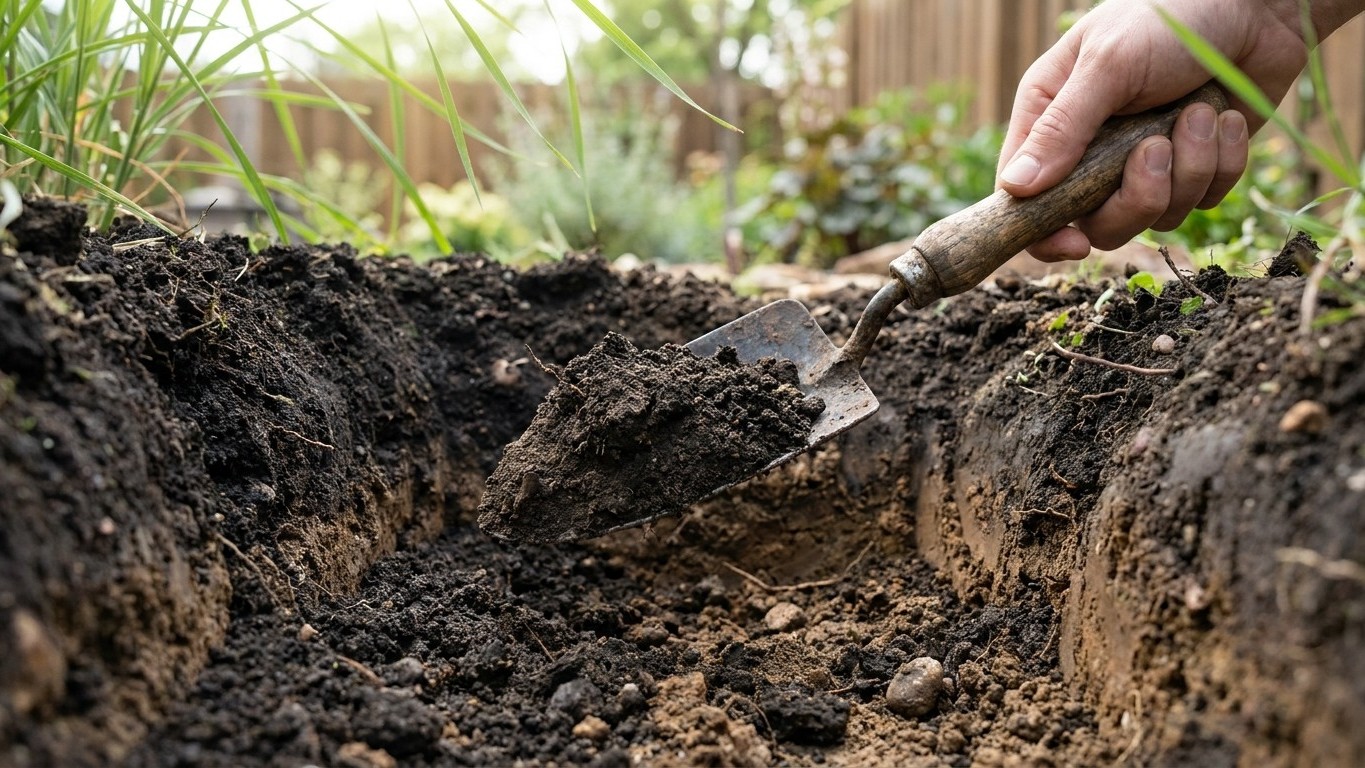

Kansas soil starts, on paper at least, with the Harney series: a deep, dark Mollisol that built the Corn Belt and got named the state’s official soil by law in 1990. What that soil actually holds, and what it doesn’t, tells you a lot about what to expect when you push a trowel into your own backyard.
What is under your garden

The Harney series is a Mollisol, the soil order defined by a thick, dark, organic-rich surface layer that forms under prairie grass over thousands of years. It’s the reason Kansas and its neighbors became some of the most productive farmland on the continent. USDA’s Soil Survey Geographic Database records the surface horizon of the major Harney components (150 of them sampled) at a pH of about 6.7, which sits just on the acid side of neutral. Texture comes in as loam to silt loam: 9 percent sand, 24 percent clay, 67 percent silt. Organic matter runs about 2.0 percent, and drainage is classed as well drained.
| Reading | Value |
|---|---|
| Surface pH | about 6.7 |
| Sand | 9 percent |
| Clay | 24 percent |
| Silt | 67 percent |
| Organic matter | about 2.0 percent |
| Drainage class | well drained |
None of that is your soil, though, at least not automatically. The Harney series is a representative sample, the soil that stands in for the whole state on maps and in classrooms. Your actual yard could sit on a river-bottom deposit that never saw a Mollisol form on it, or on hill ground with three inches of topsoil over rock, or on fill dirt a builder trucked in and graded flat before your house went up. That last case is more common than people think, and it behaves nothing like the numbers above.
Reading your own soil in five minutes
Two quick checks tell you more than staring at the ground ever will. First, the ribbon test: wet a small handful of soil until it’s moldable, then squeeze it between thumb and forefinger, pushing it upward into a ribbon. Clay-heavy soil forms a long, slick ribbon over two inches before it breaks. Loam holds a short, ragged ribbon of an inch or so. Sandy soil won’t ribbon at all; it just falls apart. Second, the jar test: fill a clear jar a third full of soil, add water to near the top, shake hard, then let it sit overnight. Sand settles first and fastest, forming the bottom layer within minutes. Silt follows over the next hour or two. Clay stays suspended longest and settles last, often leaving the water cloudy for a day. Measure the layers the next morning and you’ve got a rough texture reading, done at your own kitchen table, for free.
Testing before you amend
Guessing at pH or nutrient levels wastes money twice: once on the wrong amendment, and again on the amendment you actually needed but bought too late. A soil test tells you things your eyes simply can’t, like phosphorus and potassium levels, cation exchange capacity, and the exact pH of the ground you’re planting, not the regional average. Given that the Harney series sits near neutral at about 6.7, a gardener on that kind of ground might reasonably expect a similar reading. Expecting isn’t knowing, though, and plenty of yards test well outside that number once fill dirt, old ash piles, or decades of fertilizer get factored in.
Taking a sample properly matters as much as sending it in. A single scoop from one spot tells you about that one spot, not your garden.
- Pick 6 to 10 spots across the bed or lawn area you’re testing, avoiding spots right next to walls, driveways, or old brush piles.
- At each spot, dig a small core 6 to 8 inches deep, which is roughly where vegetable and lawn roots actually feed.
- Drop all the cores into a clean bucket and break up any clumps by hand.
- Mix the cores together thoroughly, then pull about two cups of the mixed soil for your sample bag.
- Let the soil air-dry a day or two before bagging it if it’s wet, since damp samples can skew lab results.
- Label the bag with the bed location and drop it with your local extension office along with the test form.
When results come back, the pH number is the one to read first, since it decides which amendments will even work. Phosphorus, potassium, and organic matter percentages come next, and most extension reports include a plain-language recommendation alongside the raw numbers.
Amending it
The Harney series reads near neutral at about 6.7, which for most vegetables and lawns is close to the comfort zone and needs no dramatic correction. But that number is a state representative figure, not your yard’s, and plenty of Kansas gardens run higher, especially on ground with heavy clay subsoil or limestone-influenced parent material. The corrections below are written for what happens at the extremes, since that’s where most amendment mistakes get made.
If your test comes back below about 5.5: lime, not sulfur
Acid soil below roughly 5.5 locks up phosphorus so plants can’t reach it, and it’s rough on brassicas like cabbage and broccoli, which prefer sweeter ground. Lime is the correction here, worked into the top several inches and given time to react with the soil. This is not a fast fix. Lime moves pH over a season or two, not over a weekend, because it has to dissolve and migrate through the soil profile before it changes anything. Sulfur would be the wrong move entirely on acid ground, since it pushes pH further down, not up.
If your test comes back above about 7.3: sulfur and organic matter, never lime
High pH ground above about 7.3 is a different problem, and lime has no place on it, full stop. Adding lime to already-alkaline soil just makes a bad situation worse. The honest fix is elemental sulfur, worked in gradually over multiple seasons, paired with regular additions of organic matter like compost or aged manure to buffer the soil biologically. High pH also locks iron out of reach for plant roots, which is exactly what’s behind the yellow leaves with dark green veins you sometimes see on azaleas, blueberries, or even tomatoes in alkaline beds. That symptom is a pH problem wearing a nutrient-deficiency costume.
If you’re on heavy clay: organic matter, not sand
At 24 percent clay, Harney soil sits on the heavier side of loam, and plenty of Kansas yards run heavier still. The fix is organic matter, compost, shredded leaves, aged manure, worked in every season to open up structure and improve drainage. Never add sand to clay soil hoping to lighten it; the two combine into something closer to concrete than to loam. Clay also punishes impatience: working it while wet destroys its structure for a full season, so wait until a squeezed handful crumbles rather than smears before you dig.
If you’re on sandy ground: organic matter and shorter, more frequent watering
Sandy soil, the opposite problem, drains too fast for nutrients or water to stick around. Organic matter again does the heavy lifting, holding moisture and nutrients that would otherwise wash straight through. Watering strategy has to change too: shorter, more frequent sessions beat a single deep soak, since sandy ground can’t hold a big volume long enough for roots to use it. Clay corrections tend to show real change within a single season if you’re consistent; pH swings in either direction take two to three seasons before they stick.
Drainage and compaction
The Harney series is classed well drained, meaning water moves through it at a reasonable pace without pooling for days. That’s a description of the mapped series though, not a guarantee about your yard, especially if your lot got graded and compacted during construction, which flattens pore space and slows drainage no matter what the parent soil was built to do.
A simple percolation test settles the question for your own ground. Dig a hole about a foot deep and a foot across, fill it completely with water, and let it drain once. Then fill it again and time how fast the water level drops. A drop of one to two inches per hour is a healthy, workable rate. Faster than that and you’re dealing with sandy, fast-draining ground that will need more frequent watering. Slower, especially under half an inch an hour, points to compaction or a clay-heavy subsoil holding water where roots don’t want it sitting.
Foot traffic and machinery compact soil more than most gardeners expect, squeezing out the pore space roots and water both need. Double digging, once the standard fix, has fallen out of favor because it disturbs soil biology and structure for a full season and the benefit rarely outlasts the next hard rain. On ground that tests slow and stays soggy, a raised bed beats years of amendment. It’s a more honest answer than promising a gardener that three seasons of compost will fix what a compacted clay subsoil is doing underneath.
- Well-draining, fast-percolating ground: water deeply but less often, and watch for nutrients washing through before roots can use them.
- Slow-draining, compacted ground: build raised beds for vegetables, and reserve in-ground planting for tough, wet-tolerant shrubs and trees.
- Either way: keep foot traffic off garden beds by using mulched paths, since compaction from walking is often worse than anything a shovel does.
Local help
Kansas State University’s extension service, K-State Research and Extension, runs soil testing through county offices statewide. A sample dropped off there gets lab results back with actual numbers for your ground, not a regional estimate, and the county office will walk through what the results mean and what to do next.
Common questions
Is Harney soil the same everywhere in Kansas?
No. It’s the state’s official representative soil, but Kansas spans river bottoms, hill country, and heavily disturbed urban lots that look nothing like the mapped Harney series.
Do I need a soil test if my yard looks fine?
Yes, since pH and nutrient problems often show no visible symptoms until they’re severe, and a test costs far less than a season of poor yields.
Can I fix pH in one season?
Rarely. Lime and sulfur both work gradually, reacting with soil over multiple seasons rather than producing an overnight change.
Why are my plant leaves yellow with green veins?
That pattern usually points to iron locked up by high soil pH, not a lack of iron in the ground itself. A soil test confirms it before you reach for an iron supplement.