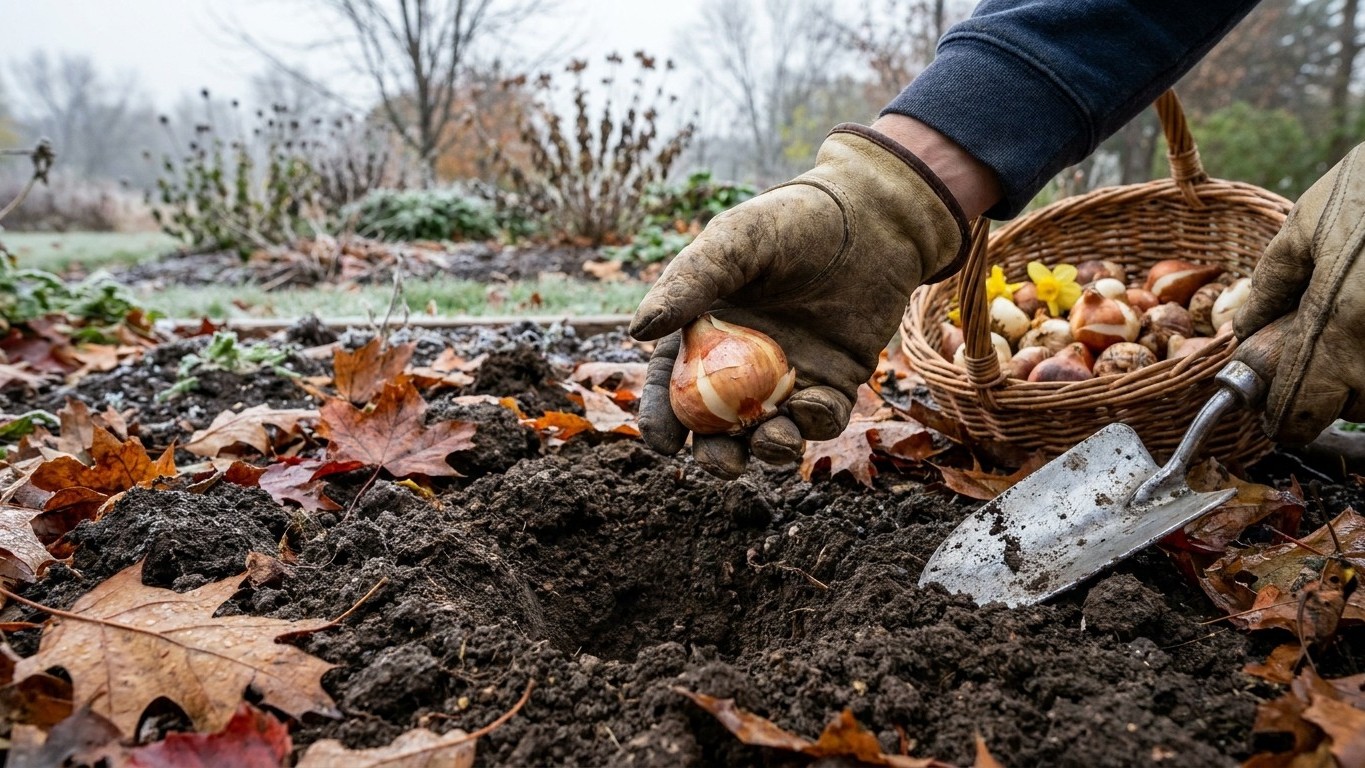

Spring bulbs planted in Wisconsin get something most of the country can’t offer: a winter cold enough, and long enough, to force real flowers rather than short-stemmed disappointments. The state’s coldest-month low of 17.2°F clears the chill requirement of nearly every classic spring bulb with room to spare, the real question isn’t whether Wisconsin is cold enough, it’s which bulbs to plant, when, and how to keep squirrels out of them — or, for those who’d rather skip winter altogether, how to try Forcing Spring Bulbs Indoors in Wisconsin.
When to plant bulbs in Wisconsin

Bulb planting in Wisconsin runs from mid-September through late October, timed to land about six weeks before the ground freezes hard. That window anchors on the state’s average first fall frost, which NOAA’s 1991-2020 climate normals put between October 17 and October 29 depending on where you sit in the state. Frost isn’t the same as a hard freeze, but it’s the marker gardeners use to count backward.
Plant too early and the bulb sits in soil that’s still warm from summer. Warm soil tells a tulip or daffodil to push top growth right away, green shoots that then get cut down by the first real freeze, weakening or killing the bulb before it ever flowers. Plant too late and the opposite problem shows up: the bulb goes into the ground without enough time to grow roots before the soil locks up solid. A bulb that hasn’t rooted by freeze-up either fails to emerge in spring or comes up stunted, flowering weeks behind its properly-planted neighbors.
The frost date is an average, not a promise
That October 17-29 range is exactly what it sounds like: a band built from thirty years of data, not a guarantee for any single autumn. Half of all years in the historical record fall on one side of that window, half on the other. A gardener working off “late October” in a year that turns cold in early October has already lost the safety margin. The practical fix is simple: don’t wait for the calendar. Watch the soil. Once daytime highs are consistently landing in the 40s and 50s and nighttime temperatures dip into the 30s and 40s, the six-week countdown has effectively started, regardless of what the date on the wall says.
Northern Wisconsin, well away from Lake Michigan’s moderating effect, tends to freeze noticeably earlier than the reference station used for these normals. Gardeners near Lake Superior or in the far north should treat late September as their planting start, not their planting deadline.
Whether your winter is cold enough
Every spring bulb needs a sustained cold period before it will flower. The industry figure, consistent across tulips, daffodils, hyacinths, and crocus, is twelve to fourteen weeks with soil temperatures below about 45°F. Skip that exposure and the bulb doesn’t die outright, it just refuses to do the one thing you planted it for. The result is a plant that produces leaves and no flower, or a flower bud so short and cramped it never clears the foliage. That 45°F threshold and that twelve-to-fourteen-week window are the numbers to hold onto no matter where you garden, because they’re what let you judge any bulb variety on its own terms rather than trusting the label.
Wisconsin’s numbers make this an easy call. A coldest-month average minimum of 17.2°F, recorded at the Milwaukee reference station, sits so far below 45°F that soil temperatures across the state stay in the required chilling range for months, not weeks. That’s true even in the milder southern counties near USDA zone 6a. This isn’t a marginal climate scraping by on a technicality, it’s a wide margin that removes pre-chilling from the conversation entirely for anything hardy in this range. Gardeners in warmer states sometimes buy pre-chilled bulbs or refrigerate them for twelve weeks themselves, keeping them away from ripening fruit because the ethylene gas fruit gives off can kill the flower bud inside a chilling bulb. Wisconsin gardeners can skip that step and let the ground do the work.
| Bulb | Cold required (weeks below 45°F) | What Wisconsin delivers | Verdict |
|---|---|---|---|
| Tulips | 14 | Well over 14, statewide | Met with wide margin, no pre-chill needed |
| Daffodils | 12-15 | Well over 15, statewide | Met with wide margin, no pre-chill needed |
| Hyacinths | 12-14 | Well over 14, statewide | Met with wide margin, no pre-chill needed |
| Crocus | 8-15 | Well over 15, statewide | Met with wide margin, no pre-chill needed |
| Alliums | 8-10 | Well over 10, statewide | Met with wide margin, no pre-chill needed |
The one place this margin doesn’t help is bulbs that fail for the opposite reason: not enough cold tolerance to survive the extreme minimum, rather than not enough chill hours to flower. That’s a hardiness question, not a chilling one, and it’s covered next.
Which bulbs suit Wisconsin
Wisconsin’s hardiness range runs from zone 3b in the far north to zone 6a along the southern border, per the USDA’s 2023 map. Most classic spring bulbs are rated hardy well within that band, which is why the state’s cold winters read as an asset rather than a liability once you’re planting things bred for exactly this kind of climate.
- Daffodils (Narcissus) — hardy zones 3-8
- Tulips — hardy zones 3-8
- Crocus — hardy zones 3-8
- Hyacinths — hardy zones 4-8
- Ornamental alliums — hardy zones 3-8
- Snowdrops (Galanthus) — hardy zones 3-7
- Grape hyacinth (Muscari) — hardy zones 3-8
- Siberian squill (Scilla) — hardy zones 2-8
Hyacinths sit closest to the edge in the far north, where zone 3b winters can push past what a zone 4 rating comfortably tolerates. That’s not a hard line, though, a hyacinth bed against a south-facing foundation wall, with a few inches of mulch, often survives a winter that would kill the same bulb in an exposed, wind-scoured bed. Hardiness ratings describe average exposure, not the microclimate in a specific yard.
Bulbs that disappoint here
The bulbs that fail in Wisconsin mostly fail for the same reason they fail almost everywhere north of zone 7: they’re rated for winters this state doesn’t have, in the sense that they can’t survive them at all. Anemone coronaria and ranunculus, both rated to roughly zone 7-10, rot or freeze out completely in Wisconsin soil and simply never come back after year one. Freesia and ixia, rated zone 9-10, behave the same way, a beautiful first-year display, bought and planted like any other spring bulb, followed by nothing the second spring. None of these are chilling failures. They’re bulbs that were never built to survive a Wisconsin January, and no amount of mulch changes that math.
What digs them up here
Squirrels and voles don’t raid bulb beds at random. Daffodils and everything in the onion family carry natural compounds that make them bitter or mildly toxic to rodents, so they’re routinely left alone. Tulips and crocus have no such defense, to a squirrel, a freshly planted tulip bulb reads as a buried snack, and voles will tunnel along a row of crocus corms all winter without much resistance.
- Bulbs rodents dig up: tulips, crocus
- Bulbs rodents leave alone: daffodils, alliums, snowdrops, grape hyacinth
Anyone planting tulips or crocus in Wisconsin should skip the repellent sprays sold for this purpose. They wash off with the first rain or heavy dew and need constant reapplication to do anything at all. The measure that actually holds up is physical: lay a sheet of galvanized wire mesh directly over the planting bed after planting, pin it down, and leave it in place until the ground freezes solid. By the time the mesh comes off, the ground is too hard for digging anyway, and the bulbs have had the fall to root undisturbed.
Where to check for your own county
Every figure in this guide, from the frost dates to the coldest-month minimum, is tied to a single reference station near Milwaukee. Wisconsin stretches across several degrees of latitude and three-plus USDA hardiness zones, and a planting window built around the state’s most populous southern city can run three weeks off in either direction once you’re near Lake Superior or tucked into a sheltered valley in the Driftless Area.
The state’s land-grant extension service, the University of Wisconsin-Madison Division of Extension, publishes county-level guidance that accounts for exactly this kind of local variation. Its county offices track frost dates, soil conditions, and hardiness quirks specific to their area, which is the level of detail a statewide average can’t provide. Anyone gardening outside the immediate Milwaukee area, especially in the far north or right along the lakeshore, should treat this article as the general framework and their county extension office as the source for the exact dates that apply to their own soil.