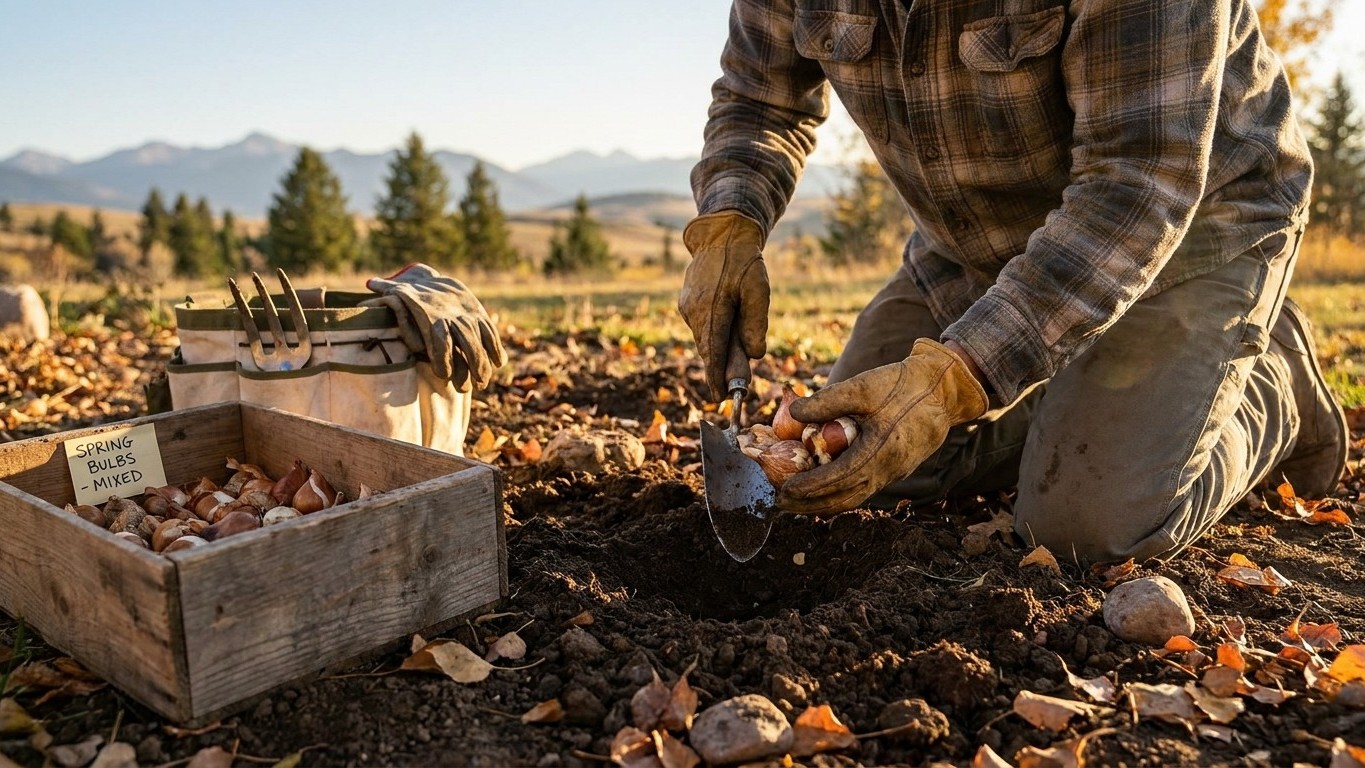

Yes, spring bulbs come back reliably in most of Wyoming — the state’s winters run so cold that chill requirements are never the problem. The real question is which bulbs survive the cold at all, and when to get them in the ground before it locks up for the season.
When to plant bulbs in Wyoming

Spring bulbs need roughly six weeks in cool soil before the ground freezes solid, which means working backward from Wyoming’s average first fall frost of September 24 to October 5 (measured at the Cheyenne station, USW00024018, NOAA’s 1991-2020 Climate Normals). That puts the ideal planting window somewhere in the second half of September through mid-October across most of the state, though gardeners at higher elevations should shift everything a week or two earlier.
Plant too soon, while the soil is still warm from summer, and the bulb often pushes tender top growth before winter arrives. That green shoot gets caught by the first hard freeze and dies back, weakening the bulb right when it should be building root mass underground instead. Plant too late, once the ground has already started to seize up, and the bulb goes in without enough time to establish roots. It may still flower the following spring, but weakly, or it may simply rot in place, unable to draw enough moisture before the freeze locks everything down. Gardeners who want more control over timing and soil conditions might also consider Growing Spring Bulbs in Containers in Wyoming, which sidesteps some of these risks entirely, while those who’d rather skip outdoor timing altogether can look into Forcing Spring Bulbs Indoors in Wyoming.
The frost date is an average, not a promise
Worth remembering: that September 24 to October 5 window is an average band, built from three decades of freeze probability data. Roughly half of all years fall on either side of it. Some autumns bring a hard freeze in mid-September; others stay mild into late October. The caution built into the federal data for this region is blunt about it too, at elevations around 6,000 feet, frost is possible in any month, and the frost-free season runs about 130 days. That’s a short runway. Gardeners who wait for a calendar date instead of watching the actual forecast sometimes lose the whole planting window in a single cold snap.
The practical approach: aim for the earlier half of the window rather than the later half. A bulb planted three weeks before the ground freezes with room to spare beats one planted three days before an unexpected early freeze. If a warm September stretches on, there’s no harm in waiting a little longer for cooler soil, bulbs planted into soil that’s still 65°F or warmer tend to root poorly compared to soil in the 40s and 50s.
Whether your winter is cold enough
Every spring bulb needs a stretch of real cold before it will flower. Most varieties require twelve to fourteen weeks with soil temperatures below about 45°F. Skip that requirement and the bulb doesn’t die outright, it just refuses to perform. It sends up leaves, sometimes a stem, but no flower, or a flower bud that never clears the soil line. This is the single figure that matters most when judging any bulb offered for sale, anywhere, because it’s the number that decides success or failure regardless of what the catalog photo promises.
Wyoming has the opposite problem from most of the country. Cheyenne’s coldest month averages a nightly low of just 18.1°F (NOAA Climate Normals, 1991-2020), a mean minimum, not a record low, which means that’s a typical winter night, not an outlier. Soil under that kind of air temperature drops well below 45°F and stays there for months, from around mid-October clear through April in most years. That’s not a narrow pass on the chill requirement. It’s a wide margin, several times longer than the minimum any bulb needs.
That margin buys two things. First, it opens the full catalog of spring bulbs sold for northern gardens, with no exceptions on the cold-chill front. Second, it means Wyoming gardeners can skip a step that gardeners in Arizona, Texas, or coastal California can’t avoid: artificial pre-chilling, which means twelve weeks in a refrigerator crisper drawer, kept away from ripening apples and other fruit because the ethylene gas they release can kill the flower bud sitting inside a stored bulb. None of that applies here. The ground does the work for free.
| Bulb | Weeks of cold required | What Wyoming delivers | Verdict |
|---|---|---|---|
| Tulips | 14-15 weeks | Roughly 20+ weeks below 45°F | Comfortably exceeded, no pre-chill needed |
| Daffodils | 12-14 weeks | Roughly 20+ weeks below 45°F | Comfortably exceeded, no pre-chill needed |
| Hyacinths | 12-14 weeks | Roughly 20+ weeks below 45°F | Comfortably exceeded, no pre-chill needed |
| Crocus | 8-15 weeks | Roughly 20+ weeks below 45°F | Comfortably exceeded, no pre-chill needed |
| Alliums | 8-10 weeks | Roughly 20+ weeks below 45°F | Comfortably exceeded, no pre-chill needed |
The failure risk in Wyoming isn’t a lack of cold. It’s the opposite kind of cold problem: whether a given bulb’s hardiness range can survive winter here at all, which is a separate question from how much chill it needs to flower.
Which bulbs suit Wyoming
Wyoming spans USDA Hardiness Zones 3a to 6a (USDA Plant Hardiness Zone Map, 2023 update, based on 1991-2020 normals), a system built on one measurement: the average annual extreme minimum temperature. It’s a wide range for one state, and the zone number alone can mislead, a bulb rated hardy to zone 4 might sail through a sheltered zone 3a garden bed against a south-facing wall and die in an exposed one a few miles away. Treat the boundary as a soft edge, not a wall.
Bulbs whose hardiness range comfortably covers most of Wyoming:
- Tulips — hardy zones 3-8
- Daffodils (Narcissus) — hardy zones 3-8
- Crocus — hardy zones 3-8
- Siberian squill (Scilla siberica) — hardy zones 2-8
- Snowdrops (Galanthus) — hardy zones 3-7
- Grape hyacinth (Muscari) — hardy zones 4-8
- Allium — hardy zones 4-8
- Hyacinth — hardy zones 4-8, worth a sheltered spot in zone 3a areas
Some popular spring bulbs simply don’t belong here, and the failure mode is worth knowing in advance rather than after the fact. Ranunculus (hardy zones 8-10) and anemone coronaria (zones 7-10) rot in place over a Wyoming winter; the ground stays wet and cold in exactly the combination these Mediterranean corms can’t tolerate. Freesia and ixia (both zones 8-10 or warmer) may push a little foliage the first spring on stored energy, then vanish for good, since the bulb itself never survives a real freeze. None of these are worth the shelf price in a Wyoming garden bed unless grown as an annual and dug up each fall, which most gardeners won’t bother doing.
What digs them up here
Squirrels and voles aren’t random about which bulbs they dig up. It comes down to chemistry. Daffodils and anything in the onion family contain compounds that make them bitter or mildly toxic to rodents, so they get left alone almost every time. Tulips and crocus have no such defense, they’re essentially a starchy snack sitting a few inches underground, and both squirrels and voles will excavate a bed methodically once they find one.
- Bulbs rodents leave alone: daffodils/narcissus, alliums, snowdrops, fritillaria, grape hyacinth
- Bulbs rodents dig up: tulips, crocus
For the vulnerable bulbs, the one measure that actually holds up is wire mesh, hardware cloth laid flat over the planting bed and pinned down until the ground freezes solid. Once frozen, digging gets hard enough that most rodents give up and move on. Repellent sprays and granules sold for this purpose wash off with the first watering or rain and need constant reapplication, which makes them a poor match for a bulb bed planted once and left alone for six months.
Where to check for your own county
Every figure above, the frost date, the coldest-month minimum, comes from a single reference station in Cheyenne. Wyoming stretches across several degrees of latitude and a wide range of elevation, from river valleys under 4,000 feet to mountain towns above 8,000. A planting window built around the state’s low-elevation southeast corner can run two to three weeks off for a garden in the Bighorn Basin or up near Jackson, where frost arrives earlier and the frost-free season is shorter still.
The University of Wyoming Extension tracks local frost data and hardiness notes by county, and the county office is the fastest way to get a planting date adjusted for actual local elevation and microclimate rather than a statewide average. For a bulb bed that only gets one shot each fall, that local adjustment is worth the phone call.