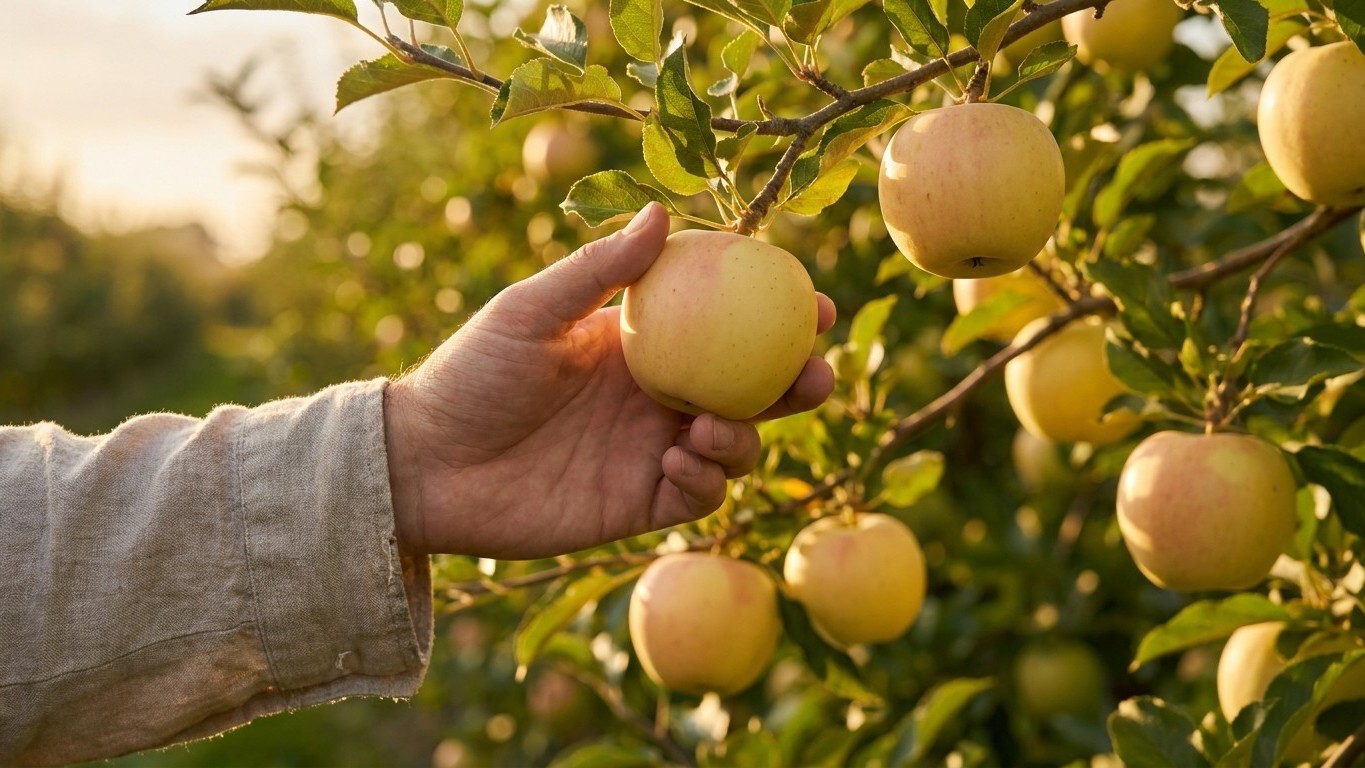

Earligold is an early-season apple bred for growers who want ripe fruit before Labor Day: hardy in zones 4 through 7, ready in late August to early September, and rated very susceptible to fire blight. That last point decides whether it belongs in your yard. Where fire blight pressure runs low, Earligold rewards you with a mildly sweet, lightly tart apple weeks ahead of most of the orchard. Where the disease is common, it’s a harder sell.
What Earligold actually is

According to USU Extension’s guide to apple production for the Utah home garden, Earligold gives the grower four things worth knowing before anything else:
- When it ripens: Late August to Early September
- What it tastes like: Mildly sweet and lightly tart, with tender yellow flesh
- What it’s good for: Fresh eating as one of the season’s first apples
- How Long It Keeps: Not long, it goes mealy within weeks
The eating profile is the reason people plant it at all. Tender yellow flesh with a mild sweetness and a light tartness reads as a snacking apple, not a baking one, and that distinction matters more than most people assume. Pie and sauce apples need flesh that holds its shape under heat and acidity strong enough to survive cooking; Earligold’s flesh softens too readily and its tartness is too light to carry a filling on its own. Save it for the hand, not the oven.
Timing is the other half of the appeal. Earligold ripens with bloom classed as Mid season, which puts the harvest window in late August into early September, ahead of the bulk of the fall apple crop. For a household that wants fruit off the tree before the rest of the orchard is even close, that early date is the whole point of growing it.
The catch is storage. This isn’t a variety you tuck into the root cellar for winter. Within a few weeks of picking, the flesh turns mealy and the fresh-eating quality that made it worth growing disappears. Plan to eat it, share it, or process it quickly rather than counting on months of storage.
Will it grow where you are
Hardiness zones 4 through 7
USU Extension lists Earligold as hardy in zones 4 through 7, a range that covers a wide swath of the northern and central United States, from cold-winter states like Minnesota and Vermont down through the mid-Atlantic and into parts of the transitional South. That’s a broad window as apple varieties go, but it’s still a range, not a single number, and the cold end and warm end of that range ask different things of a grower. At zone 4, winter survival is the concern. At zone 7, the tree survives the winter without trouble, but summer heat and the local disease pressure become the bigger variables.
Winter chill: not published here
Hardiness zone tells you whether the tree survives winter cold. It doesn’t tell you whether the tree will flower and fruit properly the following spring, and that’s where winter chill comes in. Chill hours measure the accumulated cold the tree needs during dormancy to break bud evenly when spring arrives; too little chill and bloom comes late, uneven, or thin. USU Extension’s guide doesn’t publish a chill-hour figure for Earligold, so rather than guess at a number, the honest answer is that this detail isn’t documented in the source used for this page. Growers in zones 6 and 7, where mild winters sometimes fall short on chill accumulation, are the ones who should check with a local extension office before planting, since chill requirements vary enough between varieties that a number matters more there than it does further north.
What to plant beside it
Nearly all apple varieties crop better with a compatible partner nearby, and Earligold isn’t the exception. Two trees blooming at the same time still isn’t automatically enough, since a parent variety can’t pollinate its own seedling and some pairings simply don’t cross well even with overlapping bloom. That’s exactly why a named partner list matters more than a bloom-season chart alone.
For Earligold, that named list isn’t published in the source used for this page. USU Extension’s guide gives the bloom timing (Mid season) and the hardiness range, but it doesn’t name specific pollination partners for this variety, and rather than guess at names that would only be a plausible-sounding fill-in, the straightforward answer is that this detail isn’t documented here.
What you can do with the information available is narrow the field. A Mid season bloom time means the safest bet is another Mid season variety, since overlapping bloom windows are the baseline requirement before compatibility even comes into question. A local nursery or extension office that stocks Earligold locally will usually be able to confirm which varieties in their own inventory bloom alongside it. For the general rules on how apple pollination works, including why some pairs fail even with matching bloom dates, see our apple pollination guide.
One more thing worth flagging for anyone assuming a single tree will be enough on its own: no sterile-pollen designation is mentioned for Earligold in this source either, but the general rule for apples still applies. Plan on at least one other variety in the yard, or a neighbor’s tree close enough for bees to bridge the gap, rather than counting on a lone Earligold to set a full crop by itself.
Growing it well
Fire blight: Very Susceptible
This is the rating that decides whether Earligold belongs in your yard at all. USU Extension rates it very susceptible to fire blight, a bacterial disease that moves fast in warm, wet spring weather, entering through blossoms first and then racing down into shoots and branches. In the garden, that shows up as blackened blossom clusters that look scorched, followed by shoots that wilt and curl into a shepherd’s-crook shape at the tip. Left unchecked, it can kill young wood in a single season and, in bad years, take out whole limbs.
Managing it means pruning out infected wood well below the visible damage, disinfecting tools between cuts, and avoiding heavy nitrogen fertilizer, since vigorous new growth is exactly what the bacteria prefer to infect. Growers in regions with warm, humid spring weather, the mid-Atlantic and parts of the Southeast in particular, will see more pressure than growers in drier or cooler climates. If fire blight is already a known problem on your property or in your neighborhood, that’s the single biggest reason to look at a different variety before planting Earligold.
Habit and biennial bearing
No specific habit or biennial-bearing rating is published for Earligold in the source used for this page, so rather than assign a trait it doesn’t document, the general practice for early-season apples applies here too: thin the crop by hand in late spring, spacing fruit several inches apart on the branch, to reduce stress on the tree and lower the odds of a heavy year followed by a light one. Without a documented rating either way, thinning is cheap insurance regardless of how the tree turns out to behave.
Picking it and keeping it
The harvest window for Earligold runs Late August to Early September, but a calendar date is only a starting point. The tree itself gives better signals, and they’re worth checking in order:
- Lift and twist: Cup the apple in your palm, lift it gently, and give it a slight twist. A ripe apple separates from the spur with little resistance; one that clings and has to be pulled or pried off isn’t ready yet.
- Seed color: Cut one test apple open and check the seeds. Pale or greenish seeds mean more time is needed; brown seeds are a sign of maturity.
- Ground color: Look at the background skin color on the shaded side of the fruit, away from the sun-blushed cheek. A shift from green toward yellow on that shaded side is one of the more reliable field signs that the apple has finished ripening on the tree.
Storage
Earligold isn’t built for the long haul. It goes mealy within weeks of picking, so treat it as a fresh-eating apple to work through quickly rather than one to tuck away in cold storage for winter. Refrigeration slows the softening some, but it won’t turn this into a keeper variety. Pick it, eat it, and enjoy that it beat almost everything else in the orchard to the table.
Common questions
Is Earligold the same apple as Golden Delicious?
No. The two are sometimes confused because of the shared “gold” reference, but the facts used for this page describe Earligold as its own early-season variety with a distinct ripening date, well ahead of Golden Delicious’s typical harvest.
Can I grow Earligold in a warmer zone 8 or 9 climate?
USU Extension’s published range tops out at zone 7. Growing further south falls outside the documented hardiness window, and warm-winter regions also tend to raise fire blight pressure, compounding the risk for a variety already rated very susceptible.
Does Earligold need a pollination partner?
Almost certainly yes, since nearly all apple varieties crop better with a compatible partner, but no specific partner names are published in the source used for this page. Choose another Mid-season bloomer and confirm compatibility locally.
How do I protect Earligold from fire blight?
Prune out infected wood promptly, cutting well below visible damage and disinfecting tools between cuts, avoid heavy nitrogen fertilizer that pushes vulnerable new growth, and consider the local disease history before planting at all.
What’s the best use for Earligold apples once picked?
Fresh eating, and soon. The tender yellow flesh and mild sweet-tart balance don’t hold up well to cooking, and the apple goes mealy within weeks, so it’s best enjoyed off the tree rather than stored or baked.