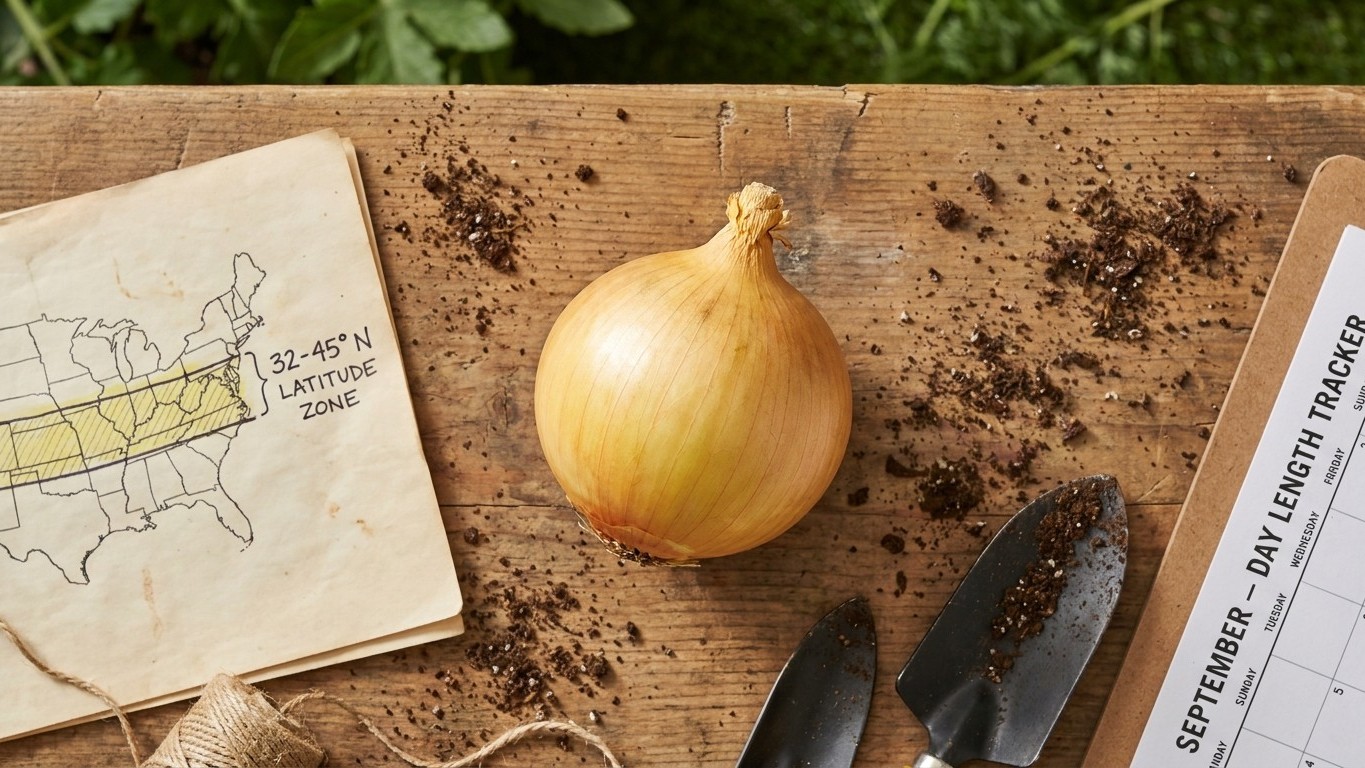

Expression is an intermediate-day onion, which means it only bulbs properly between roughly 32 and 45 degrees north latitude. That single fact determines whether this variety belongs in your garden at all. Get the latitude right and you’re looking at a 105-day yellow onion with a straightforward growing rhythm. Get it wrong and no amount of good soil will save you.
Will Expression bulb where you are

Expression falls into the intermediate-day category, sometimes called day-neutral, which puts its working latitude range at 32 to 45 degrees north. That band runs through the middle third of the continental United States, roughly from northern Georgia and the top of Texas up through southern Michigan and central Oregon. Inside that stripe of the map, this onion has what it needs to form a bulb.
Outside it, the plant doesn’t shrink the problem down to a smaller onion. It skips bulbing entirely. You get a healthy-looking clump of green tops all summer, and then, once you dig it up or try to store it, you get rot instead of a cured onion. That’s the part gardeners rarely expect, because it runs against how most vegetables behave.
The reason comes down to a mechanism that has nothing to do with heat. Onions bulb in response to day length, the number of daylight hours their leaves are exposed to, not the temperature of the soil or the air. A stretch of 95-degree days will not push an intermediate-day onion toward bulbing if the daylight hours aren’t in its trigger range, and a cool, cloudy summer at the right latitude will still get the job done. This is also why long-day onions are grown up near the Canadian border and short-day onions dominate the Gulf Coast: the far north simply receives more hours of summer daylight than the south does, and each type is matched to what its latitude actually delivers.
If you garden at 30 degrees north or at 47 degrees north, you’re outside the published range, and Expression is not the variety to gamble on. If you’re at 33 or at 44, you’re in the blurred edge of the continuum rather than a hard failure zone. Extension bulletins on onion day-length response are worth a look before you commit a whole bed to any variety this close to a boundary, and the Penn State Extension office serving your county is a reliable starting point for confirming how your specific location tends to behave.
What Expression is like
Once the latitude question is settled, what you’re actually growing is a yellow onion built around a 105-day timeline from transplant to maturity. That’s a mid-length season as onions go, long enough that you need to plan around it but not the marathon some storage varieties demand.
No flavor profile and no storage duration are published for Expression specifically, and it would be a disservice to invent either. What can be said is what its day-length group tends to suggest as a general pattern. Short-day onions, grown mostly in the South, typically run sweeter and milder, and they tend to keep for a shorter window. Long-day onions, grown in the North, typically run sharper and store longer, sometimes well into winter. Intermediate-day types like Expression usually land somewhere between those two tendencies, but that’s a pattern across the category, not a guarantee for this particular onion.
The reason sweetness and storage life pull in opposite directions isn’t arbitrary. The same sulfur compounds responsible for an onion’s bite are also the compounds that protect the bulb from breaking down in storage. A mild onion has fewer of them and spoils faster. A sharp onion has more and holds up longer in a mesh bag through the winter. No variety escapes that trade-off, so don’t expect a sweet Expression onion that also keeps six months, because that combination doesn’t exist in onions generally.
Here’s what the catalog data actually confirms about Expression:
- Color: Yellow
- Day-length group: Intermediate-day
- Days to maturity: 105 days from transplant
- Adapted latitude range: 32 to 45 degrees north
When to plant it
Planting timing for onions is dictated almost entirely by day-length group, and that’s exactly why it varies so much by region even for the same crop. Short-day onions go into the ground in autumn across the mild-winter South, overwinter as small plants, and get harvested by late spring. Long-day onions go in during late winter or very early spring in northern states, once the ground is workable, and they mature through the long daylight hours of a northern summer.
Expression, as an intermediate-day variety, generally follows the spring planting window used across the middle latitude band it’s suited to, similar to how long-day onions are handled further north, though gardeners near the southern edge of its range sometimes have more flexibility with an earlier start. The exact calendar date matters less than what your local frost patterns and soil conditions allow, and a county extension office can tell you the realistic planting window for your specific area.
What matters more than any date on a calendar is a test every onion grower should apply regardless of variety: the plant needs to have built up enough leaf mass before day length reaches the trigger point that starts bulbing. Onions form their bulb from the base of the leaves, and the number and thickness of leaves present at the moment bulbing kicks in is what determines the final bulb size. A transplant that’s still small and thin when daylight hits the trigger threshold will bulb anyway, on schedule, but it will bulb small, because there simply isn’t enough leaf structure to feed a larger bulb. A transplant that went in too late has already lost that race before the season even gets going.
That’s the practical reason experienced growers push transplants or sets into the ground as early as the soil and weather allow. It isn’t about beating a frost. It’s about giving the plant every possible week of leaf growth before the calendar takes the decision out of its hands.
Growing it well
Onions have a root system that stays shallow and doesn’t spread far, which makes them poor at competing with anything else growing nearby. A bed with weeds crowding in isn’t just untidy, it’s actively pulling moisture and nutrients away from bulbs that have no way to reach deeper or wider for what they’re missing. The visible result later in the season is smaller bulbs across the whole row, not a few stunted plants here and there.
Consistent moisture matters for the same reason. Because the roots can’t chase water down through dry soil the way a deeper-rooted crop can, a dry stretch during bulb formation shows up directly as reduced bulb size at harvest, not as wilted leaves that recover once you catch up on watering. By the time the plant looks stressed above ground, the bulb below has often already lost the growth it wasn’t going to get back.
Bolting is the other issue worth watching for. A plant that sends up a flower stalk partway through the season has shifted its energy toward seed production, and the bulb that results won’t store well even if it looks normal at harvest. Onions that bolt should be pulled and used first, within days or weeks rather than set aside for winter storage, because the internal quality that makes long storage possible has already been compromised by the plant’s decision to flower instead of bulk up.
None of this changes the basic profile of what Expression needs compared to any other onion variety: full sun, soil that drains well, weeds kept down, and moisture kept steady through the bulbing stretch of the season.
Harvesting and keeping it
Onions announce their own readiness, and it’s a signal worth trusting over any date circled on a calendar. As bulbs finish sizing up, the tops start to yellow and eventually fall over on their own, flopping down at the neck without any help. That collapse, happening across most of the row rather than just one or two plants, is the cue that harvest time has arrived.
Pulling the bulbs is only half the job. Curing is the step that determines whether those onions make it through storage or rot in the bag within weeks, and it’s the step most home gardeners skip or rush. The process is simple in concept: bulbs need to sit somewhere warm, dry, and well-ventilated until the neck and outer skin dry down to a papery texture. Skip that drying period and moisture trapped in the neck becomes the entry point for rot later, even if the bulb looked perfectly fine coming out of the ground.
No storage duration is published for Expression specifically, so plan around what its intermediate-day category generally suggests rather than assuming a number that hasn’t been confirmed. As a point of comparison worth keeping in mind: an onion variety that keeps six months carries a household from harvest into spring, while one that only keeps three months needs to be worked into meals well before the season is over.
The sequence, start to finish, looks like this:
- Watch for tops yellowing and falling over on their own across most of the bed.
- Pull the bulbs once the majority of tops have collapsed, rather than waiting for every last one.
- Lay bulbs out somewhere warm, dry, and airy, tops still attached, out of direct rain.
- Let necks and outer skins dry until they’re papery to the touch, typically a matter of weeks, not days.
- Trim dried tops, brush off loose soil, and move cured bulbs into mesh bags or a similar ventilated storage setup.
- Check stored bulbs periodically and use any that show softening first, before they affect neighbors in the same bag.