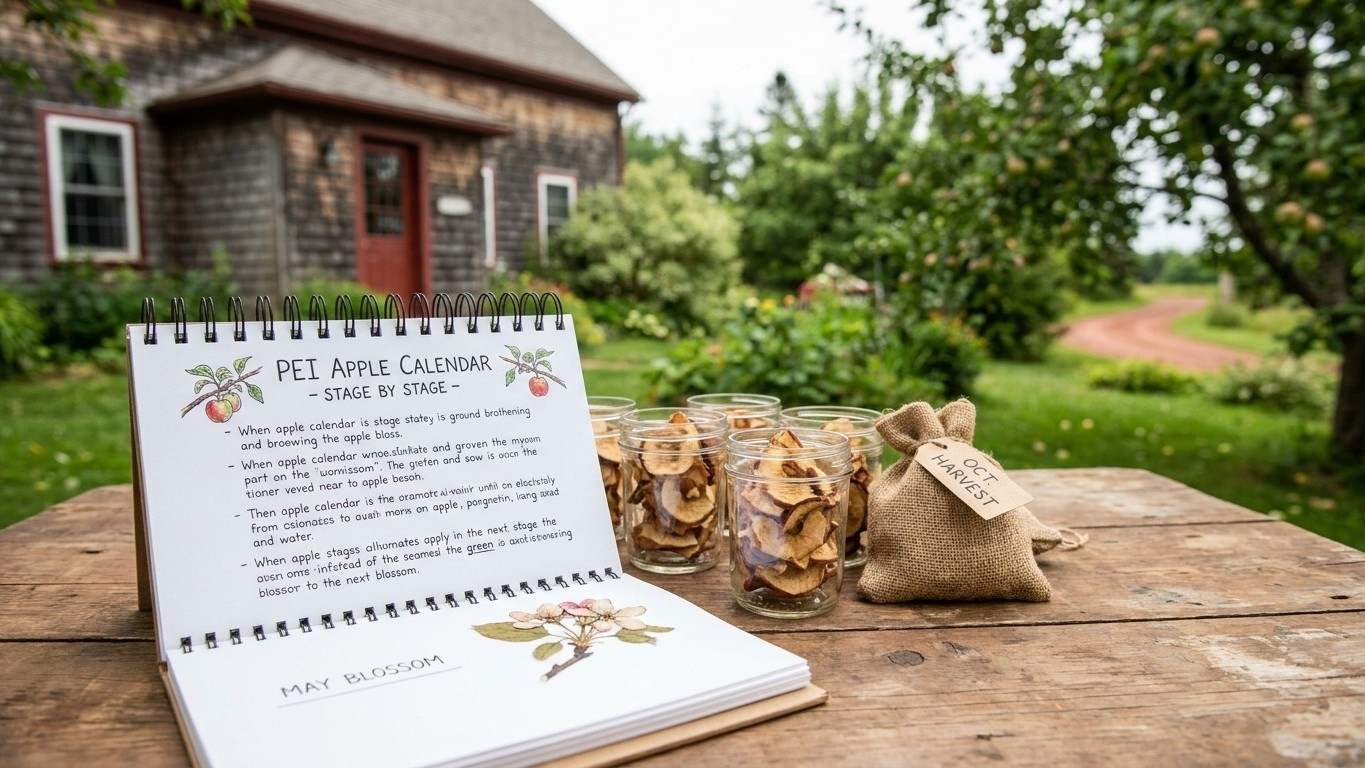

Apple trees on Prince Edward Island move through dormancy, green tip, pink, bloom, petal fall, fruit set and harvest on a calendar set by frost, not by the flip of a page. Environment and Climate Change Canada’s 1981-2010 normals put Charlottetown’s average last spring frost at May 16 and its average first fall frost at October 17, and bloom for most cultivars falls somewhere inside that window. Check the buds on your own trees at each stage before you act, rather than trusting a date on the wall.
The short answer for Prince Edward Island
On Prince Edward Island, apple bloom generally lands inside the frost-risk window that Environment and Climate Change Canada’s 1981-2010 normals describe for the Charlottetown A station: an average last spring frost of May 16 and an average first fall frost of October 17. That is a mean date from ECCC, not a safe date. Frost falls later than May 16 in roughly half of all years on record and earlier than October 17 in the other half, so a bloom that opens on schedule can still meet a frost that arrives late.
Because bloom typically follows green tip by two to three weeks, and green tip itself only starts once the tree has banked enough cold hours to break dormancy, the calendar answers two separate questions. The first is whether the winter was cold enough for long enough to satisfy the tree’s chill requirement. The second is whether spring frost is finished by the time flowers open. ECCC’s normals put Charlottetown’s coldest month at a mean daily minimum of -12.1 °C, cold enough to satisfy the chill needs of nearly every apple cultivar sold for Canadian gardens, and also cold enough to injure wood that broke dormancy too early in a false spring.
The stage-by-stage detail below assumes a tree already chosen for this climate. If that decision is still ahead of you, The Best Apple Varieties for Prince Edward Island covers cultivar names, rootstock hardiness and chill hours before you plant.
What actually decides the calendar in any single year is accumulated warmth since green tip, not the date itself. A tree sitting at pink stage during an unseasonably warm week will reach bloom faster than the average interval suggests. A tree that hit bloom during a cold spell can stall at that stage for what feels like weeks, waiting on heat rather than on the sun angle.
Working through it

From dormancy to bloom
Dormancy runs from leaf fall through the winter and is a survival test, not an activity. The tree needs to tolerate whatever the coldest month delivers, and ECCC’s normals put that coldest month’s mean daily minimum at Charlottetown at -12.1 °C. A cultivar or rootstock not hardy to that range shows dieback on one-year wood by the following spring, long after the damage was actually done. If you have not yet worked through site selection and spacing, Growing Apples in Prince Edward Island covers that groundwork.
Green tip arrives once accumulated spring warmth triggers the buds to swell and show colour, usually weeks before ECCC’s May 16 average last frost date at Charlottetown. That gap matters: green tissue at this stage is far less frost-hardy than a dormant bud, so a cold snap that would have done nothing in February can burn new growth in April. Pink follows, when the flower cluster shows colour but has not opened. This is the most frost-sensitive stage of the whole calendar, more sensitive than open bloom itself, because the tissue is fully exposed and not yet hardened by opening.
Bloom opens the flowers for pollination. Because Charlottetown’s average last frost of May 16 is a mean and not a guarantee, a bloom that times itself to the average calendar date still meets a damaging frost in a meaningful share of years. Petal fall follows once pollination is done and petals drop, and frost tolerance improves a little at this stage compared with pink and full bloom, though a hard freeze can still abort the young fruitlets.
From fruit set to harvest
Fruit set is the stage where the pollinated flower becomes a small green fruit, and the tree drops a portion of that set on its own in early summer, a natural thinning called June drop. From here the calendar is a race against the calendar’s other end: ECCC’s average first fall frost at Charlottetown of October 17. A cultivar’s published days-to-maturity figure, counted from bloom rather than from a fixed date, tells you roughly where harvest should land, but that count shifts by a week or two either way depending on how warm the summer runs.
| Stage | What triggers it | Frost risk | What to do |
|---|---|---|---|
| Dormancy | Day length and cold | Low, tree is hardened | Prune while wood is bare |
| Green tip | Accumulated spring warmth | Moderate | Watch overnight lows closely |
| Pink | Warmth continuing after green tip | Highest of any stage | Delay feeding, watch for frost warnings |
| Bloom | Two to three weeks after green tip | High | Protect if frost is forecast, allow pollinators to work |
| Petal fall | Pollination complete | Moderate | Begin monitoring for pests, thin lightly |
| Fruit set | Petal fall plus warm days | Low | Support heavy limbs, thin further if needed |
| Harvest | Cultivar’s maturity count from bloom | Rising again toward fall | Pick before the average first frost passes |
What changes across Prince Edward Island
Every figure above is anchored to the Charlottetown A weather station, and the Island is not one climate. Coastal ground along the Northumberland Strait, on the province’s south side, sits over water that warms and cools more slowly than soil, which tends to slow the spring warm-up that triggers green tip and to buffer the first sharp cold of fall. Inland fields away from that moderating water can swing faster in both directions, warming into green tip earlier on a mild run and dropping into a hard frost sooner once autumn turns.
Low-lying and sheltered spots, the kind of dip or hollow where cold air pools overnight, run colder at bud break and at bloom than a slope or a hilltop a short distance away, because cold air is denser and settles into the low ground rather than draining off it. An orchard planted in one of those hollows will show pink and bloom later than a neighbouring block on a rise, and it will also catch a spring frost that the rise escapes entirely. This is the single most common reason two orchards a few kilometres apart report different bloom dates in the same week.
Elevation works the same way at a larger scale. Higher ground in the eastern and central parts of the Island tends to lag the reference station’s warm-up in spring and to see its first frost sooner in fall, which narrows the safe window for bloom and for harvest on both ends. None of this changes the direction of the calendar, only its timing, and the only way to know your own site’s offset from Charlottetown is to track bud stage against a thermometer actually placed on your own ground for a season or two.
The mistakes this climate punishes
Choosing an early-blooming cultivar purely to chase an early harvest is the most common error here, because a bloom that opens well ahead of ECCC’s May 16 average last frost at Charlottetown is betting on the frost also running early. In years where frost runs later than average, which happens in roughly half the years on record, that early bloom meets the frost directly and the crop is thinned or lost at the flower stage, not the fruit stage.
Planting a cultivar rated hardy only to a milder zone than this climate delivers is the second mistake, and it shows up not the first winter but a few winters later, in a hard-cold stretch. ECCC’s normals put Charlottetown’s coldest month at a mean daily minimum of -12.1 °C, and a cultivar or rootstock bred for gentler winters can suffer cambium damage or bud kill in that range even though it looked fine the year it was planted.
Feeding nitrogen late in the season is the third, and it shows up at the other end of the calendar. Late feeding pushes soft new growth right when the tree should be hardening off for winter, and that unhardened tissue is exactly what a fall frost damages first. Because ECCC’s first fall frost average of October 17 at Charlottetown is also a mean, meaning frost arrives earlier than that in about half of all years, a feeding schedule timed to the average date rather than to the tree’s own growth stage leaves soft wood exposed more often than a grower expects.
Harvesting by the calendar instead of by the fruit is the fourth. A late-maturing cultivar’s published days-to-maturity figure is counted from bloom and drifts by a week or two with the season’s weather, and a grower who waits for a fixed date rather than checking the fruit can lose the crop to the first fall frost while still waiting for the “right” week to arrive.
Checking this against your county
Every date and figure in this calendar comes from the Charlottetown A station, and Prince County, Kings County and the parts of Queens County away from the coast will all run slightly differently. For a check specific to your own ground, and for anything involving spray schedules, disease pressure or pest timing that changes year to year, the Prince Edward Island government’s agriculture page is the source to consult.
That page is the right place to confirm anything this article did not have a documented figure for, rather than guessing at a number that was not measured for your part of the Island.
Common questions
How do I know when green tip actually starts on my tree?
Look at the buds directly rather than counting from a date. Green tip is the point where you can see an actual sliver of green pushing out of the bud scales, and it happens at different times even between two trees in the same yard depending on cultivar and on how sheltered each tree is.
Can I plant a cultivar that needs a longer growing season than this calendar suggests?
You can, but its published days-to-maturity count from bloom needs to fit comfortably before ECCC’s average first fall frost of October 17 at Charlottetown, and that average frost date arrives earlier than October 17 in about half of all years. A very late cultivar leaves little margin.
Does a late spring frost after bloom always mean I lose the whole crop?
Not always. A light frost after petal fall, once fruitlets have set, tends to do less damage than the same frost hitting open bloom or the pink stage, because the flower tissue itself is what is most vulnerable. A frost during full bloom is the one that costs the most fruit.
Why did my neighbour’s tree bloom a full week before mine?
Local ground differences explain most of that gap. A tree on a slope, in full sun, or away from a low spot where cold air pools will reach green tip and bloom sooner than one in a sheltered hollow, even a short distance away, because the microclimate at bud height is what the tree actually responds to.