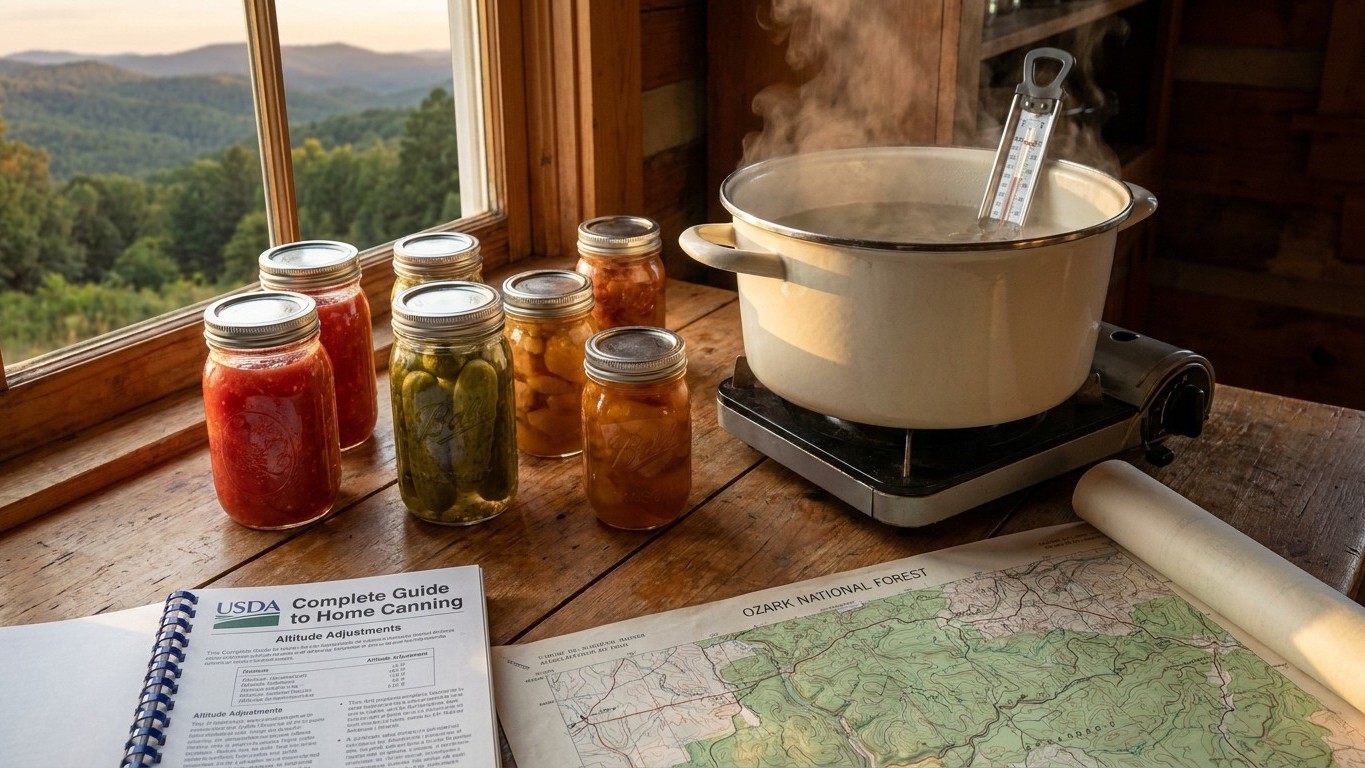

Arkansas canners rarely think about elevation until a jar fails to seal right or a recipe warns them to “adjust for altitude.” The truth is simpler than it sounds: your own address, not the state as a whole, decides whether you need to change anything. Most of the state sits low enough that standard times apply, but the higher ground changes the math completely.
The short answer

Little Rock, the reference city for this kind of question, sits at 335 feet in elevation. At that height, water boils somewhere between 208°F and 212°F, the published range the USDA’s Complete Guide to Home Canning gives for the 0 to 2,000 foot band. That is close enough to sea level’s 212°F that the difference barely registers in a canning kettle.
This is where a state-level answer stops being useful. Arkansas is not one elevation. Little Rock is a reference point, not a statewide figure, and a reader forty miles up into the Ozarks or the Ouachitas is standing on ground that a Little Rock boiling point says nothing about. The band that covers 0 to 2,000 feet is wide, and it happens to include much of the Arkansas Delta and the central part of the state around the capital. If that describes where your kitchen sits, you are working inside the lowest, most forgiving band on the USDA’s altitude chart.
Why the band matters more than the number
Canning charts do not track every foot of elevation individually. They group elevations into bands, and the boiling-water canning and pressure canning adjustments are tied to which band you fall into, not to the exact number of feet under your feet. Little Rock’s 335 feet and a town sitting at 1,800 feet both land in the same 0 to 2,000 foot band, and both would use the same processing guidance for a given recipe. Climb past that band, into the higher country that runs through Newton, Madison, or Polk counties, and the boiling point drops enough that the band changes, and so does what the recipe asks of you.
So the short answer for a Little Rock kitchen is: probably no adjustment needed. The short answer for a kitchen higher up is: check, because the number that matters is the one under your own house, not the one under the state capitol.
Why a lower boil is a weaker process
Water boils when its vapor pressure matches the pressure of the air pushing down on it. At sea level, that balance happens at 212°F. Push the same pot up to 10,000 feet, where the air is thinner and pushes less, and the water boils at 194°F, according to the same USDA guide that gives Little Rock’s range. The water is still boiling. It is just boiling at a lower temperature, and that lower temperature is the entire problem.
Heat kills bacteria, spores, and enzymes, but it does the job on a curve, not a switch. A jar processed at 212°F for a set number of minutes delivers a certain amount of lethal heat exposure. Drop the boiling temperature to 194°F and hold it for the exact same number of minutes, and the jar receives measurably less of that lethal exposure. The food inside might look, smell, and taste identical to a properly processed jar. The spores of Clostridium botulinum, the organism at the center of every home canning safety rule, do not announce whether they survived.
Here is the part that trips people up: boiling the water harder does not fix this. Water at a rolling boil and water at a bare simmering boil are both sitting at the same maximum temperature for that altitude and that pressure. Turning up the burner makes the water boil away faster, not hotter. There is no way to force a pot of water at 6,000 feet to reach 212°F by adding more flame. Physics has already set the ceiling.
What actually compensates is time or pressure, not heat intensity. In a boiling-water canner, the fix is leaving jars in the boiling water longer, so the food spends more total time exposed to whatever temperature that water can reach. In a pressure canner, the fix works differently: raising the pressure inside the sealed canner raises the temperature the water and steam can reach, pushing it back up past 212°F even at altitude, and that restores the lethal margin a recipe was designed around. Both fixes exist for the same reason. A weaker boil needs a stronger process to make up the difference.
Finding your own elevation
The number that matters for your canner is the one at your kitchen sink, and Little Rock’s 335 feet has no bearing on it if you live somewhere else in the state. Here is the order to work through to find your own.
- Start with your street address, not your town’s name or your county seat, since elevation can shift by hundreds of feet within a few miles in hill country.
- Use the National Center for Home Food Preservation’s “Find Your Elevation” page, built specifically for canners who need this number and nothing more complicated.
- Enter your address or ZIP code as the tool asks, and read off the elevation in feet.
- Compare that number against the elevation bands listed in the tested recipe you plan to use, since the recipe’s own chart is where the adjustment lives, not a general online elevation lookup.
- If your elevation sits right on the line between two bands, treat yourself as belonging to the higher one, since that is the safer direction to round.
- Write the number down somewhere you will see it again, on the inside of a cabinet door or a recipe binder, so you are not repeating this search every canning season.
This is a one-time task per kitchen, unless you move. Once you know the number, every tested recipe you use afterward tells you what to do with it.
What goes wrong
- A jar that looks perfectly sealed but was never properly processed. Altitude failures are silent. The lid pops down, the jar seals, and nothing about the appearance signals that the heat exposure fell short. The remedy is checking your elevation against the recipe’s chart before processing, not after, since there is no visual test that catches this later.
- A recipe pulled from a sea-level source with no altitude notes at all. Many older cookbooks and online recipes were written by or for someone at low elevation and simply never mention adjustment, leaving a canner at higher ground to assume the times given are universal. The fix is treating every canning recipe as sea-level by default unless it explicitly states otherwise, and adjusting from there using your own elevation.
- Reading a pressure gauge as though elevation does not exist. A dial or weighted gauge set for sea-level pressure at a higher elevation delivers less lethal heat than the recipe assumed, the same underlying problem as a boiling-water canner run too briefly. The remedy is matching the gauge setting to the pressure listed for your specific elevation band in the tested recipe, not the default setting printed on the canner’s lid.
- Assuming a harder boil makes up for altitude. Cranking the burner higher feels like it should help, but boiling water cannot exceed the maximum temperature its surrounding air pressure allows. The only real remedy is more time or more pressure, not more flame.
Where the exact adjustment comes from
This page will not give you a processing time or a canner pressure, and no elevation guide should. Those numbers belong to the tested recipe for the specific food you are canning, developed and verified for exactly that food, that jar size, and that altitude. Elevation only tells you which column of the chart to read; the recipe supplies the number in that column.
For the actual adjusted times and pressures, go to the National Center for Home Food Preservation, the University of Georgia’s food safety research center, and look up the specific food you are processing. The reason this matters more than it might seem: Clostridium botulinum toxin has no taste and no smell. A jar that was under-processed because of an altitude miscalculation gives no warning sign before it is opened. The chart exists because guessing is not a safe substitute for it.
Common questions
Does Little Rock’s elevation apply to my whole county?
No. Elevation changes within short distances, especially in hilly parts of the state. Little Rock’s 335 feet describes one point, and your own reading, found through the steps above, is the one that governs your canner.
Do I need to adjust for pressure canning if I’m already adjusting for boiling-water canning?
They are two separate charts within the same tested recipe, and both are tied to elevation, but they work through different mechanisms, so check both rather than assuming one adjustment covers the other.
Can I just process everything longer to be safe, regardless of elevation?
Stick to the elevation-specific time in the tested recipe rather than guessing longer. Over-processing certain foods affects texture and quality, and the safe approach is matching your actual elevation to the chart, not padding the number.
What if my elevation falls exactly on the line between two bands listed in a recipe?
Round up to the higher band. It costs a little more time or pressure, and it removes any doubt about whether the lower band’s heat exposure was enough.