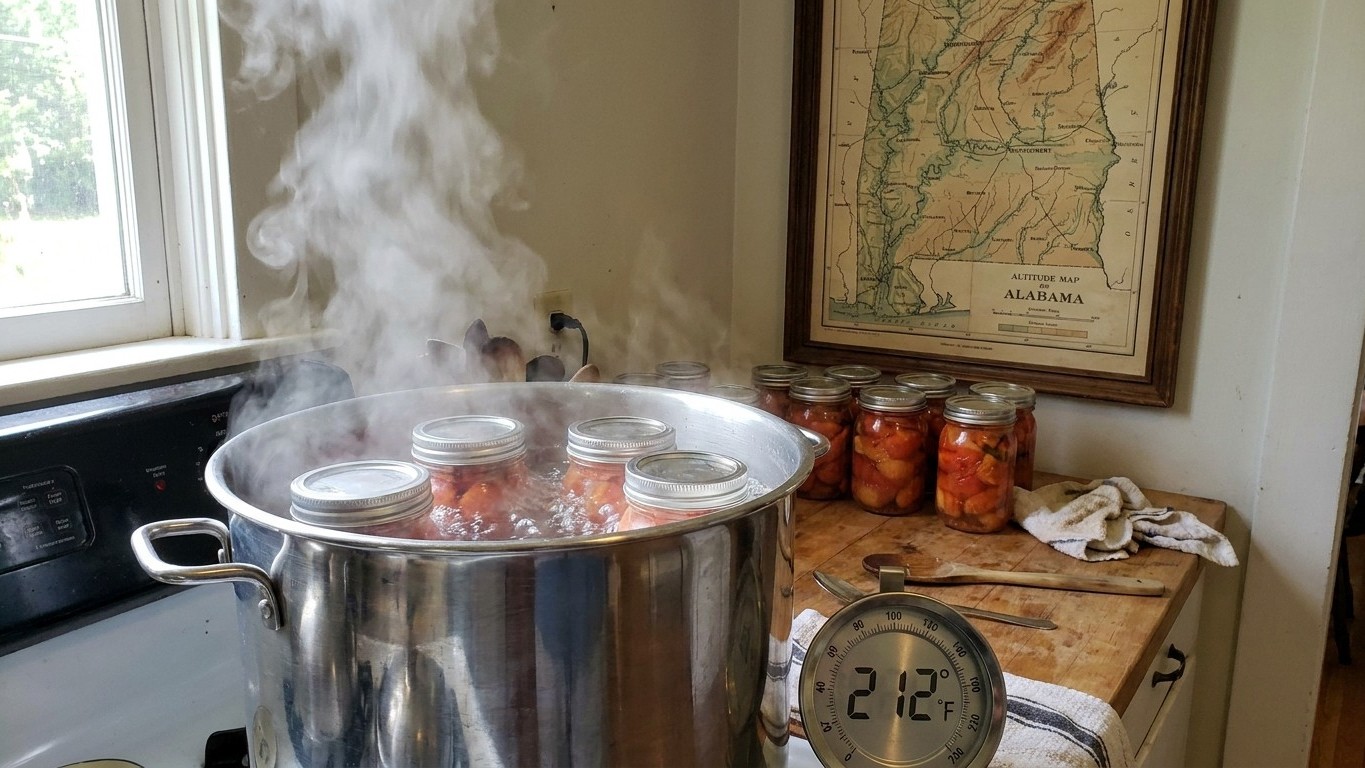

Huntsville sits at 633 feet above sea level, and at that height water boils somewhere between 208°F and 212°F, the range published for the 0-to-2,000-foot elevation band. That’s close enough to sea level’s 212°F that most boiling-water canning in the Huntsville area needs little or no adjustment. But Alabama runs from Gulf Coast marshes near sea level to ridges in the northeast well above 1,800 feet, so the number that matters is never the state’s, it’s yours.
The short answer

Start with the two figures that frame everything else: Huntsville’s elevation is 633 feet, and the USDA’s Complete Guide to Home Canning brackets the boiling point at that height between 208°F and 212°F. Compare that to sea level, where water boils at a clean 212°F, or to a mountain town at 10,000 feet, where it drops to 194°F. Huntsville isn’t a mountain town. Its boil sits within a few degrees of the sea-level standard, which is the whole reason low elevations get simpler treatment in canning charts than high ones do.
Does that mean nothing changes for a Huntsville-area canner? Not automatically, and this is the part worth slowing down for. Alabama is not one elevation. Someone in Mobile is canning close to sea level. Someone on Sand Mountain or near Mount Cheaha, the state’s high point, is working several hundred feet higher than Huntsville itself. The 633-foot figure describes one city, chosen as a reference point because it’s a recognizable population center, not because it stands in for the whole state. Your kitchen might be lower, might be higher, and the difference of even a few hundred feet can shift which line of an altitude chart applies to your jar.
Why the range, not a single number
The 208°F to 212°F bracket isn’t sloppiness, it’s the reality of how boiling point tables are built. They’re published in bands, typically covering a few thousand feet at a time, because the boiling point drop from elevation gain is gradual and continuous, not a series of sharp steps. Within the 0-to-2,000-foot band that covers Huntsville, the boiling point drifts down from that 212°F sea-level mark toward 208°F as you approach the upper edge of the band. A cabin at 200 feet and a farmhouse at 1,900 feet are technically in the same reported band, but they’re not boiling water at exactly the same temperature.
That distinction is why the honest answer to “does my elevation matter” is: check your own number, not Huntsville’s, and not “Alabama’s” in the abstract. For most home canners working in the low hundreds of feet, the practical impact is small. For those higher up in the state’s hill country, it can be enough to matter, and the only way to know is to look up the actual elevation of your address rather than assume the state capital, the nearest big city, or “the South” tells you anything reliable.
Why a lower boil is a weaker process
Here’s the mechanism, stripped down to its essentials: water boils at a lower temperature as elevation climbs, because atmospheric pressure drops the higher you go, and it’s that pressure pressing down on the water’s surface that determines when it turns to vapor. Less pressure means the water gives up and boils sooner, at a cooler temperature. At sea level that’s 212°F. At 10,000 feet it’s 194°F. Every foot in between shaves off a fraction of a degree.
A cooler boil kills less. That’s the entire problem in one sentence. Canning relies on heat to destroy the organisms and enzymes that spoil food or, far more seriously, to destroy Clostridium botulinum spores in low-acid foods. The temperature reached inside the jar, sustained for a specific length of time, is what does that work. Drop the temperature even a few degrees and the same processing time no longer delivers the same lethality. The food might look identical. The jar might seal perfectly. The bacteria that survive don’t announce themselves.
This is where a common instinct leads canners astray: cranking up the heat under the canner, assuming a harder, more violent boil will compensate. It won’t, because boiling water cannot get hotter than its boiling point. Turn the burner to high and the water boils faster and more vigorously, throwing off more steam, but it still tops out at whatever temperature the elevation allows. A rolling boil at 208°F is still 208°F. A gentle boil at 208°F is still 208°F. More flame doesn’t buy more heat once the water is already boiling; it just wastes fuel and evaporates your canner dry faster.
What actually compensates is time, or in the case of pressure canning, pressure. A boiling-water canner run at a lower boiling point needs longer in the water to reach the same cumulative heat exposure that a shorter time would deliver at sea level. A pressure canner sidesteps the elevation problem differently: added pressure inside the sealed canner raises the boiling point of the water above what it would be in an open pot, and at higher elevations that pressure has to be pushed up further to reach the same effective temperature the recipe was designed around. Neither adjustment is something to estimate by feel. Both come from tested tables matched to a specific elevation range and a specific recipe, which is a subject the next sections walk through in order.
Finding your own elevation
- Start with your address, not your city’s reputation. “Alabama” and even “Huntsville” are too broad; elevation can shift by hundreds of feet within a few miles, especially near ridgelines or river valleys.
- Check a topographic or elevation lookup tool. Several free online tools return elevation in feet for any address or set of coordinates, usually pulled from geographic survey data.
- Use the National Center for Home Food Preservation’s own elevation tool. NCHFP publishes a “Find Your Elevation” page built specifically so home canners can get a number without guessing.
- Round to the nearest elevation band on your recipe’s chart. Tested recipes list adjustments by elevation range (for example, sea level to 1,000 feet, 1,001 to 3,000 feet, and so on), so you need to know which band your number falls into, not the number to the exact foot.
- Re-check if you move or if you’re canning away from home. A church kitchen, a relative’s house, or a cabin can sit at a meaningfully different elevation than your own kitchen, even within the same county.
What goes wrong
- A jar that seals perfectly but was never processed hot enough. Elevation was ignored, the recipe’s base time was used as-is, and the boil ran cooler than the process assumed. The seal forming is not proof of safety; it only proves the lid sat under vacuum, which can happen even in an under-processed jar. The remedy is to match the process time or pressure to the correct elevation band before you start, every single time.
- A recipe pulled from a sea-level source without checking its origin. Recipe cards, older cookbooks, and posts written for a different region sometimes assume sea level and never say so. The remedy is to treat any canning recipe as sea-level baseline unless it explicitly states otherwise, and adjust from there using your own elevation.
- A pressure gauge read as if elevation didn’t exist. Dial gauges and weighted gauges both need a pressure setting matched to elevation, and a canner run at a sea-level pressure setting in a higher part of the state delivers less effective heat than the recipe assumes. The remedy is to confirm the correct pressure for your elevation band before sealing the canner, and to have a dial gauge checked periodically for accuracy since they can drift over time.
- Splitting the difference instead of rounding up. Some canners average two elevation bands or guess a number “close enough.” The remedy is to round up to the next elevation band when in doubt, since a slightly longer process or slightly higher pressure costs a few extra minutes, while an under-processed jar risks the food entirely.
Where the exact adjustment comes from
This page won’t hand you a processing time or a canner pressure, and that’s deliberate. The right adjustment depends on the specific food, the jar size, whether it’s packed raw or hot, and the method, boiling water or pressure, and those details only exist inside a tested recipe. Mixing a general elevation number with a processing time pulled from a different food or a different source is exactly how under-processing happens.
The National Center for Home Food Preservation, at the University of Georgia, maintains tested recipes with elevation adjustments built in for each one, and that’s the resource to use once you know your own elevation from the steps above. The reason this matters more than it might seem: Clostridium botulinum, the organism behind botulism, produces a toxin with no taste and no smell. A jar that’s under-processed can look, smell, and taste completely normal. There’s no sensory warning, which is exactly why the adjustment has to come from a tested source rather than a guess.
Common questions
Does Huntsville’s elevation apply to my whole county?
No. Huntsville’s 633 feet is a reference point for the city itself, not a stand-in for surrounding towns or rural addresses, which can sit noticeably higher or lower depending on local terrain.
If I’m below 1,000 feet, do I still need to check anything?
Yes, because “below 1,000 feet” still spans a range, and the correct move is to look up your specific elevation and match it to the exact band listed on your recipe’s chart rather than assuming low elevation means no chart at all.
Can I use a weather app’s elevation reading instead of a dedicated tool?
Weather apps sometimes show elevation, but accuracy varies by app and device. A dedicated elevation lookup tool or the NCHFP’s own elevation page gives a more reliable number for canning purposes.
Does altitude affect boiling-water canning and pressure canning the same way?
The underlying cause is the same, a lower boiling point at higher elevation, but the fix differs by method: boiling-water canning compensates with longer processing time, while pressure canning compensates by raising the canner’s pressure setting.