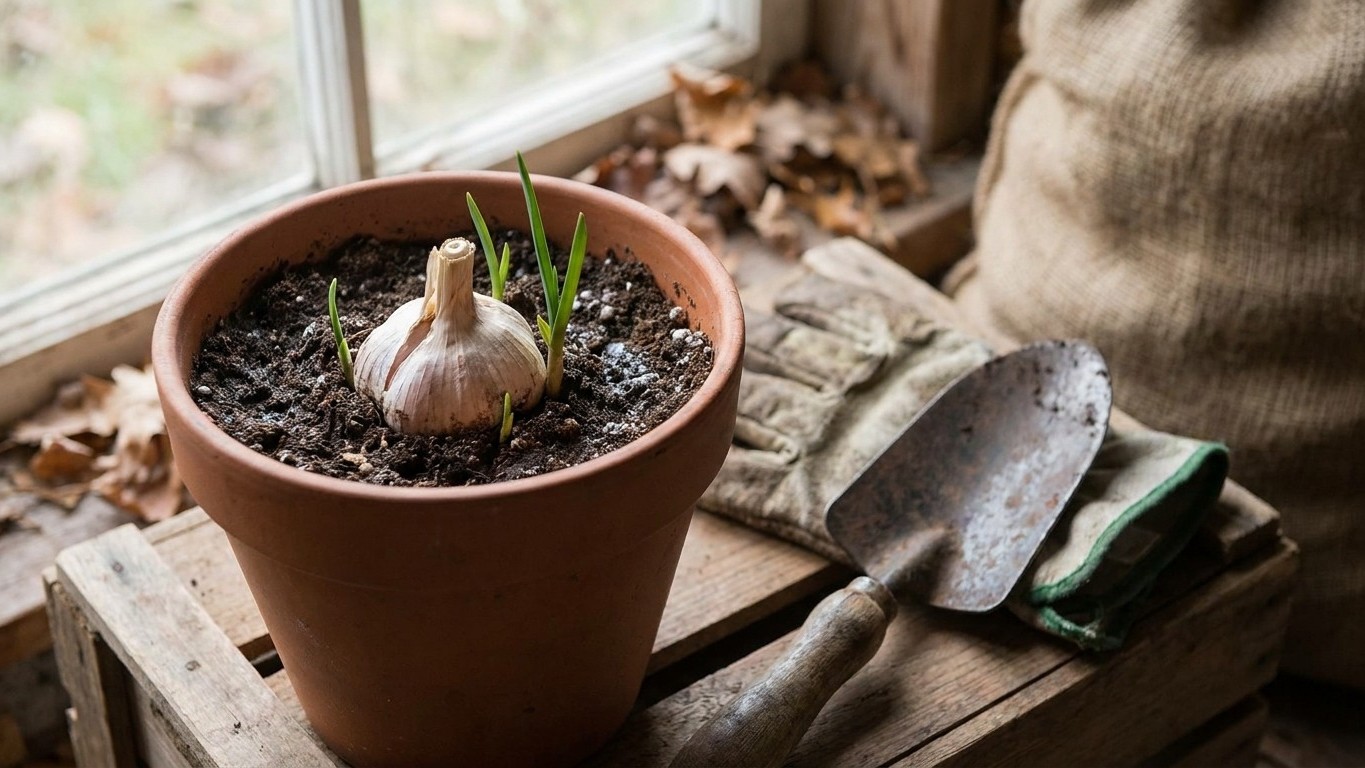

Garlic needs a real stretch of cold, not just cool weather, because that cold is what tells a single clove to split into a multi-clove bulb instead of growing into one plain, undivided round. Skip that cold period, or cut it short, and the plant grows fine all season but hands you a disappointing harvest. The one thing to check before you plant: whether your climate gives cloves a long enough winter on its own, or whether you’ll need to fake one with a refrigerator instead.
Why this matters for garlic

Every hardneck garlic clove carries the instructions for a full bulb, but those instructions only run if the clove passes through a sustained cold period first. Horticulturists call this vernalization. Without it, the plant still sends up leaves and looks perfectly healthy through spring, but underground it never divides. Instead of the multi-clove bulb you’re expecting, you dig up a round, a single, smooth bulb about the size of a golf ball with no internal segments at all. This decision sits right at the start of growing garlic, before any of the season’s other choices about spacing or mulch even matter.
The trouble with this mistake is timing. Garlic goes into the ground in fall and doesn’t come out until deep into the following summer, so an error made in October or November stays invisible for the entire life of the crop. By the time you see the result, the season is over and there’s no fixing it, only planting again next year and hoping the cold worked out better. That nine-month gap between decision and consequence is what makes garlic unlike a crop such as lettuce or beans, where a mistake shows up in days. The cold requirement is set once, at planting, and everything else about the season just plays out the choice you already made.
When to do it
The right planting window is anchored to the first fall frost, not to a date on the calendar. Growers plant several weeks before the ground freezes solid, giving cloves time to grow roots without pushing up much top growth. Root growth needs cool soil and some time, but the shoot itself should stay short or absent going into winter. Plant too early and a warm stretch can bring on tall green growth that a hard freeze then damages.
Sources do not agree on exactly how many weeks of cold a bulb needs, and the honest answer depends on variety and region. Hardneck varieties such as ‘Music’, ‘German White’ and ‘Chesnok Red’ have a strong vernalization requirement and are bred for regions with a genuine winter. Softneck varieties such as ‘California Early’ and ‘Inchelium Red’ need less cold and are the standard choice where winters barely freeze the ground. Growers in climates too mild to vernalize hardneck types naturally sometimes refrigerate seed cloves for several weeks before planting to substitute for the missing winter, or skip fall planting altogether in favor of the approach described in Planting Garlic in Spring: What You Get, and What You Give Up, which trades bulb size for a shorter commitment. Check NOAA’s climate normals for the nearest reporting station, along with your state extension service’s planting calendar, before settling on a date, since a single national figure will not fit your ground.
How to do it
Start with disease-free seed garlic bought from a supplier, not bulbs from the grocery store, which are often treated to suppress sprouting and may carry disease. Break the bulb into individual cloves right before planting, not weeks ahead, and keep the papery skin on each clove intact.
Spacing and depth
Discard any clove that’s soft, discolored or noticeably smaller than the rest, since a weak clove produces a weak plant. Push each remaining clove into loosened, well-drained soil pointed end up, root plate down, to a depth of about two inches. Space cloves roughly six inches apart within the row and about twelve inches between rows, which gives each bulb room to bulk up without competing hard for water and nutrients. Work compost into the bed before planting, since garlic feeds heavily over its long season and a bed that runs short on nutrients partway through spring won’t recover in time.
- Use only cloves at least the size of a thumbnail; small cloves produce small bulbs
- Plant with the pointed tip up, the flat root scar down
- Water at planting to settle soil around each clove, then let fall rain take over
- Pull mulch back gradually once shoots appear in spring
Mulch and aftercare
Once cloves are in, cover the bed with straw or shredded leaves, thick enough to insulate the soil but not so thick it smothers the shoots that push up in spring. The mulch’s job is less about keeping the ground warm and more about keeping soil temperature steady, since it’s the repeated freeze-thaw cycling of exposed soil, not cold itself, that heaves cloves up and snaps young roots. Once the cold months pass and shoots emerge, hardneck plants eventually send up a curling flower stalk called a scape. Cutting scapes at the right point, as covered in Garlic Scapes: When to Cut Them, and What It Does to the Bulb, redirects the plant’s energy into the bulb instead of the stalk, and it’s a task that only exists because the clove made it through vernalization in the first place.
| Trait | Hardneck varieties | Softneck varieties |
|---|---|---|
| Cold requirement | High, needs a real winter | Lower, tolerates mild winters |
| Example cultivars | ‘Music’, ‘German White’, ‘Chesnok Red’ | ‘California Early’, ‘Inchelium Red’ |
| Clove count per bulb | Fewer, larger cloves | More, smaller cloves |
| Storage life | Shorter, several months | Longer, often into spring |
What goes wrong
The round
The failure that shows up most often is the round, a single undivided bulb caused by too little cold, too short a season in the ground, or seed cloves grown from warm-winter stock that was never suited to the region in the first place. You won’t see this until harvest, months after planting, and by then the only fix is choosing a different variety or a longer chilling method for next fall.
Planting too early is the second common error. A stretch of warm fall weather pushes cloves into leafing out well before winter, and that top growth is exactly what a hard freeze burns back. The plant usually survives, but it spends spring energy recovering leaf tissue instead of building the bulb, and the bulbs at harvest run smaller than they should. The tell shows up in late winter or early spring, when green tips look frost-scorched or blackened at the edges, a sign the clove leafed out too soon.
Frost heaving and mulch
Frost heaving is the failure most tied to mulch. Bare or thinly mulched soil that repeatedly freezes and thaws through winter can push cloves partway out of the ground, exposing the root plate to drying air and cold. Check exposed beds after any freeze-thaw stretch and press heaved cloves back into the soil promptly, since a clove sitting on the surface loses roots fast. At the other extreme, mulch piled on too thick and left too long into spring traps moisture against the shoot and rots it before it clears the surface.
How this changes across the country
Cold-winter states
A grower in a far northern state works with a longer, more dependable stretch of cold than one near the Gulf Coast, and that difference changes both variety choice and mulch strategy. In states like Minnesota, Wisconsin and Maine, winters are long and hard enough that hardneck varieties vernalize easily in the ground, and the bigger risk is losing cloves to frost heave on the coldest, most exposed sites, which makes a generous mulch layer worth the extra material and labor.
Mild-winter states
In the Deep South, coastal California and other regions with short, mild winters, the ground rarely freezes hard enough to fully vernalize a hardneck clove, so growers there lean toward softneck varieties or refrigerate seed cloves to substitute for a missing winter. Some mild-winter growers skip the fall planting question altogether and treat garlic as a spring crop instead, accepting smaller bulbs in exchange for sidestepping the vernalization problem. States in between, such as Virginia, Missouri and Kansas, sit in a transition zone where growers should follow the local county extension calendar rather than assume either coastal or northern timing applies. Frost dates and typical winter severity vary widely even within a single state, so the only reliable local figures come from NOAA’s climate normals for the nearest reporting station and from the state extension service, not from a national average.
Common questions
Can I Plant Garlic in spring instead of fall?
Yes, but expect smaller bulbs, since spring-planted cloves miss most or all of the natural cold period and get less total time in the ground. Refrigerating seed cloves for several weeks before a spring planting can substitute for some of that missing chill.
What does it mean if my garlic only has one clove?
That’s a round, and it means the clove never got enough sustained cold before or during the growing season to trigger division. Rounds are edible but won’t divide into planting stock for next year, so replant with fresh seed garlic instead.
Does storing seed garlic in the fridge count as its cold period?
It can, and growers in mild-winter climates refrigerate hardneck seed garlic on purpose before planting to make up for a winter that doesn’t get cold enough. A kitchen fridge works for this as long as the cloves aren’t stored next to apples or other ethylene-producing produce, which can trigger early sprouting.
How do I know if my garlic got enough cold this winter?
You won’t know for certain until harvest, when a properly vernalized bulb splits into multiple defined cloves under the wrapper. Healthy-looking leaves in spring don’t confirm anything, since a plant can grow normally above ground and still form a round underneath.