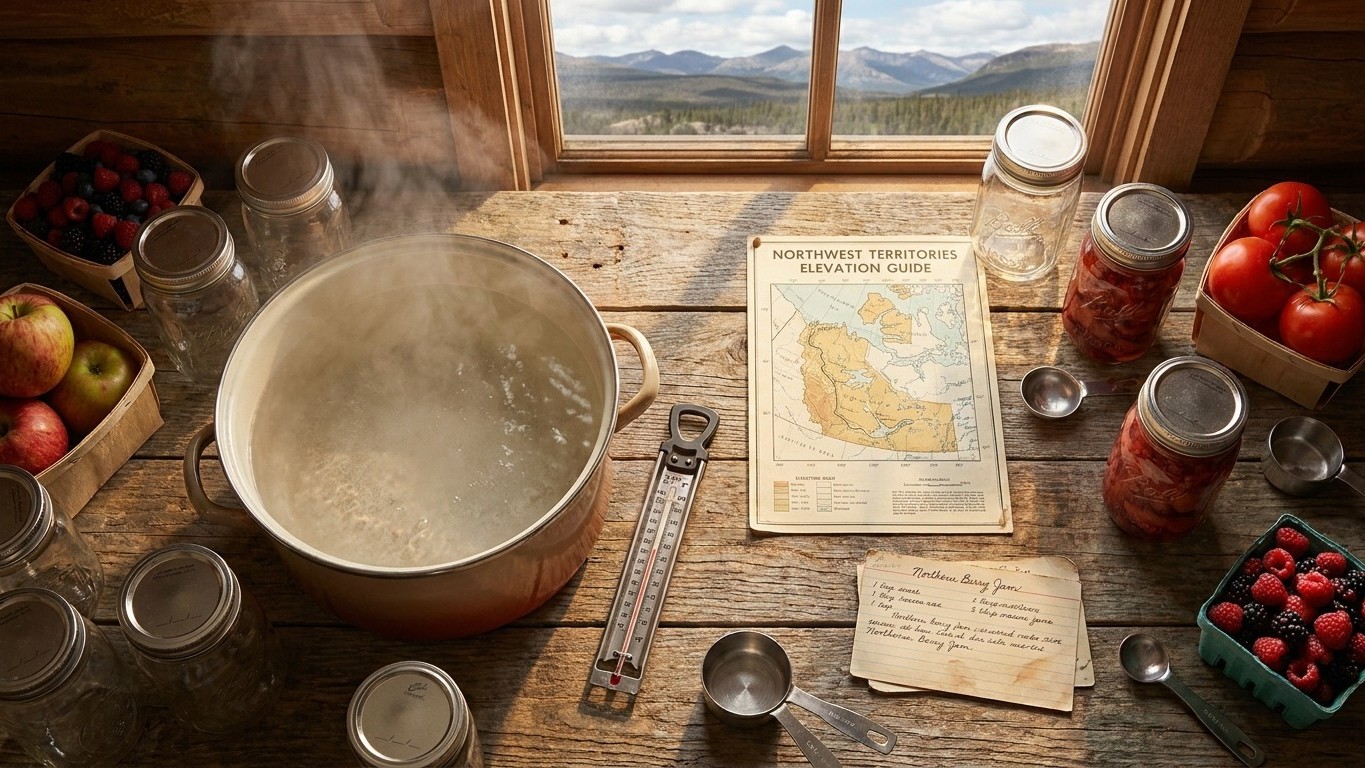

Yellowknife sits at 827 feet, and at that height water still boils close enough to sea level (208 to 212 F) that most home canners don’t need to adjust anything below the 1,000-foot mark. If you can jars near the territorial capital, you’re likely fine following a standard recipe. But Northwest Territories is enormous, and plenty of homesteads, cabins and communities sit at very different heights than the reference point below.
The short answer

Start with the number that actually matters here: Yellowknife, used as the reference city for this region, sits at 827 feet above sea level. Water at that elevation boils somewhere between 208 F and 212 F, the range published by the USDA for locations under 2,000 feet. That’s a narrow band, and it lands squarely in the zone where most published canning recipes assume no altitude adjustment is needed at all.
For anyone canning within that 0 to 2,000-foot band, this is genuinely simple: nothing changes. The tested processing times in a trustworthy recipe were built with this exact boiling range in mind. No extra minutes in the water bath canner, no extra pounds of pressure. This is the rare case where the safe answer is also the easy one.
But that number belongs to one city, not the territory
Here’s where people get tripped up. Northwest Territories is not a flat plane sitting at 827 feet. It’s a sprawling territory with river valleys, plateaus, and terrain that climbs well beyond the lowlands around Great Slave Lake. Yellowknife’s elevation tells you about Yellowknife. It tells you nothing about a property forty miles away, let alone one in a different community entirely.
This distinction isn’t pedantic. Canning safety hinges on the boiling point of water at your specific location, because that boiling point determines how much heat actually penetrates the jar during processing. A recipe writer somewhere assumed a boiling point when they calculated the tested time. If your real boiling point runs cooler than what they assumed, the process as written falls short. The reference city gives you a starting point for understanding the mechanism, not a substitute for checking your own elevation, which the next section covers directly.
So the short answer is really two answers stitched together: near Yellowknife’s elevation, standard recipes work as printed. Anywhere meaningfully higher, the math changes, and you need to know by how much before you touch a canner lid.
Why a lower boil is a weaker process
Water’s boiling point drops as elevation rises. That’s not a canning quirk, it’s basic physics: air pressure decreases as you climb, and water needs less energy to turn to vapor when there’s less atmospheric pressure pushing down on it. At sea level, water boils at 212 F. Climb to 10,000 feet, and that same pot of water boils at just 194 F. The water is still boiling, rolling and bubbling exactly like it does at sea level, but it’s doing that at a noticeably lower temperature.
That temperature difference is the entire problem. Canning relies on heat to destroy microorganisms and enzymes inside the jar, including Clostridium botulinum spores in low-acid foods. A boiling-water canner processing at 212 F delivers more thermal destruction over the same number of minutes than one processing at 200 F. Drop the effective temperature and you drop the kill rate, even though the water is doing exactly what boiling water is supposed to do.
This is why cranking up the burner doesn’t fix anything. Boiling water cannot get hotter than its boiling point, no matter how vigorously it boils or how high the flame runs underneath the pot. A gentle boil and a violent, rolling boil sit at the identical temperature, because once water reaches its boiling point, added heat drives off more steam rather than raising the temperature further. Someone at 6,000 feet who boils their canner hard for twenty minutes hasn’t achieved anything a sea-level cook wouldn’t achieve with a much gentler boil, because the ceiling temperature is fixed by elevation, not by effort.
What actually compensates for a lower boiling point is time or pressure, not intensity. In a boiling-water canner, the fix is running the process longer, giving the cooler water more minutes to accomplish what hotter water would accomplish faster. In a pressure canner, the fix works differently: added pressure inside the sealed canner raises the internal temperature above what open boiling water could ever reach on its own, and at altitude that pressure needs to increase further to hit the same internal temperature a lower elevation would reach with less pressure. Either way, the compensation is built into the tested recipe’s altitude chart, not something a cook improvises on the stove.
Finding your own elevation
Since Yellowknife’s 827 feet only tells you about Yellowknife, the next step is pinning down the elevation where your own kitchen actually sits. That number, not the reference city’s, is what determines any adjustment your recipe needs.
- Identify your specific location, meaning the town, community, or address where the canning will actually happen, not the nearest large center or the territorial capital.
- Visit the National Center for Home Food Preservation’s website and locate its “Find Your Elevation” resource, built specifically so home canners can look up elevation by location rather than guessing.
- Enter your location into that tool and record the elevation figure it returns, in feet above sea level.
- Compare that figure against the altitude adjustment chart included with your specific tested recipe, since different foods and different canning methods break the elevation bands at different points.
- Apply the adjustment listed for your elevation band exactly as printed, whether that means additional minutes in a boiling-water canner or additional pounds of pressure in a pressure canner.
Skipping straight from “I live in Northwest Territories” to “I’ll can like they do in Yellowknife” is exactly the shortcut that causes trouble. A cabin up a hillside or a homestead on higher ground can sit hundreds or thousands of feet above the reference city, and that gap is precisely what determines whether an adjustment is needed at all.
What goes wrong
- An under-processed jar that looks perfectly normal. A jar canned at altitude without the needed adjustment can seal, seem shelf-stable, and show no visible spoilage, while still failing to reach a temperature high enough to destroy dangerous spores. The fix is checking elevation before processing, not after, since there’s no visual test that reveals an under-processed jar later.
- A recipe pulled from a sea-level source without checking its altitude assumptions. Plenty of recipes circulating online or in older family collections were written for a specific elevation, often unstated, and applied elsewhere without adjustment. The remedy is using a recipe from the National Center for Home Food Preservation, which publishes elevation charts alongside its tested times specifically so cooks at any height can adjust correctly.
- A pressure gauge read as though elevation doesn’t affect it. Pressure canners need higher pressure at higher elevations to reach the same internal temperature a lower elevation achieves at lower pressure. Treating 10 pounds of pressure as universally sufficient, regardless of where the canner sits, ignores exactly the adjustment altitude requires. The fix is matching the pressure setting to the elevation band listed in the tested recipe, checked against your actual elevation, not assumed.
- Assuming a longer boil compensates for everything, at any elevation, without limit. Time adjustments in boiling-water canning are also elevation-specific and vary by food. Guessing at “a bit longer” rather than using the tested figure for your exact elevation band leaves the outcome unverified either way.
Where the exact adjustment comes from
This page won’t hand you a processing time or a pressure setting, and that’s intentional. Those numbers belong to the tested recipe for the specific food you’re canning, whether that’s green beans, salmon, or tomato sauce, because different foods require different baseline processes before altitude even enters the calculation. Grafting a generic adjustment onto the wrong base recipe can produce a jar that looks fine and isn’t.
For the actual adjustment, go to the National Center for Home Food Preservation and use the tested recipe and its accompanying altitude chart for your food. The reason this precision matters isn’t abstract. Clostridium botulinum toxin, the risk an under-processed low-acid jar carries, has no taste and no smell. Nothing about opening or tasting the jar will warn you if the process fell short.
Common questions
Does Yellowknife’s elevation apply to my property if I live elsewhere in Northwest Territories?
No. Yellowknife’s 827 feet is a reference point for one city. Your own elevation may sit well above or below that figure, and it’s your elevation that determines any canning adjustment, not the territorial capital’s.
If I boil my canner harder and longer than usual, does that make up for altitude on its own?
Boiling harder doesn’t raise the temperature past the boiling point for your elevation, since water can’t get hotter than its boiling point regardless of how vigorously it boils. Only following the tested time adjustment for your elevation band compensates correctly.
Is 827 feet high enough that I need to adjust my recipes near Yellowknife?
At 827 feet, you fall within the 0 to 2,000-foot band, where the boiling point runs between 208 F and 212 F. Recipes tested for that band generally require no adjustment, though you should confirm this against the specific chart for your food.
Where do I find the actual processing time or pressure for my elevation?
The National Center for Home Food Preservation publishes tested recipes with elevation-specific charts for exactly this purpose. Look up your food there rather than estimating an adjustment yourself.