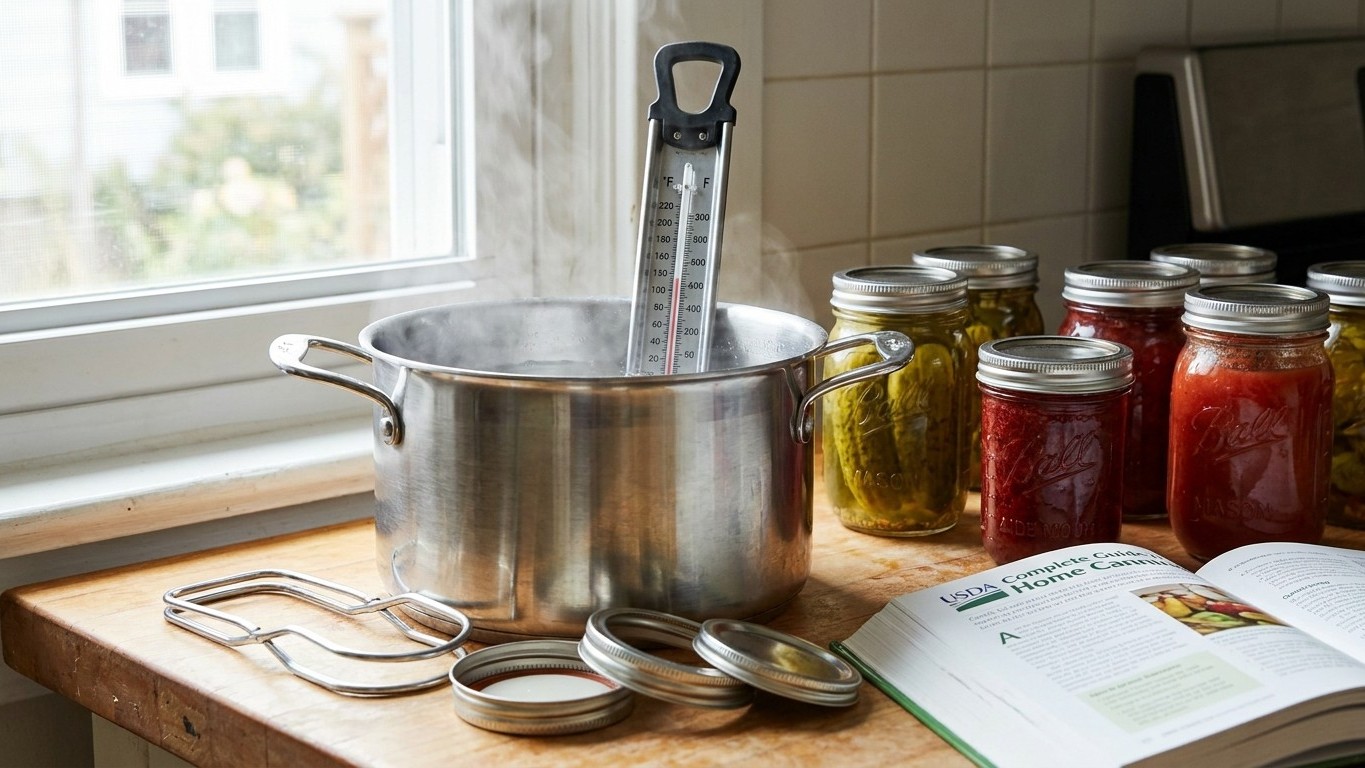

Montreal sits at 709 feet above sea level, and at that elevation water boils between 208°F and 212°F depending on conditions that day. That’s a small drop from the standard 212°F most canning charts assume. For someone canning near this elevation, the short answer is that little changes. For someone higher up in the province, the answer flips completely, and the jar in the pantry either gets processed long enough to be safe or it doesn’t.
The short answer

Montreal, the reference city used here, sits at 709 feet in elevation. The USDA’s Complete Guide to Home Canning groups elevations into bands, and 709 feet falls into the lowest one, the 0 to 2,000 foot band. Within that band, published boiling temperatures run between 208°F and 212°F. That’s the number to hold onto: not a single fixed temperature, but a range tied to a band of elevations, because water’s boiling point drifts downward as you climb.
Does this change anything for a home canner working near Montreal’s elevation? For most tested recipes, not much. The 0 to 2,000 foot band is the baseline most canning instructions are written for, and it’s the widest safety margin the guide allows before it asks for a longer processing time or higher canner pressure. Compare that to a location at 6,000 feet, where the boiling point drops several more degrees and every single jar in every single batch needs an adjustment, no exceptions. Montreal’s 709 feet sits nowhere near that territory.
Why the reference city matters here
That 709-foot figure describes Montreal specifically, not the province of Quebec as a whole. Quebec stretches from river valleys barely above sea level to highlands in the Laurentians and the Gaspé that climb well past a thousand feet, and further north the terrain rises again. A province, like a state, doesn’t have one elevation. It has thousands of them, and the canning adjustment that matters is the one tied to the kitchen where the jars are actually being processed, not the one tied to the province’s largest city or its geographic center.
This is where a lot of confusion creeps in. A canner in a valley an hour outside Montreal might sit at 300 feet, comfortably inside that same 0 to 2,000 foot band. Someone else in a hillier part of the province could be sitting at 1,800 feet, still technically in the same band but close enough to its edge that it’s worth double-checking rather than assuming. The reference city gives a starting point for understanding how the bands work. It isn’t a substitute for knowing the actual number where the canner sits on the stove.
Why a lower boil is a weaker process
Water’s boiling point isn’t fixed at 212°F. That number only holds at sea level, where atmospheric pressure pushes down hard enough to keep water liquid until it hits that temperature. Climb higher and the air thins, the pressure pushing down on the water drops, and water boils at a lower temperature as a result. At 10,000 feet, water boils at roughly 194°F. At Montreal’s 709 feet, it boils somewhere between 208°F and 212°F. The water is still boiling, vigorously, with bubbles and steam and all the visual signs anyone learned to associate with “hot enough.” It just isn’t as hot.
That gap matters because canning depends on heat killing microorganisms, particularly the spores that can produce botulinum toxin in low-acid foods. A process built around 212°F assumes a certain amount of heat reaches the center of the jar over a certain span of time. Drop the boiling temperature by even a few degrees and that same span of time delivers less total heat. The bacteria that would have died at 212°F over twenty minutes might survive at 205°F over the same twenty minutes. The seal can look perfect, the jar can sit on a shelf for months looking exactly like a safely processed one, and still not have received a strong enough process.
A natural instinct is to turn up the burner and boil harder. It doesn’t work, because boiling water can’t get hotter than its boiling point no matter how high the flame goes. Turn the heat up as far as it goes and the water boils faster, loses steam more violently, evaporates quicker, but it does not exceed the temperature at which it boils. The only two ways to compensate for a lower boiling point are time and pressure. A boiling-water canner compensates by processing jars longer, letting more total heat accumulate at a lower temperature. A pressure canner compensates differently: it raises the pressure inside the sealed canner, and raising pressure raises the temperature water can reach past 212°F even at altitude. That’s the entire logic behind altitude adjustments in canning, nothing more mysterious than that.
Finding your own elevation
Montreal’s 709 feet is a reference point, not a personal one. Before adjusting any recipe, a canner needs the actual elevation of the kitchen where the processing happens. That number is easy enough to find.
- Start with the National Center for Home Food Preservation’s “Find Your Elevation” page, built specifically for canners who need this number before they touch a recipe.
- Enter the address, town, or zip code closest to where the canning is actually done, not the nearest large city.
- Note the elevation in feet exactly as returned, without rounding down to a nicer number.
- Match that elevation to the band listed in the tested recipe being used (bands typically run in increments such as 0 to 1,000 feet, 1,001 to 3,000 feet, and higher).
- Apply the adjustment listed for that specific band and that specific food in the tested recipe, not a general rule of thumb carried over from a different recipe.
- Recheck the elevation figure if the kitchen moves, a cabin gets used instead of the main house, or canning happens somewhere other than usual, since even a short drive can shift the number enough to cross into a different band.
The reason this step can’t be skipped is that recipes are written around bands, not around a single city’s number. A recipe adjustment for 1,000 to 3,000 feet doesn’t apply the same way to someone at 3,200 feet, and rounding a personal elevation down to make it fit a more convenient band is exactly the kind of shortcut that produces an under-processed jar.
What goes wrong
- An under-processed jar that looks completely normal. The lid seals, the liquid looks clear, nothing smells off. Altitude-related under-processing doesn’t announce itself. The remedy is trusting the tested time and pressure for the actual elevation band rather than trusting appearance, since botulinum toxin gives no visual warning at all.
- A recipe pulled from a sea-level source. Family recipes, older cookbooks, and recipes shared from a location at or near sea level often carry no altitude adjustment at all, because none was needed where they were written. Using that same recipe unchanged at a higher elevation carries the boiling-point gap straight into the jar. The remedy is checking the source’s assumed elevation and adjusting to a tested chart for the reader’s actual band before following it.
- A pressure gauge read as if elevation didn’t exist. Pressure canner gauges are calibrated assumptions built for a specific relationship between pressure and temperature, and that relationship shifts with elevation. Reading the gauge and canning at the pressure listed for sea level, while sitting at a higher elevation, delivers less effective heat than the number on the dial suggests. The remedy is matching the gauge type (dial or weighted) and the reader’s elevation band to the pressure listed for both in a tested recipe, not just the pressure listed for the food alone.
- Splitting the difference between two elevation bands. A canner sitting near the edge of two bands sometimes averages the adjustments or picks whichever sounds easier. Tested recipes don’t work by interpolation. The remedy is using the band the actual elevation falls into, even if it’s the less convenient one.
Where the exact adjustment comes from
Nothing on this page states a processing time or a canner pressure, and that’s deliberate. The right adjustment depends on the specific food, the jar size, the method (boiling-water or pressure), and the reader’s actual elevation band, all four together. That combination lives in tested recipes, not in a general explainer about altitude.
The National Center for Home Food Preservation publishes those tested adjustments, organized by food and elevation band, and that’s the source to use once the reader’s own elevation is known. The reason this can’t be approximated or guessed at is that botulinum toxin has no taste and no smell. A jar that’s under-processed by even a small margin gives no warning before it’s opened and eaten, which is exactly why the adjustment has to come from a tested source rather than a rule of thumb.
Common questions
Does Montreal’s elevation apply to the whole province of Quebec?
No. Montreal’s 709 feet is a reference point for one city. Quebec spans elevations from near sea level to well above a thousand feet in its hillier regions, and the adjustment that matters is tied to the reader’s own kitchen, not to the province’s largest city.
If I’m below 1,000 feet, do I need to change anything?
Elevations in the 0 to 2,000 foot band, where Montreal’s 709 feet falls, generally need the smallest adjustments in tested recipes, sometimes none at all depending on the specific food. Confirming against the tested recipe for that particular food is still the safest step rather than assuming.
Why does boiling water look the same at every elevation if the temperature is different?
Boiling is a visual event, bubbles and steam, that happens whenever water reaches its boiling point, whatever that point happens to be at that elevation. At 709 feet it happens between 208°F and 212°F. At 10,000 feet it happens around 194°F. The water looks identically active either way, which is exactly why relying on sight instead of a tested time or pressure is risky.
Can I just process every jar longer to be safe, regardless of elevation?
Processing times in tested recipes are already matched to a specific elevation band and a specific food. Adding extra time without knowing the actual elevation band can either leave a jar still under-processed or push it past what the recipe was tested for. The safer path is confirming the actual elevation first, then following the adjustment listed for that band in a tested recipe from the National Center for Home Food Preservation.