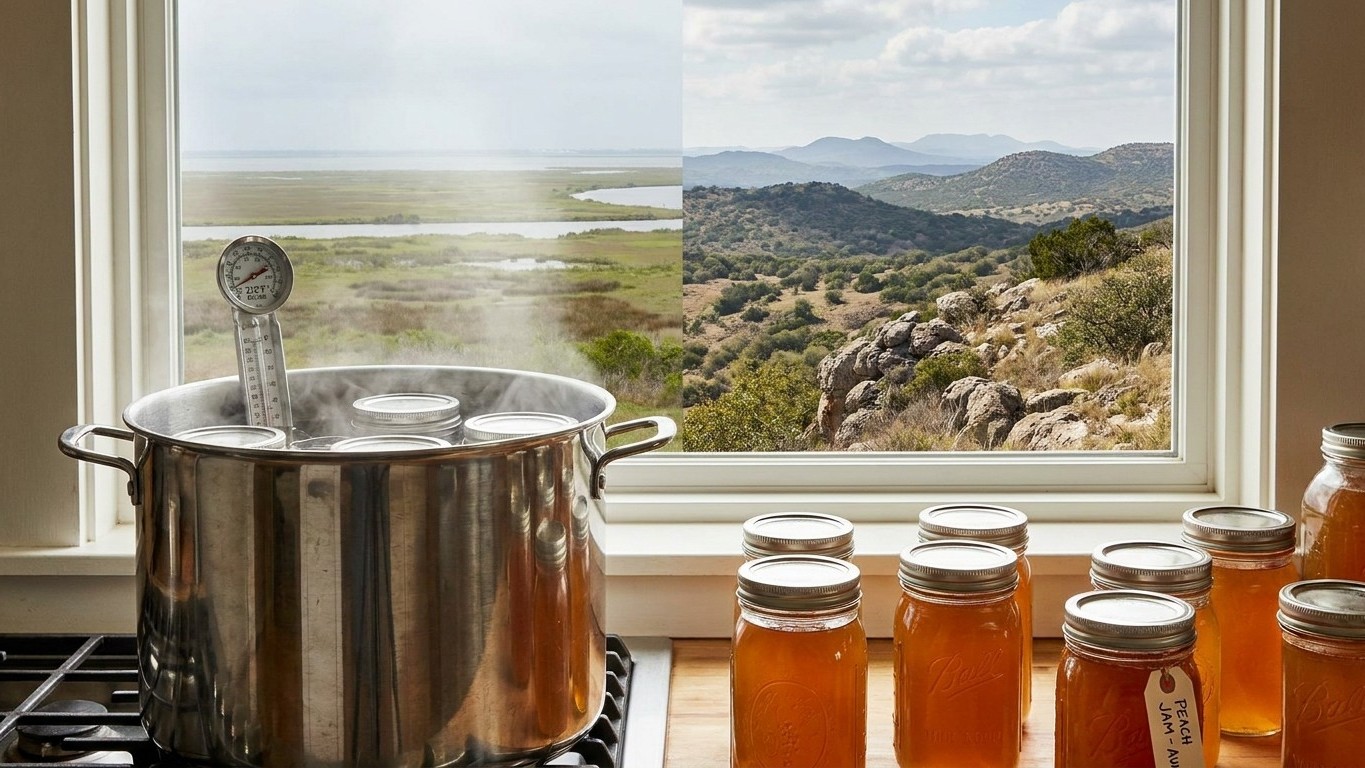

Houston, the reference city for this guide, sits at just 39 feet above sea level. Water there boils between 208°F and 212°F, essentially the sea-level standard. If you can in Houston, or anywhere near the Gulf Coast, altitude changes nothing about your process. But Texas is enormous, and elevation climbs fast the farther west and north you go, which means the answer for your kitchen depends on your own address, not on the state as a whole.
The short answer

Start with the number that matters: Houston, 39 feet, water boiling between 208°F and 212°F. That range comes from the USDA Complete Guide to Home Canning as published by the National Center for Home Food Preservation, and it’s the boiling behavior at essentially sea level. At 39 feet, you are not dealing with a weakened boil in any practical sense. A boiling-water canner behaves exactly as the tested recipe assumes, and a pressure canner needs no bump above the baseline pressure most recipes list first.
That’s the whole story for a canner working at Houston’s elevation, or anywhere in that same low band. But it is not the whole story for Texas.
Texas covers roughly 268,000 square miles, and its terrain does not sit still. The Gulf Coast is low and flat. Head toward Central Texas and the Hill Country, and the ground climbs. Push further west toward the Trans-Pecos, and the state’s terrain climbs sharply again, well past anything you’d find near Houston or Dallas. A state this size doesn’t have one elevation, it has a spread, and the canning adjustment that applies to you follows your own kitchen’s elevation, not a single figure for “Texas.”
Why this figure is a starting point, not your answer
The 39-foot figure for Houston is useful because it anchors the whole conversation: it tells you what “no adjustment needed” looks like in real numbers. If your home sits within that same low band, roughly sea level up to about 2,000 feet, you’re likely in the same boat as Houston canners: no altitude adjustment required for most tested recipes. Climb past that band, and the physics starts working against you, and the compensations in a tested recipe start to matter.
The line the National Center for Home Food Preservation draws is exactly there: below roughly 1,000 feet, most boiling-water canning recipes need no change at all. Cross that threshold and the required processing time in a boiling-water canner increases in steps as elevation climbs, and a pressure canner needs a higher pressure to compensate. None of that applies to a canner working at Houston’s 39 feet. It very likely applies to a canner working in the Hill Country, and it almost certainly applies to a canner working in far West Texas.
Why a lower boil is a weaker process
Here’s the mechanism, and it’s simpler than most people expect. Water boils when its vapor pressure matches the surrounding air pressure. At sea level, air pressure is high enough that water has to reach 212°F before it boils. Climb in elevation, and the air thins, air pressure drops, and water boils at a lower temperature to compensate. At 10,000 feet, published boiling temperatures drop to 194°F. The water is still boiling, rolling, steaming, doing everything a boil looks like it should do. It’s just doing it at a lower temperature.
That lower temperature is the entire problem. Canning relies on heat to destroy microorganisms, including the bacterium that causes botulism and its spores. A process built around 212°F assumes a certain amount of heat exposure over a certain amount of time. Swap in 194°F, and every minute of that same process delivers less lethal heat than the recipe was designed to deliver. The jar might look identical to one processed at sea level. The seal might be perfect. The contents might taste fine. But the microbial kill achieved inside that jar is measurably weaker, because the water never got as hot to begin with.
This is exactly why “just boil it harder” doesn’t fix anything. Boiling water cannot exceed its boiling point at a given air pressure, no matter how hard the burner runs underneath it. Turning up the heat makes the water boil more vigorously, more bubbles, more visible motion, but it does not raise the temperature past what that elevation allows. A rolling boil at 194°F is still 194°F. There is no amount of stovetop intensity that turns it into 212°F. The only way to compensate for a cooler boil is to change something else in the process.
Two things can compensate, and tested recipes handle each one differently depending on the method. In a boiling-water canner, the fix is time: leaving jars in that cooler boil longer, so the total heat delivered over the extended period matches what a shorter time at 212°F would deliver. In a pressure canner, the fix is pressure: raising the pressure inside the canner, which raises the temperature the steam reaches inside, restoring the same lethal temperature a sea-level process would hit at a lower pressure setting. Neither fix is something a home canner should calculate from scratch. Both come from tested recipes built specifically around elevation bands.
Finding your own elevation
Houston’s 39 feet tells you nothing about your own kitchen unless you happen to live in Houston. Before you can figure out whether your process needs adjusting, you need your own number, and the National Center for Home Food Preservation publishes a “Find Your Elevation” page built for exactly this purpose.
- Locate the National Center for Home Food Preservation’s elevation lookup tool, published on their site under the heading “Find Your Elevation.”
- Enter your address, city, or zip code, since the tool works from location rather than requiring you to already know a figure.
- Read the elevation result in feet above sea level, which is the number your canning adjustment will actually depend on.
- Compare that number against the elevation bands listed in your tested recipe, whether it’s from the USDA Complete Guide to Home Canning or another NCHFP-published source.
- Note which band you fall into, since most tested recipes list adjustments by range rather than by exact foot count.
- Recheck this number if you move, even within Texas, since a short drive from the coast toward the Hill Country or beyond can shift you into a different band entirely.
That last step matters more in Texas than in almost any other state, given how much the terrain shifts across relatively short distances once you leave the coastal plain.
What goes wrong
- An under-processed jar that looks perfect. A jar canned at a real elevation above the low band, but processed using a sea-level time or pressure, seals normally, looks normal, and can still carry an unsafe level of surviving bacteria or spores. The fix is checking your actual elevation against the recipe’s stated bands before you can, not after you notice a problem, because there’s usually nothing to notice.
- A recipe pulled from a sea-level source. Plenty of recipes circulating online or in older family notebooks were written by or for someone canning near sea level, with no altitude guidance at all. Using that recipe unmodified at any elevation above the low band means the stated time or pressure is too weak for where you actually live. The fix is sourcing recipes that explicitly list elevation-based adjustments, and applying the one matching your own number.
- A pressure gauge read as if elevation didn’t exist. Reading a dial gauge or weighted gauge at the pressure a sea-level recipe lists, without adding the elevation-based increase the same recipe specifies for higher bands, delivers less heat than intended even though the canner appears to be working correctly. The fix is applying the exact pressure the tested recipe lists for your elevation band, not the baseline figure meant for sea level.
Where the exact adjustment comes from
This page hasn’t given you a processing time or a canner pressure, and it won’t. That number depends on the specific food you’re canning, the recipe’s acidity, the jar size, and your elevation band together, and it belongs to a tested recipe, not to a general guide about altitude. The National Center for Home Food Preservation publishes those tested adjustments food by food, and that’s the source to check before you process anything.
The reason this matters as much as it does is simple and unforgiving: botulinum toxin has no taste and no smell. A jar that’s under-processed because the elevation adjustment was skipped or guessed at will not announce itself. It won’t smell off. It won’t taste strange. The only protection is following the tested time, pressure, and adjustment published for your specific elevation and your specific food, sourced from the National Center for Home Food Preservation rather than memory, habit, or a recipe that never accounted for where you live.
Common questions
Does Houston’s elevation apply to all of Texas?
No. Houston’s 39 feet is a reference point for the low coastal band, not a figure for the state. Texas terrain rises significantly moving west and north, and your own elevation is the one that determines your adjustment.
Do I need to adjust anything if I live near the Gulf Coast?
If your elevation falls in the same low band as Houston’s, most tested recipes require no altitude adjustment. Confirm your own number through the NCHFP elevation lookup rather than assuming based on general region.
Why can’t I just boil the water longer to be safe, without checking my elevation?
Because the required adjustment isn’t a guess you can round up. Tested recipes list specific time or pressure figures by elevation band, and under- or over-shooting them either weakens the process or risks other problems. Checking your actual elevation and matching it to the recipe’s stated bands is the only reliable approach.
What if my county spans multiple elevation bands?
Use your specific address or zip code in the NCHFP elevation lookup rather than a county-wide assumption. Elevation can shift meaningfully within a single county in parts of Texas, especially moving from river valleys toward higher ground.