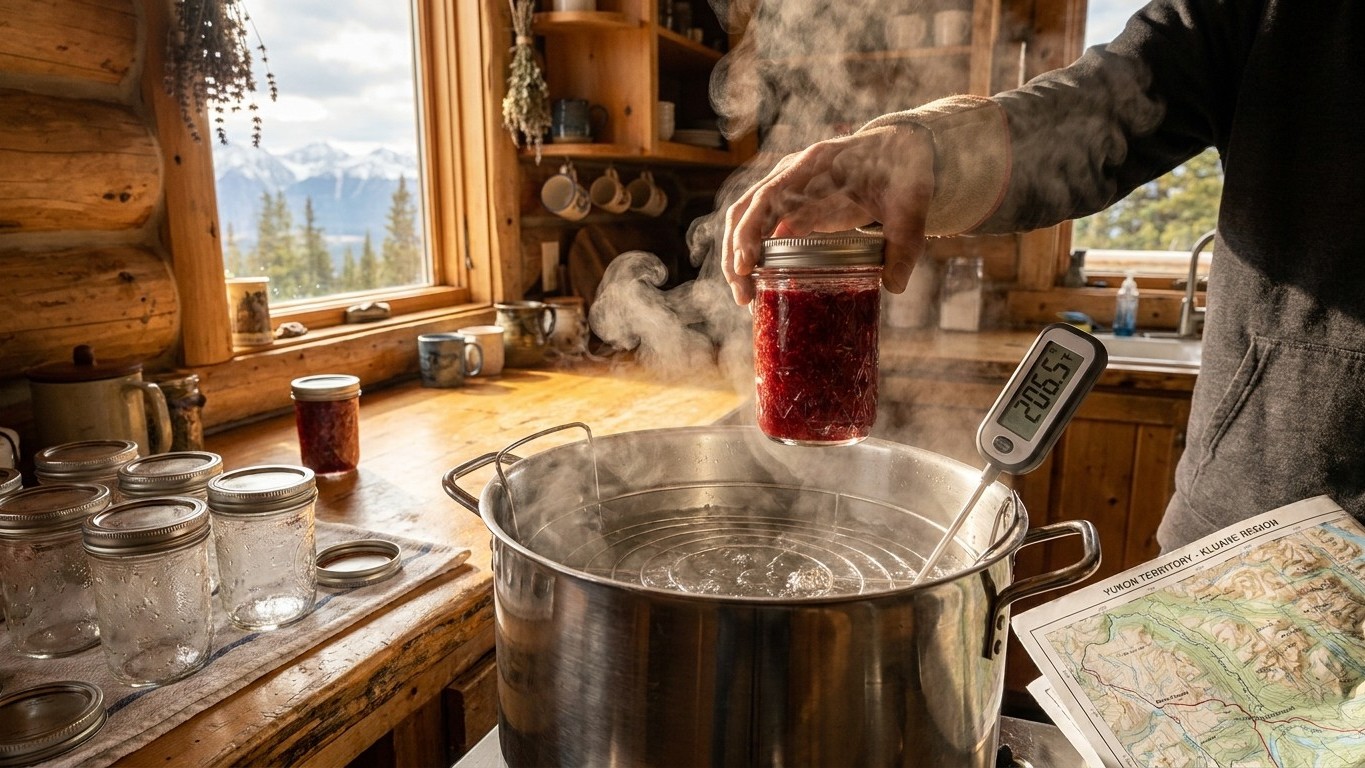

Yes, in most of Yukon, canning takes longer or needs more pressure than a recipe written for sea level assumes. Whitehorse, the territory’s largest population center, sits high enough that water boils several degrees below 212°F. That gap matters because a boiling-water canner or a pressure canner exists to reach a temperature high enough to destroy Clostridium botulinum spores. Below a certain point, a standard recipe works as printed. Above it, every recipe needs an adjustment tied to where you actually live.
The short answer

Whitehorse sits at 2,320 feet, according to elevation data from the Open-Meteo Geocoding service (GeoNames). At that height, water boils somewhere between 204°F and 208°F, not the 212°F that canning charts are built around, per the USDA Complete Guide to Home Canning as published by the National Center for Home Food Preservation. That is not a small gap. It is enough that anyone canning at or near Whitehorse’s elevation needs to adjust the process, whether they’re running a boiling-water bath for pickles and jam or a pressure canner for low-acid vegetables and meat.
Whitehorse falls in the 2,000-to-4,000-foot elevation band, one of several bands used to classify how much adjustment a given site needs. That number describes Whitehorse specifically, not the Yukon as a whole. The territory spans a huge range of terrain, from river valleys to mountain passes, and elevation shifts by thousands of feet within short driving distances. A reader canning near the Alaska border, up a mountain road, or down in a lower valley could be sitting at an elevation quite different from Whitehorse’s 2,320 feet, and the adjustment they need follows their own ground, not the reference city’s.
Two temperatures, one gap
The 204°F to 208°F range published for Whitehorse’s elevation is a band, not a single fixed number, because boiling point shifts continuously with air pressure and small variations in exact elevation. What stays constant is the direction of the shift: higher ground means a lower boiling point, always. At sea level water hits a full boil at 212°F. Climb to 10,000 feet and it boils at 194°F. Whitehorse sits partway along that curve, and so does most of the population of Yukon. For canning purposes, that curve is the entire story: a lower boiling temperature is a weaker heat treatment, and a weaker heat treatment needs to be compensated for somehow.
Why a lower boil is a weaker process
Water boils when it turns to vapor, and the temperature at which that happens depends on the pressure pressing down on it. At sea level, atmospheric pressure is high enough to hold water at 212°F before it boils. Go up in elevation and there’s less air overhead, so less pressure, so water boils at a lower temperature. In Whitehorse’s case, that means a rolling boil arrives around 204°F to 208°F instead of 212°F, per the USDA figures cited above. A boil is still a boil. It just isn’t as hot.
That distinction is the whole reason altitude matters for canning. A canning process is built to hold food at a specific temperature for a specific length of time, long enough to destroy the organisms that cause spoilage and, more seriously, the spores that produce botulinum toxin. When the boiling point drops, the food inside the jar never reaches the temperature the process was designed around. It doesn’t matter how vigorously the water boils. A hard, rolling boil at 205°F is still 205°F. Boiling water cannot get hotter than its own boiling point, no matter how much heat you throw at the burner. Turning up the stove speeds up the boil, not the temperature.
What compensates
Since the temperature itself can’t be pushed higher in an open boiling-water canner, the only lever left is time. Recipes built for altitude add extra minutes to the processing step, giving the lower temperature more time to do the same job a hotter, sea-level boil does faster. Pressure canners work differently: they trap steam and raise both pressure and temperature above what a simple boil can reach, so the compensation there is measured in pounds of pressure rather than minutes, with higher elevations calling for more pressure to reach the same effective temperature. Either way, the fix isn’t a harder boil. It’s a longer or a hotter one, engineered into the recipe itself.
Finding your own elevation
Whitehorse’s 2,320 feet describes one point on the map. A reader canning elsewhere in Yukon needs their own number before any adjustment makes sense.
- Start with the address or the nearest named community where the canning will actually happen, not the territory’s capital or any other reference point.
- Use a reliable elevation lookup tool, such as a topographic map service or a GPS device that reports altitude, to get a figure in feet for that specific location.
- Check the National Center for Home Food Preservation’s “Find Your Elevation” page, built for exactly this step, to confirm the figure and see how it’s typically reported for canning purposes.
- Round to the nearest elevation band listed in the tested recipe’s altitude adjustment chart, since most charts group elevations into ranges rather than requiring an exact foot count.
- Recheck if the canning location changes, since a cabin up a mountain road and a kitchen in a river valley a few miles apart can sit in different elevation bands entirely.
What goes wrong
The core failures
- An under-processed jar that looks perfectly normal. A jar canned at a sea-level time but a Yukon elevation can seal, seem shelf-stable, and show no visible sign of a problem, while the process inside never reached a safe temperature. The remedy is using the processing time or pressure listed for the canner’s actual elevation band, not the printed default.
- A recipe pulled from a sea-level source. Many recipes online or in older cookbooks are written without any altitude note at all, assuming 212°F as the boiling point everywhere. The remedy is treating every untested or undated recipe as a sea-level recipe by default, and adding the elevation adjustment from a tested source before using it.
- A pressure gauge read as if elevation didn’t exist. Dial gauges and weighted gauges both need to be set according to elevation, and a canner that reads 10 pounds of pressure at sea level is not delivering the same effective heat treatment at 2,320 feet. The remedy is checking the gauge setting against the elevation band for the specific canner and food, since dial gauges also need periodic accuracy checks against a known standard.
- Assuming a single Yukon-wide number covers every kitchen. Because elevation varies by thousands of feet across the territory, a chart built around Whitehorse’s 2,320 feet may understate what’s needed elsewhere. The remedy is always confirming elevation at the actual canning site rather than borrowing a number from a city, a friend, or a general territory figure.
Where the exact adjustment comes from
This page won’t give a processing time or a pressure setting, because neither belongs here. The correct adjustment depends on the specific food, the jar size, the recipe, and the elevation together, and that combination is only published inside a tested recipe. The National Center for Home Food Preservation publishes those tested recipes and their altitude adjustment charts, and that’s the source to check before processing anything from Whitehorse or anywhere else in Yukon.
The reason to take this seriously has nothing to do with taste or appearance. Botulinum toxin has no taste and no smell, and a jar that looks, smells, and tastes completely normal can still carry it if the process fell short. That single fact is why the adjustment matters more than convenience, and why guessing at a number isn’t worth the risk.
Common questions
Does every recipe need an altitude adjustment in Yukon?
Any recipe used above sea level should be checked against a tested altitude adjustment chart. Given that Whitehorse alone sits at 2,320 feet, most canning done in the territory falls into a range where an adjustment applies.
Is Whitehorse’s elevation the same as my own?
No. Whitehorse’s 2,320 feet is one reference point in a territory where elevation varies widely. Confirm the elevation at the actual location where the canning happens before choosing an adjustment.
Can I just boil the jars longer than the recipe says, to be safe?
Adding extra time without following a tested chart isn’t a reliable substitute for the correct, elevation-specific adjustment, since different foods and jar sizes respond differently. Use the National Center for Home Food Preservation’s tested figures for the specific food and elevation band involved.
Does a harder, more vigorous boil make up for the lower boiling point?
No. Boiling water can’t exceed its own boiling point regardless of how hard it’s boiling. A vigorous boil at 205°F is still 205°F, and the only real compensation is added time in a boiling-water canner or added pressure in a pressure canner.