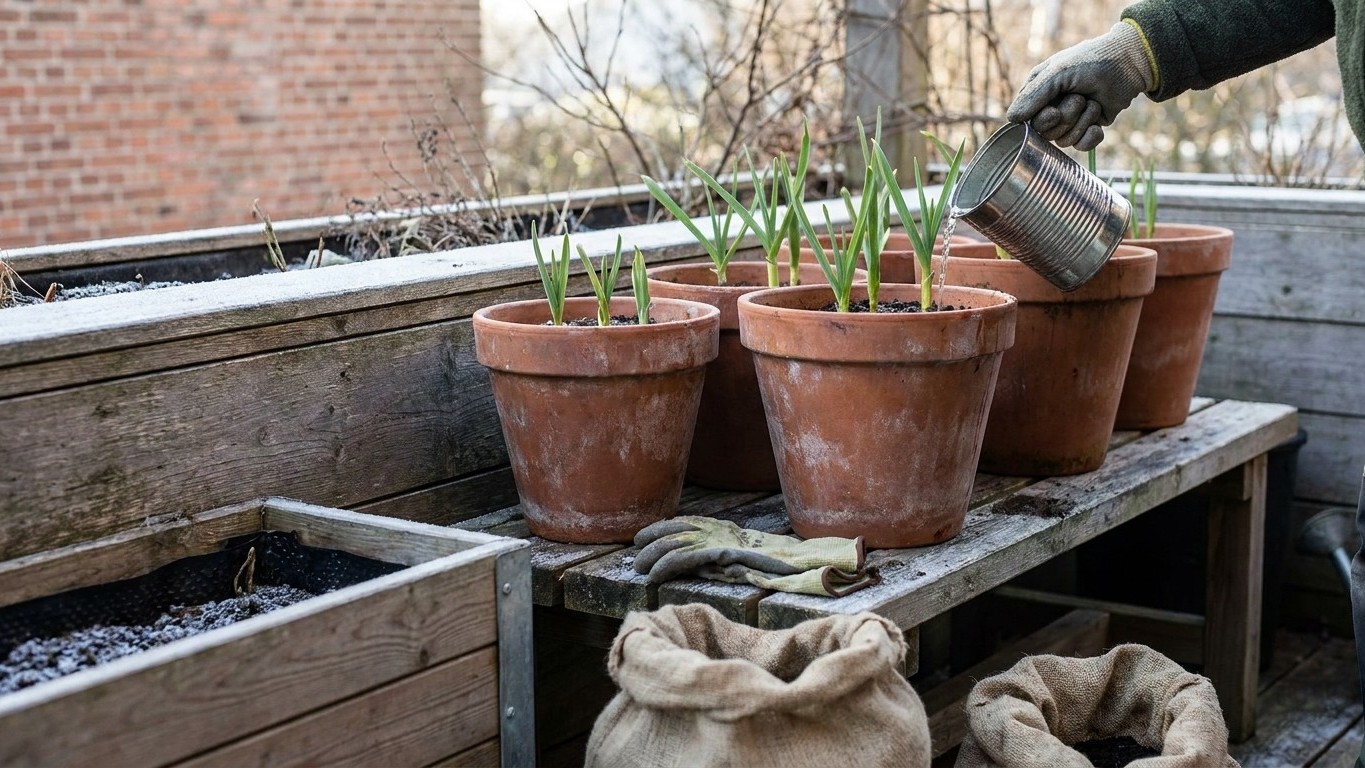

Garlic grown in a container needs more depth than most vegetables get credit for. A pot shallower than about 12 inches leaves too little room for the root system to develop before the bulb starts forming, and the result is a crop of marble-sized bulbs that no amount of fertilizer fixes after the fact. Depth, not pot diameter, is the single measurement that decides whether container garlic succeeds. Before you plant a single clove, confirm your container gives at least 12 inches of soil below where the clove sits, with drainage holes already drilled in the bottom.
Why this matters for garlic

Garlic spends roughly nine months in the ground, and a container garden compresses every mistake into a smaller, more exposed volume of soil. A pot has far more surface area touching cold air relative to the soil inside it than an equivalent patch of garden bed does, so the cloves and roots inside a container freeze harder and faster than the same cloves would in open ground. That difference is exactly why container instructions can’t just copy the in-ground routine and call it done.
The basics of clove selection and planting depth described in Growing Garlic still apply once you move to a pot, but the margin for error shrinks. A container that stays waterlogged through a wet winter rots the cloves before they ever sprout, and because the pot is sealed off from the surrounding soil’s natural drainage, there’s nowhere for that excess water to go. You won’t see the failure until spring, when nothing comes up, or until harvest, when what you dig out is soft and discolored instead of firm.
When to do it
Garlic seed cloves go into the container in fall, timed off the first fall frost in your area rather than a fixed calendar date, because the clove needs several weeks of cool soil to establish roots before the plant goes dormant for winter. Extension guidance disagrees by region on exactly how far ahead of that frost to plant: some sources call for getting cloves in the ground several weeks before the soil freezes solid, while guidance from milder climates, where the ground rarely freezes hard at all, allows planting later in the season.
Container soil cools faster than garden soil because there’s less mass to hold heat, so many container growers plant a week or two ahead of where their in-ground neighbors would, banking extra root growth before the cold really sets in. Check NOAA’s climate normals or your state extension service for the average first fall frost date where you live before you settle on a planting week. Waiting until spring instead is possible, and the tradeoffs of that approach are covered in Planting Garlic in Spring: What You Get, and What You Give Up, but it generally means smaller bulbs at harvest.
How to do it
Choosing the container
Look for at least 12 inches of soil depth and, if you’re planting more than a couple of cloves, a diameter of 14 inches or more so the cloves aren’t crowded against the pot wall. Drainage holes are non-negotiable. Material matters more in a container than in a bed, because the pot walls are what stand between the cloves and outdoor air all winter.
| Material | Winter insulation | Drainage | Typical lifespan |
|---|---|---|---|
| Terracotta | Poor, and can crack in a hard freeze | Good | 3-5 years outdoors |
| Plastic nursery pot | Moderate | Good with added holes | 5+ years |
| Wood planter box | Best of the common options | Good if slats or holes are present | 5-10 years, depending on wood |
| Fabric grow bag | Poor, dries and cools fast | Excellent | 2-4 years |
Planting the cloves
Fill the container with a well-draining potting mix rather than garden soil straight from the yard, since garden soil compacts and drains poorly once it’s confined to a pot. Break the bulb apart just before planting and push each clove into the mix pointed end up, root plate down, to a depth most planting guides put at around two inches. Space cloves roughly 4 to 6 inches apart so each bulb has room to bulk up without competing for water and nutrients.
- Water the container thoroughly right after planting to settle the soil around each clove
- Add a few inches of mulch, straw or shredded leaves work well, once the soil surface starts to cool
- Label the pot if you’re growing more than one variety, since sprouts look identical early on
Watering through the season
Garlic wants consistent moisture without ever sitting wet. After the fall planting and initial watering, cut back sharply once cold weather sets in, giving the pot only enough water to keep the soil from drying out completely during dormancy. Resume regular watering once green growth reappears in spring, and keep the soil evenly moist through bulb formation, then taper off in the weeks before harvest so the bulbs can cure properly in the ground.
What goes wrong
Most container garlic failures share the same shape: nothing looks wrong for months, and then the problem shows up all at once. Small bulbs at harvest almost always trace back to a pot that was too shallow or cloves planted too close together, and there’s no way to catch this mid-season since the bulb only bulks up in its final weeks. Rot shows up either as cloves that never sprout in spring or, on digging, as soft brown tissue instead of firm cloves, and it’s caused by a container that held too much water over winter, usually from missing or blocked drainage holes.
Freeze damage to the roots is harder to catch early because it happens below the soil line, invisible until spring green-up simply doesn’t happen. The tell is a container that stays bare while nearby in-ground garlic or other potted garlic is already sending up shoots. This is more common than most beginners expect, precisely because container soil freezes deeper and faster than garden soil does.
- No sprout by spring green-up: check for rot or freeze-killed roots by gently digging up one clove
- Yellowing leaf tips in a wet spring: usually overwatering, ease off and check drainage holes are clear
- Small bulbs at harvest despite healthy foliage: revisit pot depth and clove spacing before next season
How this changes across the country
Winter severity is the variable that changes container garlic care the most, and it changes it in opposite directions depending on where you garden. In the coldest zones on the USDA plant hardiness map, roughly zone 3 and 4 conditions found across places like North Dakota and northern Minnesota, container roots are genuinely at risk of freezing solid, since a pot offers nowhere near the insulation of the surrounding earth. Growers in that range commonly move pots into an unheated garage or shed for the coldest stretch of winter, sink the pots into a garden bed up to their rims, or wrap the container walls in insulating material like bubble wrap or old blankets.
At the milder end of the map, in zone 8 and warmer conditions found along the Gulf Coast or coastal areas of the Pacific Northwest and California, containers rarely face a hard freeze at all, and the bigger risk is not enough winter chill for varieties that need a cold spell to form a proper bulb. Hardneck types generally need more cold exposure than softnecks do, which matters even more in a container since a pot chills less deeply than garden soil, and the tradeoffs between the two types are laid out in Hardneck or Softneck Garlic: Which One Survives Your Winter. Check the USDA hardiness zone map for your own zone number before deciding how much winter protection your containers actually need, since guidance built for one end of the map can be actively wrong at the other.
Common questions
Can I grow garlic in a 5-gallon bucket?
Yes, if the bucket gives at least 12 inches of depth and you drill several drainage holes in the bottom, since buckets rarely come with any. A standard 5-gallon bucket is narrow enough that it usually only fits 3 to 4 cloves spaced properly, so plan on multiple buckets if you want a meaningful harvest.
Do I have to bring my garlic containers indoors for winter?
It depends on how cold your winters get. In the coldest parts of the country, moving pots into an unheated garage or shed, or insulating them in place, protects the roots from a hard freeze, while gardeners in milder climates can usually leave containers outdoors all winter with just a layer of mulch on top.
Can I plant garlic from the grocery store in a container?
You can, but it comes with real downsides. Grocery store garlic is sometimes treated with a sprout inhibitor, and it’s rarely suited to your local climate the way certified seed garlic from a nursery or seed company is, so results are less predictable than starting with seed stock bred for growing.
How many cloves fit in one pot?
That depends entirely on the pot’s diameter, since each clove needs roughly 4 to 6 inches of space around it to bulk up properly. A 14-inch pot comfortably holds around 3 to 4 cloves, while a wide half-barrel planter can fit a dozen or more if the depth is still adequate.