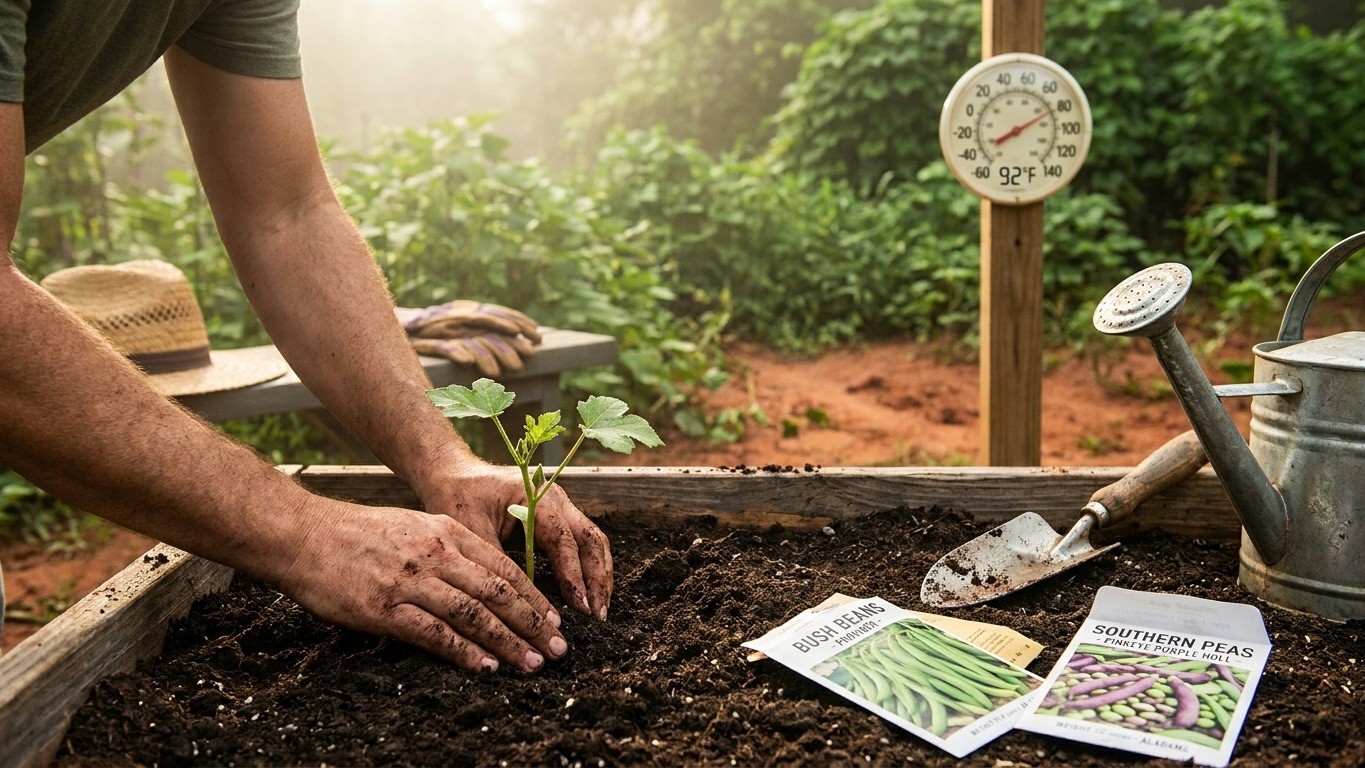

August in Alabama isn’t a frost month at all, it’s a heat-and-countdown month. With the first fall freeze not expected until November 2 to November 16 in the reference climate data, most counties still have 80 to 105 days of growing season left. That’s enough time for a real fall garden if you sow the right things now and treat the heat, not the cold, as the obstacle to manage.
What goes in the ground in August

The calendar says summer, but the number that actually matters this month is the frost countdown, not the date on the wall. Alabama’s first fall freeze lands somewhere between November 2 and November 16 at the reference station, which means a seed or transplant going into the ground in early August has roughly 90 to 100 days to finish before cold ends the season. That window shrinks fast as the month goes on, so timing inside August matters more than most gardeners assume.
Fast crops are the safe bet right now. Bush beans, southern peas, and okra sown in the first half of the month still have time to produce a real harvest before frost, since all three mature in 55 to 70 days and shrug off the heat that would stall cooler-season crops. Summer squash and cucumbers can go in as a second planting through early August too, aimed at replacing plants that squash vine borers or bacterial wilt have already taken out.
Tomato and pepper transplants for a fall crop are a tighter call. They need to be in the ground by the very first days of the month in warmer parts of the state, later than that and there isn’t enough time left before frost for fruit to size up and ripen. Farther north, where the growing season is already shorter, that window closes even earlier, so a transplant that would still work in Mobile can be a gamble in Huntsville.
Direct-sown greens, collards, mustard, turnips, and rutabaga, belong later in the month rather than earlier. Hot soil slows or blocks germination for these crops, so waiting until the back half of August, when soil temperatures start easing even slightly, gives seed a better shot at coming up evenly instead of sitting dormant in baked dirt.
What to start under cover
Broccoli, cabbage, and cauliflower for the fall crop are usually started as seedlings under shade or indoors during August, not sown directly into the garden. The arithmetic works backward from that November 2 to November 16 frost window: subtract the 60 to 100 days these crops need to mature, then subtract another four to six weeks for the seedling to reach transplant size, and that lands the seed-starting date squarely in early-to-mid August for most of the state.
Run that math for your own county rather than trusting a fixed date, because the two ways this goes wrong both cost you the harvest. Start too early, and seedlings sit too long in trays before the weather is fit to transplant them, turning rootbound and leggy, stalling once they finally go in the ground. Start too late, and the transplant hits the garden fine but runs out of season before the head fills out, especially in northern counties where the first frost tends to arrive on the earlier side of that two-week range.
Seedlings started this month need real shade cloth or a covered porch spot, not just a sunny windowsill, because August heat will scorch tender brassica starts as fast as it does anything transplanted straight into open ground. Keep the starting mix consistently damp rather than soaked, since these trays dry out in hours under peak summer heat, not days.
What is ready to pick
The garden is at its fullest output this month, and most of it needs picking on a near-daily rhythm to keep plants producing. Tomatoes, peppers, okra, cucumbers, and summer squash are all in full swing, and okra in particular turns from tender to woody within a day or two past the two-to-four-inch mark, so pods left on the plant too long aren’t worth eating and slow down the next flush.
Southern peas are ready once pods rattle slightly and the peas inside feel firm through the shell, and sweet corn planted back in spring should be finishing up now, with kernels that ooze a milky liquid when pierced being the surest sign of ripeness. Watermelon and cantaloupe both give physical cues rather than a date: a dull thump and a browning tendril nearest the fruit’s stem on watermelon, a melon that slips free from the vine with light pressure on cantaloupe.
Basil and other tender herbs need harvesting hard and often in August, both to use the leaves before heat pushes the plant to flower and to keep it from bolting altogether. Eggplant fruit that’s still glossy is ready, once the skin goes dull it’s already past its best texture.
The jobs that matter this month
Watering rhythm matters more in August than almost any other task, and the mistake most gardeners make is watering shallowly every day instead of deeply two or three times a week. Deep, infrequent watering pushes roots downward where soil stays cooler and moister, while frequent shallow watering keeps roots near the surface where August heat dries them out within hours.
Mulch does double duty right now, holding that moisture in and keeping soil temperature down enough for late-month seed germination to actually happen. A three-to-four-inch layer around fruiting plants and along rows where fall greens will go in later this month pays for itself within a week of hot, dry weather.
Pest scouting can’t slip this month either. Squash vine borers, stink bugs, and fall armyworm all peak in August heat, and a squash plant that wilts suddenly despite regular watering is almost always borer damage at the base of the stem, not drought stress. Catching it early means cutting out the borer and mounding soil over the wound, catching it late means losing the plant.
Staking and caging need a final check now too, since tomato and pepper plants are at their heaviest with fruit and a stake that held fine in June can snap under August’s load. Side-dress fruiting crops with a balanced fertilizer rather than a high-nitrogen one at this point, since nitrogen now pushes leafy growth at the expense of the fruit set you’re trying to protect through the rest of the season.
What not to do in August
The most common mistake this month is treating hot soil the way gardeners treat cold soil in spring, assuming that because the air feels fine for growing, the ground is too. Soil temperatures in August routinely run high enough to block germination outright for cool-tolerant seed like lettuce and spinach, so sowing those directly into bare, sun-baked beds usually just wastes the seed. Wait for a partly shaded spot or hold off until temperatures ease later in the month.
Transplanting brassica seedlings during the hottest part of the day is another way to lose plants that were otherwise healthy. Move transplants into the garden in early evening instead, giving roots several cooler hours to start settling in before the next day’s peak heat hits.
Heavy nitrogen feeding is worth avoiding on anything you expect fruit from this month, tomatoes, peppers, squash, since it encourages leafy growth right when the plant should be putting energy into ripening what’s already set. And don’t let mulch or watering lapse during a stretch of mild weather, thinking the pressure is off. Blossom end rot and cracked fruit both trace back to inconsistent moisture, and August’s swings between dry heat and sudden downpours make that inconsistency the default unless you’re managing it directly.
Checking this against your own county
Every figure here comes from one reference station, and Alabama is long enough, north to south, that actual conditions shift by weeks depending on where you garden. Northern counties near the Tennessee border sit at the cooler, shorter-season end of the state’s 7a to 9a hardiness range (USDA Plant Hardiness Zone Map), while the Gulf Coast stays warmer later into fall, pushing that first frost toward the later end of the November 2 to November 16 window or beyond it entirely.
Elevation and local terrain move things further still. Before locking in a planting date, check county-specific guidance through the Alabama Cooperative Extension System, which tracks these variations at a level no state-wide figure can capture.
Common questions
Can I still plant tomatoes in August in Alabama?
Only very early in the month, and mainly in the warmer southern half of the state. A fall tomato transplant needs to be in the ground by the first few days of August to have enough time to fruit and ripen before frost arrives between November 2 and November 16.
What vegetables can I direct sow in August in Alabama?
Bush beans, southern peas, and okra work well sown early in the month. Collards, mustard greens, turnips, and rutabaga are better sown later in August, once soil temperatures ease enough for reliable germination.
Is it too hot to start fall garden seeds in August?
Not for brassica seedlings started under shade cloth or indoors, where you control the temperature. It is often too hot for seed sown directly into bare, sun-exposed soil, which is why timing and shade matter more than the calendar date alone.
When should I plant fall broccoli and cabbage in Alabama?
Start seed indoors or under shade in early-to-mid August, then transplant seedlings out four to six weeks later once they’ve reached a sturdy size. That timing works backward from the November frost window, giving the crop enough days to mature before cold sets in.