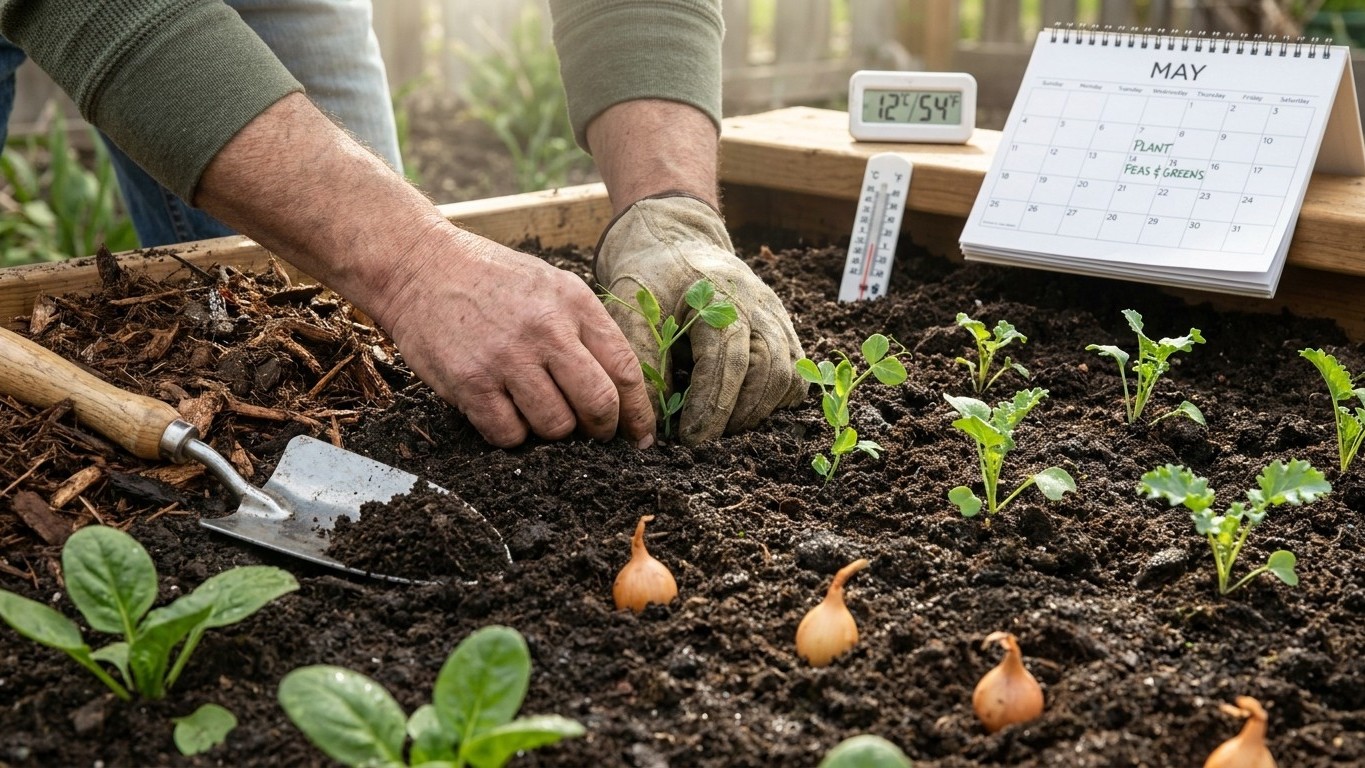

Alberta’s average last spring frost falls on May 21, and that single fact should decide everything you plant this month: cold-hardy crops like peas, onions, and leafy greens can go into open ground early in May, while tomatoes, peppers, squash, and other tender vegetables need to wait for warmer soil and a frost window that, being a long-term average, still carries real risk into late May and beyond.
What goes in the ground in May

The calendar says May, but the soil doesn’t care what the calendar says. What matters is soil temperature and how close you are to that average last frost date of May 21, recorded at the Calgary Int’l A station using 1981-2010 climate normals from Environment and Climate Change Canada. That date is a mean, not a guarantee: in roughly half of all years, frost arrives after it. Treat it as the middle of a window, not a green light.
Early in the month, cold-hardy crops are the safe bet. Peas can go directly into the ground as soon as it’s workable, and they’ll shrug off a light frost. Onion sets, shallots, and garlic (if you missed fall planting) tolerate cold soil and even a freeze once established. Spinach, lettuce, radishes, and kale seeds germinate fine in cool soil and handle a frosty morning without much drama. Root crops like carrots, beets, and parsnips are worth direct-sowing early too, since they germinate slowly regardless of soil warmth, so there’s little advantage in waiting.
Seed potatoes can go in from mid-to-late May in most of the province. The eyes sprout underground, insulated from the light frosts that would damage exposed foliage. Hardened-off brassica transplants, cabbage, broccoli, cauliflower, can move outside from mid-May onward, especially with a cloche or row cover on hand for a cold snap.
Tender crops are where May turns into a gamble. Tomatoes, peppers, cucumbers, squash, beans, and corn need soil that’s genuinely warm, not just air that feels pleasant on a sunny afternoon. Planting these before the frost risk has meaningfully passed, and given that the average date is only a midpoint, often means replanting after a late freeze wipes out the first round. Holding off until soil temperatures are reliably warm, or using season-extension covers if you plant early, protects the investment.
What to start under cover
Working backward from the frost window is more useful than working forward from a fixed date. Since the average last frost lands May 21, and knowing that date can shift later in a given year, most transplant timing for warm-season crops should target early-to-mid June for moving plants outdoors, not the calendar page for May itself.
Tomatoes, peppers, and eggplant need six to eight weeks indoors before transplanting. If they weren’t started in March or early April, May is really a month for hardening off plants that are already growing, not sowing new seed for those crops, since starting them now would leave too little runway before the season’s first fall frost, which averages September 16 at the same Calgary station.
Squash, cucumbers, and melons are different. These grow fast and resent being started too early, so sowing them indoors three to four weeks before your expected outdoor transplant date, meaning early-to-mid May for a planting date in early June, hits the sweet spot. Start too early and you get leggy, rootbound seedlings sulking in small pots. Start too late and there isn’t enough growing season left before fall frost risk returns, especially for longer-season melon varieties.
Cold frames and unheated greenhouses are useful right now for a second wave of lettuce, spinach, and brassica transplants meant for succession planting later in the month or into June. It’s a low-effort way to keep a steady supply of transplants ready without crowding a windowsill.
What is ready to pick
Fresh harvests from open ground are still limited in May, but rhubarb is the exception worth mentioning first. Established crowns push up tender stalks early in the month, and Alberta gardeners treat the first rhubarb cutting as one of the season’s genuine milestones. Pick stalks when they’re a foot or more long by pulling and twisting rather than cutting, and leave a few stalks on each plant to keep it vigorous.
Perennial herbs like chives come back early too, often ready to snip well before most annual crops have even germinated. If asparagus is established in the garden, the first thin spears may be poking through by mid-to-late May, though a planting needs a few years of growth before harvesting heavily.
Anything overwintered under cover, spinach or kale sown the previous fall in a cold frame or under a thick mulch, may still be producing usable leaves this month, having survived the winter in a semi-dormant state and resumed growth as days lengthen.
Indoors, sprouts and microgreens remain the most reliable fresh food regardless of what’s happening outside, ready in days rather than weeks. It’s also worth going through the root cellar or cold storage now: stored squash, potatoes, and onions from the previous season are at the point where soft spots, sprouting, or mold can show up fast. Sort through them and use the ones starting to turn before they spread rot to the rest of the bin.
The jobs that matter this month
Soil preparation tops the list, and timing matters more than effort here. Working wet clay soil, common across much of Alberta, causes compaction that can set a bed back for a whole season. Wait until a handful of soil crumbles rather than smears before digging or tilling.
Hardening off is the step most likely to get rushed, and it shouldn’t be. Seedlings started indoors need seven to ten days of gradually increasing outdoor exposure before they go into the ground permanently. Skip it and the shock alone can stunt or kill transplants that survived weeks of careful indoor growing.
Pest scouting starts in earnest this month. Cutworms and flea beetles become active as soil warms, and young brassica transplants are especially vulnerable. A simple cardboard collar around each transplant stem stops cutworms cold, and floating row cover keeps flea beetles off leaves without chemicals.
Succession sowing of quick crops like radishes and lettuce, planting a short row every couple of weeks rather than all at once, spreads the harvest out and avoids a glut followed by a gap. Staking peas as they start to climb saves a tangled mess later. And this is a good window to divide overgrown perennials or move small trees and shrubs while they’re still relatively dormant, before the stress of summer heat sets in. Testing soil pH and adding compost now gives amendments time to integrate before the heaviest planting arrives.
What not to do in May
The most common mistake is planting tender crops outdoors because the air feels warm on a sunny afternoon. Air temperature is a poor stand-in for soil temperature, and since the average last frost of May 21 means frost arrives later in about half of all years, an early warm spell is not proof the risk has passed. Wait for consistently warm soil, or protect tender transplants with cloches if you plant on the early side.
Uncovering cold frames or pulling mulch off perennials too early after a mild stretch is another frequent misstep. A week of pleasant weather can be followed by a hard overnight freeze, and plants that had their protection stripped too soon take the full hit.
Heavy nitrogen feeding early in the month can also backfire. It pushes soft, leafy growth that’s more vulnerable to frost damage and slower to toughen up. Hold off on nitrogen-heavy fertilizer until plants are established and the frost risk has genuinely eased.
Finally, don’t treat any single date as a hard rule. The frost average is a planning tool, not a promise, and gardeners who plant tender crops right on that date without a backup plan for row cover are gambling with a coin that lands wrong roughly half the time.
Checking this against your own county
A province-wide picture is a starting point, not an instruction specific to your yard. Alberta’s geography is enormous: the foothills near the Rockies, the northern Peace River region, and the southern prairies around Lethbridge can see frost windows shift by weeks in either direction from the Calgary-based figures used here. Elevation and local microclimates matter as much as latitude.
For a planting calendar tuned to your specific district, check Alberta Agriculture and Irrigation, and confirm your local plant hardiness zone through Natural Resources Canada’s mapping tool rather than relying on the Canadian zone 4a figure cited here, which reflects only the reference city’s conditions.
Common questions
Is it safe to plant tomatoes outdoors in Alberta in May?
Generally not without protection. The average last spring frost is May 21, and since that’s a mean date, frost arrives later than that in roughly half of all years. Tender crops like tomatoes are safer planted after soil has warmed consistently, or protected with cloches if planted earlier.
What vegetables can I direct-sow outdoors in early May in Alberta?
Peas, onion sets, shallots, garlic, spinach, lettuce, radishes, kale, and root crops like carrots and beets all tolerate cool soil and light frost, making them safe choices for early-month direct sowing.
What does Canadian hardiness zone 4a actually mean for my garden?
It’s a Canadian system built on seven climate variables, not the single-variable USDA system used elsewhere in the US. Natural Resources Canada is clear that there’s no simple conversion between the two, and zone 4a can overlap anywhere from USDA zone 3a to 7a depending on the other factors involved, so don’t compare it directly to a USDA zone number.
When does the growing season end in Alberta?
The average first fall frost is September 16, recorded at the Calgary Int’l A station. Like the spring date, this is a long-term mean, so treat it as a planning midpoint rather than a fixed cutoff for harvesting or covering crops.