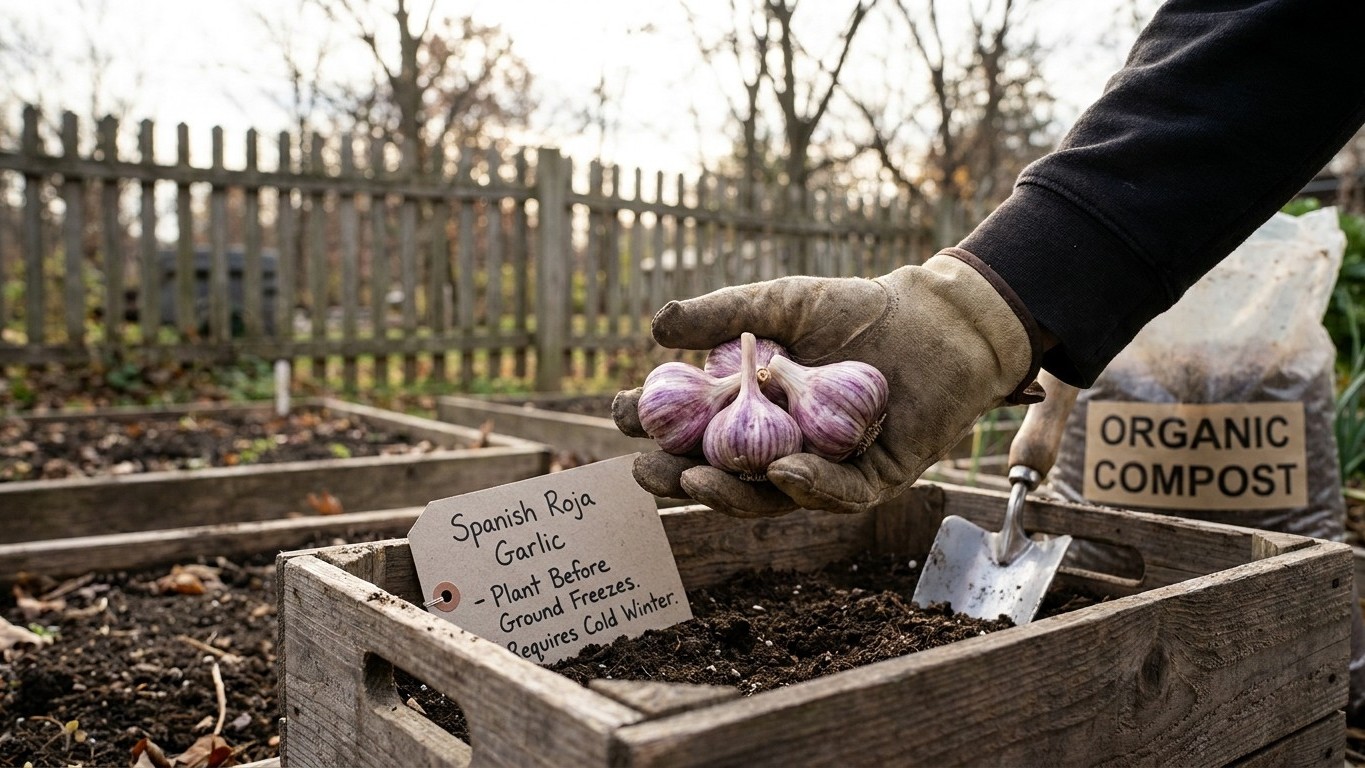

Spanish Roja is a rocambole hardneck garlic, grown for a hot, rich flavor that cooks down sweet, but it only forms a proper head of cloves after a real stretch of winter cold. Skip that cold and the clove never splits: you lift one round bulb instead of a head. Before you order seed stock, find out how many weeks your winter actually sits below 40°F, because that single figure decides whether this variety belongs in your garden.
What Spanish Roja actually is

Spanish Roja belongs to the rocambole family, one of the hardneck subgroups, alongside varieties like German Red and Killarney Red. It sends up a stiff central stalk and a curling flower stem called a scape, and the bulb itself wraps eight to twelve large cloves in a loose, easy-to-peel skin. Seed catalogs consistently describe its flavor as hot and full-bodied fresh, mellowing into something rich and almost sweet once roasted or cooked into a sauce. Among cooks who grow their own, it is often named as the benchmark for what garlic is supposed to taste like, which is part of why it keeps showing up on seed lists despite being fussier to grow than a supermarket softneck.
The trade-off is storage. Rocambole types like this one are not long keepers: expect a realistic shelf life of four to six months in a cool, dry space before cloves start softening or sprouting, well short of what a softneck braid will give you. If you want a full picture of how the type fits alongside other hardnecks, porcelains and softnecks, the Garlic Varieties overview lays out the categories side by side.
What Spanish Roja tastes like, and what to do with it
The mechanism behind Spanish Roja’s reputation is the same one that governs every hardneck: energy that would otherwise go into layers of storage skin gets diverted into the clove itself, producing fewer, larger cloves with a sharper, more layered flavor than a softneck can manage. That’s also why hardnecks like this one don’t keep as long — the plant simply isn’t built for it. Softnecks trade the opposite way, banking shelf life and braidability at the cost of complexity. If you’ve eaten garlic from a braid and found it flat, this is the variety that explains the difference; it’s frequently cited as the closest thing to what people mean when they say “real garlic,” and that reputation is a large part of why it remains a standard choice among gardeners who grow for the kitchen rather than the pantry.
That intensity is not constant across a dish. Raw, minced into a dressing or worked into something uncooked, the bite is sharp and present — this is where the variety’s character actually shows. Cook it down, and heat breaks apart the same compounds responsible for that sharpness; roast a whole head and what’s left is sweet, soft, and spreadable, true of nearly any garlic but especially noticeable with a variety this pungent to start. So use it deliberately: raw or barely cooked when you want garlic to be the point of the dish, roasted or simmered into a long-cooked sauce when you want depth without heat.
Beyond flavor and heat behavior, there isn’t much else documented about it — no notes on aroma beyond “full-bodied,” no specific culinary pairings singled out. The cloves themselves are wrapped in white skin, consistent with the rocambole type generally, but color isn’t where this variety earns its following.
Will it get the cold it needs where you are
Garlic does not divide into cloves on its own. It needs a sustained cold period after planting, a process called vernalization, and rocambole types like Spanish Roja are among the most demanding hardnecks for it. Without roughly six weeks of temperatures below 40°F, the clove sits in the ground, grows some roots and leaves, and comes up in summer as a single undivided bulb. That is not a smaller harvest. It is a different, less useful crop.
Where the cold falls short
This is where most warm-climate gardeners get burned, because generic guides just say “Plant Garlic in fall” without checking whether fall in that place ever gets cold enough. Weather-station data for a handful of the most contrasted parts of the country shows the gap clearly.
| Reference station | Weeks below 40°F | Weeks needed | Verdict |
|---|---|---|---|
| Los Angeles, California | 0 | 6 | Risky |
| New Orleans, Louisiana | 0 | 6 | Risky |
| Houston, Texas | 0 | 6 | Risky |
| Jacksonville, Florida | 0 | 6 | Risky |
| Phoenix, Arizona | 0 | 6 | Risky |
| Honolulu, Hawaii | 0 | 6 | Risky |
In every one of those places, the station record shows zero weeks of sustained sub-40°F weather against the roughly six that a rocambole needs. Growers there have two honest options: refrigerate the seed cloves for several weeks before planting to force the vernalization artificially, or plant a hardneck that asks for less cold, or better yet a softneck of the Artichoke or Silverskin type, which divides reliably even in a mild winter. This is exactly the gap that makes a variety like Inchelium Red, an Artichoke type bred for a mild winter, the more sensible choice south of the cold belt.
Where the cold is not the problem
At the other end of the range, cold is never the limiting factor. Charlottetown, the reference station for Prince Edward Island, accumulates around 1,569 growing degree-days a year, which is on the thin side but workable with an early cultivar and plastic mulch. Calgary, standing in for Alberta, runs about 1,171 degree-days. Anchorage, the station for Alaska, sits at roughly 917, and Yellowknife, for the Northwest Territories, at about 905. Whitehorse, representing the Yukon, comes in around 600, and Rankin Inlet, for Nunavut, at only about 159. In all of these places, vernalization happens easily. The limiting factor flips to cumulative summer heat, and a rocambole bulb may need a greenhouse or high tunnel to size up properly before the growing season runs out.
When to put the cloves in
Garlic is a fall-planted, summer-lifted crop everywhere it’s grown, but the exact window shifts hard by climate because it’s anchored to the first fall frost, not to a date on the calendar. The rule that matters is this: the clove needs enough time in warm-ish soil to send down roots before the ground locks up cold, but not so much time that it pushes a lot of leafy top growth, which gets damaged by hard freezes and sets the plant back.
In the coldest interior climates, that window opens early. Anchorage, for Alaska, sees growers setting cloves out in early September, with first bulbs ready by mid May the following year. In the milder deep South, the window opens much later in the year: New Orleans, for Louisiana, has growers planting from late November into mid December, with a harvest in late August. Houston, for Texas, and Jacksonville, for Florida, both run planting from early to late November, with bulbs ready in early August. Notice how wide that spread is: the same crop, planted three months apart, depending purely on when the ground actually turns cold.
State extension services disagree on the exact cutoff by region, and that is worth taking at face value rather than smoothing into one national rule. Check your state or county extension office for a locally calibrated planting window before you buy seed stock, since a date pulled from a national gardening site can be a month off in either direction for your climate.
Hardneck or softneck: what this one asks of you
Spanish Roja is a hardneck, and that habit shapes almost every decision you make with it after planting. A hardneck sends up a scape, a curling flower stalk, that has to be cut off partway through the season or it steals energy from the bulb. In exchange you get fewer, larger cloves that peel easily, a real advantage in the kitchen, but a shorter shelf life than a softneck gives you.
- Hardneck (Spanish Roja): produces a scape you must cut, 8 to 12 large cloves, easy peeling, stores 4 to 6 months, needs a long real winter
- Softneck (Artichoke or Silverskin types): no scape, 12 or more smaller cloves, tighter skins, stores 8 to 12 months, tolerates a mild winter
That trade runs straight back to climate. Hardnecks like Spanish Roja evolved for places with a long, cold winter, and they perform best where that cold is reliable year after year, which is exactly the pattern seen in Alberta, the Yukon and the Northwest Territories above. If your winters are short or unreliable, a softneck like Inchelium Red is the lower-risk choice, and if you want another hardneck with a real cold requirement but a different flavor profile, Duganski, a Purple Stripe type, is worth comparing against Spanish Roja before you commit a whole bed to one variety.
Growing and curing it without losing the crop
Plant cloves root-down, roughly two inches deep and four to six inches apart, in loose soil that drains well. Garlic sitting in wet ground over winter rots before it ever gets the chance to vernalize.
Mulch, water and the scape
Mulch matters more for an overwintered crop than it does for almost anything else in the garden, because it buffers the freeze-thaw cycles that heave cloves out of the ground and buys the roots time to establish before hard cold sets in. Straw or shredded leaves a few inches deep is the standard choice. Cut the scape once it curls, both to redirect energy into the bulb and because the tender curl itself is edible, chopped into a stir-fry or blended into pesto. Stop watering two to three weeks before you expect to lift, since wet soil right up to harvest invites staining and rot in storage.
Reading the leaves and curing
The classic mistake with garlic is lifting on a fixed date instead of reading the plant. Wait until the lower third to half of the leaves have browned while the top few stay green. Pulling too early gives you undersized bulbs with loose, unhealed wrappers. Pulling too late means the bulb splits open in the ground and loses its storage skin entirely. Once lifted, cure the whole plant, leaves and roots attached, in a shaded, well-ventilated spot out of direct sun for three to four weeks before you trim and store it. Curing badly, in a damp shed or with bulbs stacked so air can’t move around them, is the second most common way growers lose a garlic crop after the actual harvest is already in.
Common questions
Can I just plant grocery store garlic instead of buying Spanish Roja seed stock?
You can, but it’s usually a gamble. Grocery garlic is often treated to stop sprouting, and it’s rarely labeled by variety, so you have no idea whether you’re getting a hardneck that needs real cold or a softneck that doesn’t. Buying named seed stock is the only way to know you’re actually growing Spanish Roja and not something else entirely.
What happens if I forget to cut the scape?
The bulb will still form, just smaller than it would have been, since the plant is spending energy on the flower stalk instead of the below-ground clove. It’s not a lost crop, just a reduced one, and next year is a good reminder to check the bed weekly once scapes start curling.
How much seed garlic do I need for a given amount of harvest?
Each clove you plant grows into one bulb, so the math is direct: plant a pound of cloves and you’ll lift roughly as many bulbs as cloves you separated out, not a pound of garlic back. Rocambole bulbs run fewer, larger cloves per bulb than a softneck, so you’ll separate fewer planting units from the same weight of seed stock.
Can I save my own cloves from this year’s harvest to replant?
Yes, and most growers do exactly that once they have a variety established. Set aside your biggest, healthiest bulbs at harvest rather than the leftovers, since clove size at planting has a real effect on bulb size the following year, and keep that seed stock separate from your eating garlic so you’re not tempted to cook through it over winter.